
A 34-year-old with high cervical spinal cord injury has weak inspiratory effort, ineffective cough with peak cough flow 140 L/min, retained secretions, and recurrent atelectasis but intact bulbar function and cooperative participation. Which assisted cough and lung expansion approach should the therapist teach for secretion clearance and volume recruitment?
Select an answer to reveal the explanation.
Short Explanation
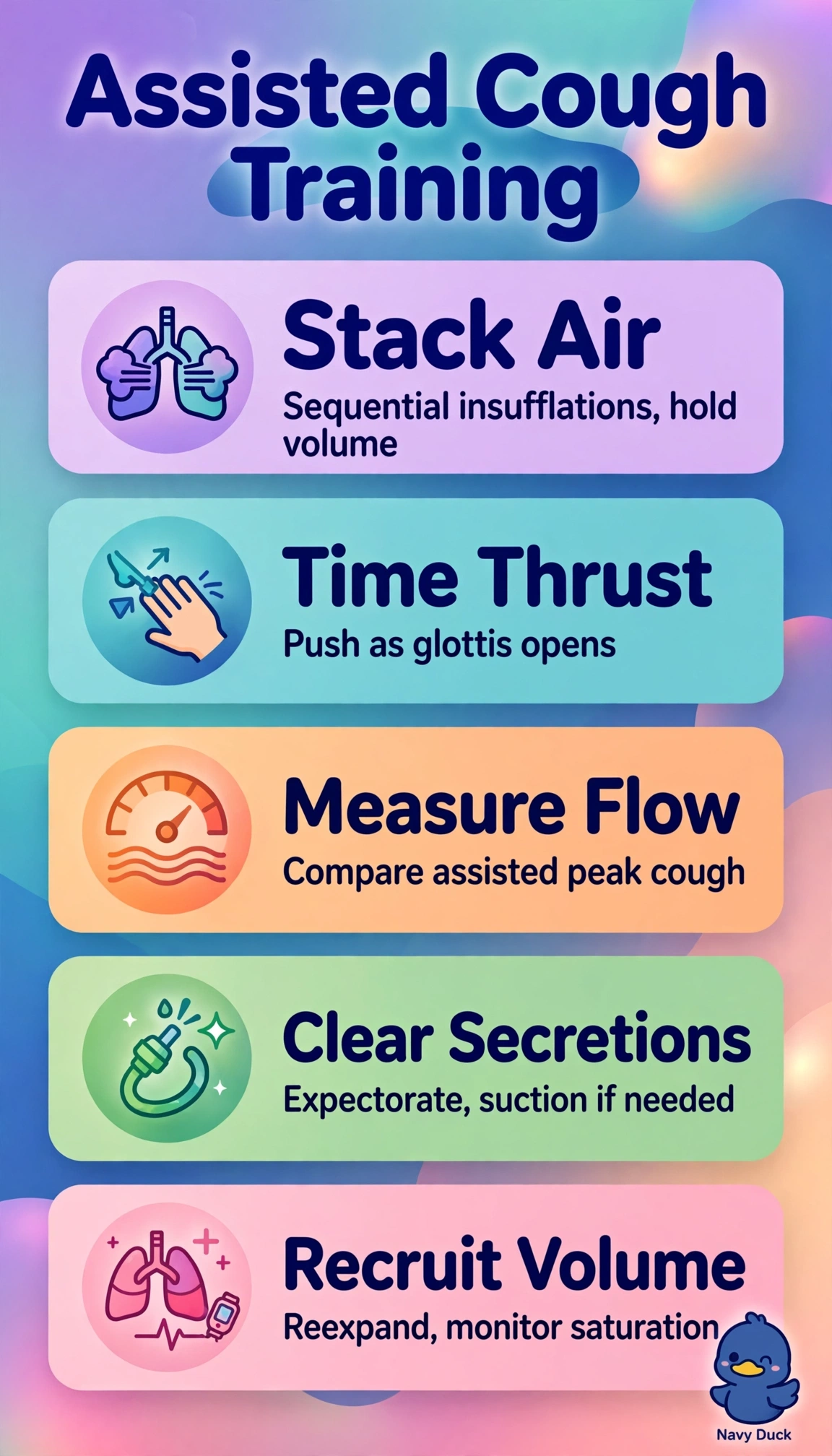
You’re working with weak breathing muscles, so stacking breaths helps fill your lungs and build a stronger cough. Pair air stacking with a belly push timed to your throat opening to help move secretions out.
Full Explanation
Combining air stacking with a manually assisted cough is appropriate because weak inspiratory effort limits lung inflation, contributing to microatelectasis and reduced compliance. A peak cough flow of 140 L/min is below the 160 L/min threshold for effective clearance; air stacking increases inspiratory volume and elastic recoil, while an abdominal thrust timed to glottic opening boosts expiratory flow to clear secretions. Intact bulbar function and cooperation support learning this technique. Glossopharyngeal breathing with air stacking can improve insufflation and lung recruitment, but without an assisted expiratory effort it may leave cough flow inadequate for mucus mobilization. An abdominal thrust after one deep breath adds expiratory force, but a single weak inspiration may not provide the maximal insufflation needed to optimize recoil and limit atelectasis. Mouthpiece ventilation can support daytime alveolar ventilation and rest fatigued muscles, but steady support does not provide the intermittent high expiratory flows needed for cough clearance. An exam caveat is that bulbar weakness, inability to close the glottis, or failure to raise assisted cough flow may favor mechanical insufflation-exsufflation. A practical check is to measure maximal insufflation capacity and assisted and unassisted peak cough flow, observe for air leaks during stacking, verify thrust timing, and reassess sputum, breath sounds, and imaging for re-expansion.