
A 71-year-old admitted with fever, productive cough and right lower lobe consolidation shows SpO2 89% on 2 L, increased work of breathing, and thick purulent secretions. Sputum cultures are pending and influenza is circulating. Which pneumonia management priority best addresses infectious disease and gas exchange?
Select an answer to reveal the explanation.
Short Explanation
You're treating infection and hypoxemia together without waiting. Early antibiotics plus oxygen and precautions stop spread and support breathing.
Full Explanation
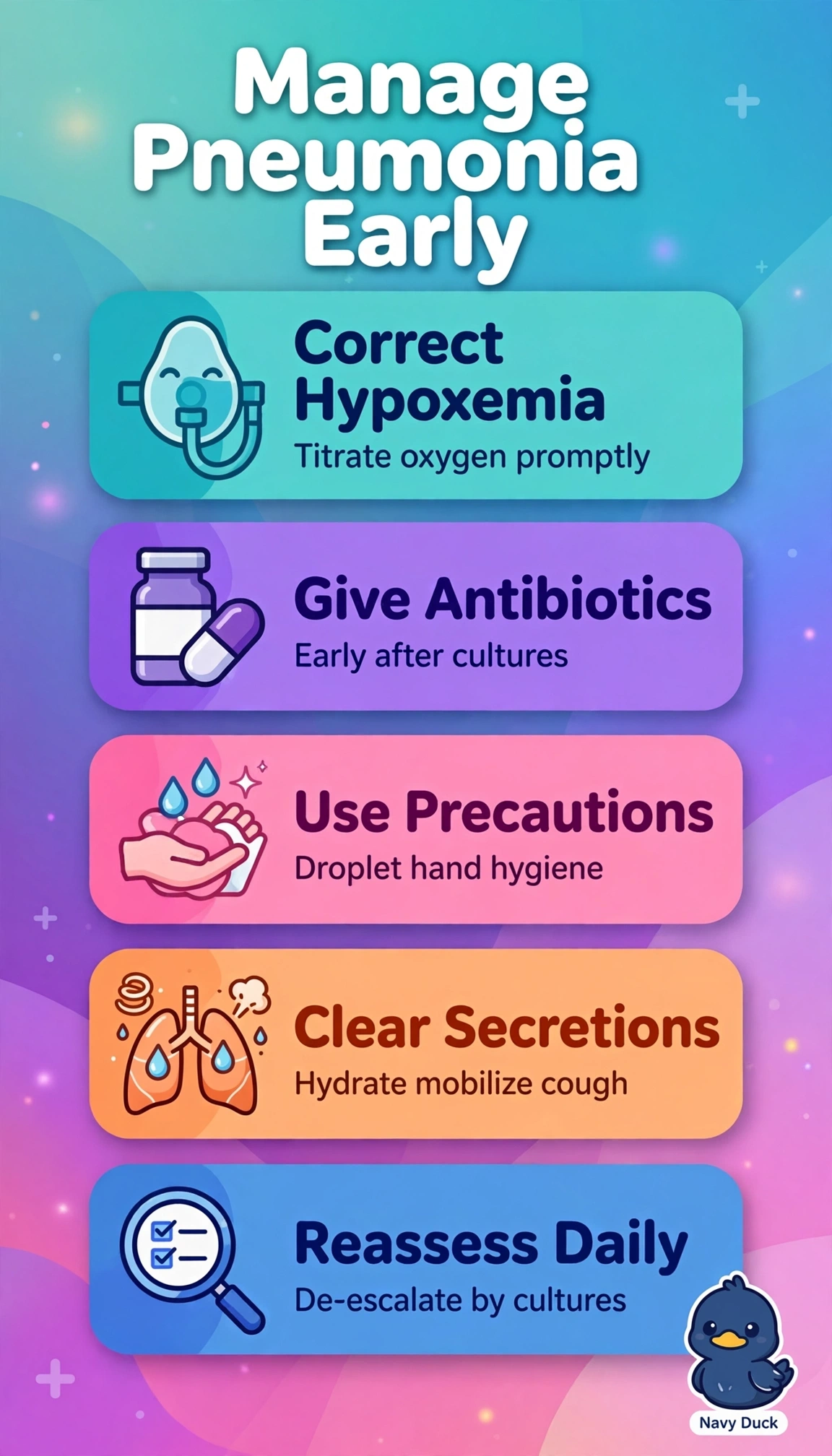
The correct priority is right because it simultaneously corrects urgent hypoxemia, controls likely bacterial pneumonia, limits influenza spread, and mobilizes secretions: SpO2 89% on 2 L with increased work of breathing requires oxygen escalation and titration to target rather than acceptance of hypoxemia, fever with productive purulent cough and right lower lobe consolidation in an older adult requires prompt empiric antibiotics while sputum is pending, circulating influenza requires added droplet precautions beyond standard measures, and thick secretions require airway clearance to reduce shunt and work of breathing and aid gas exchange. Continuing 2 L oxygen despite otherwise complete care fails by gas-exchange prioritization because uncorrected hypoxemia and distress can progress to fatigue and decompensation even when infection control is correct. Using only standard precautions despite oxygen, antibiotics and clearance fails by transmission-based precaution selection because influenza needs droplet masks, spatial separation, and cough and suction precautions that standard precautions do not provide. Providing oxygen, antibiotics and droplet precautions without airway clearance fails by secretion-retention pathophysiology because purulent plugs sustain ventilation-perfusion mismatch and preserve work of breathing despite improved FiO2. An exam caveat is that pending cultures mean start empiric antibiotics now and narrow later, not wait, and that droplet for influenza should not be confused with airborne or contact indications. A practical check is to remeasure SpO2, respiratory rate and work of breathing, sputum volume and ease of expectoration, temperature, and precaution adherence after intervention to verify infection and oxygenation improve together.