
A 70-year-old intubated patient in the medical ICU after 16 days of ventilation is scheduled for bedside percutaneous tracheotomy. The surgeon requests bronchoscopic guidance, the patient is sedated on volume-control ventilation, and the team is assembling sterile instruments with emergency airway equipment available. Which assisting responsibility should the respiratory therapist prioritize during this tracheotomy insertion?
Select an answer to reveal the explanation.
Short Explanation
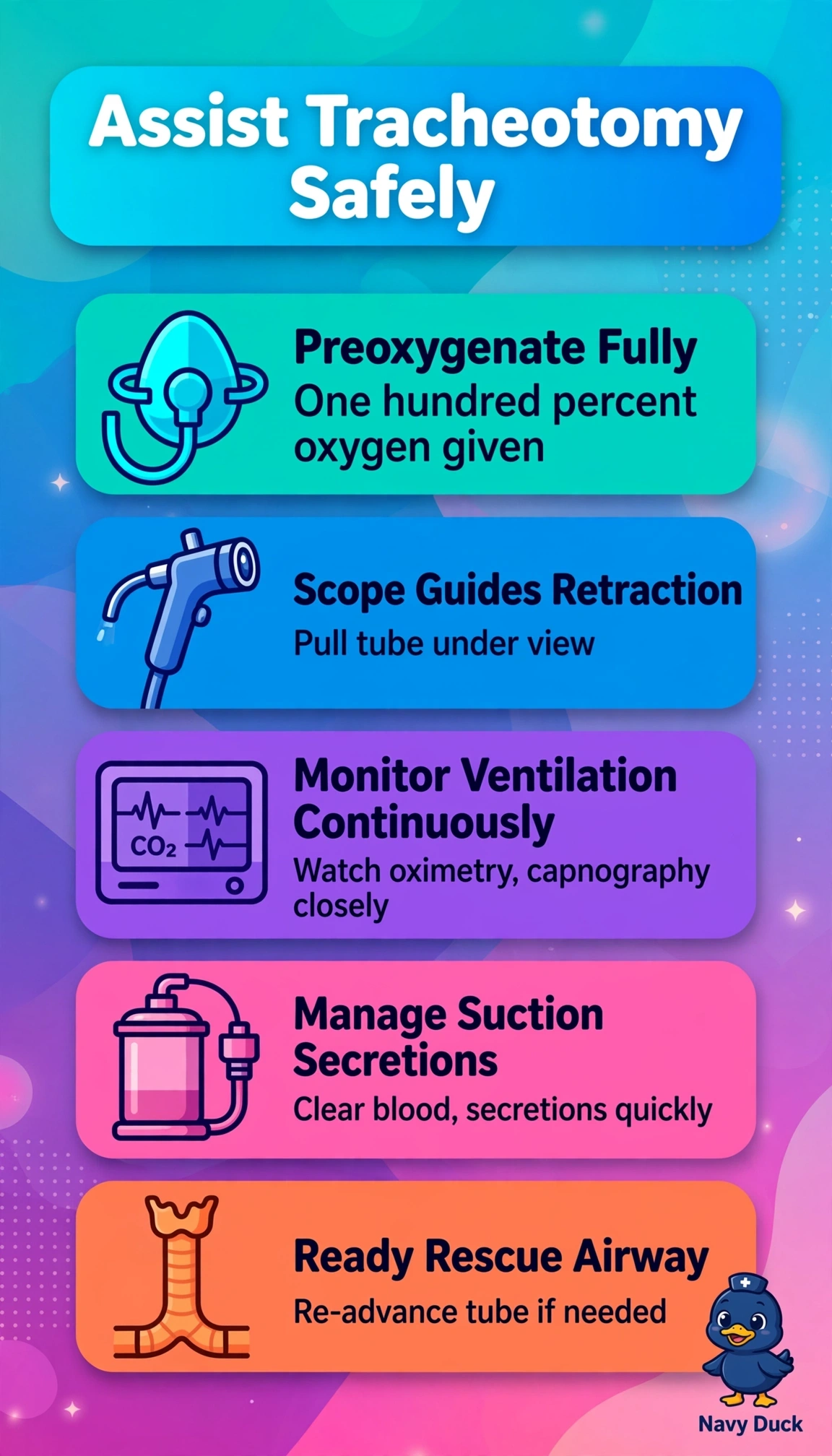
You're the airway guardian in this setup. Preoxygenating, pulling the tube back under scope guidance and watching ventilation keeps oxygen reserves high, so bronchoscopic coordination is your safety net.
Full Explanation
Assisting with percutaneous tracheotomy centers on airway management with bronchoscopic guidance, which requires preoxygenation with 100% oxygen to extend safe apnea time, controlled proximal retraction of the endotracheal tube under direct visualization so the cuff and tip clear the puncture site without extubation, continuous monitoring of oxygenation, ventilation and bronchoscope suction to manage secretions and bleeding, and immediate readiness to re-advance the tube or ventilate if desaturation occurs. The sterile instrument handling approach fails as primary priority because passing dilators and maintaining the field is a nursing or surgical assistant role that does not protect gas exchange during airway manipulation. The distal advancement approach fails by concept of tube positioning because advancing distally places the cuff and tip in the path of the needle and dilators, risking cuff puncture and obscuring transillumination. The prolonged disconnection approach fails by concept of oxygenation because disconnecting ventilation and applying cricoid pressure interrupts gas exchange and does not improve landmark identification compared with bronchoscopic transillumination. Exam caveat is to never leave the airway unmonitored to focus only on equipment, and practical check is to confirm 100% oxygen, suction function, capnography, pulse oximetry, emergency reintubation equipment, and closed-loop communication before retraction.