
A 28-year-old with Duchenne muscular dystrophy has recurrent atelectasis, a weak peak cough flow of 150 L/min, difficulty clearing secretions during colds, intact swallowing, and fatigue with manual chest physiotherapy. Which oscillatory or cough-assist intervention best improves secretion clearance for this weak cough?
Select an answer to reveal the explanation.
Short Explanation
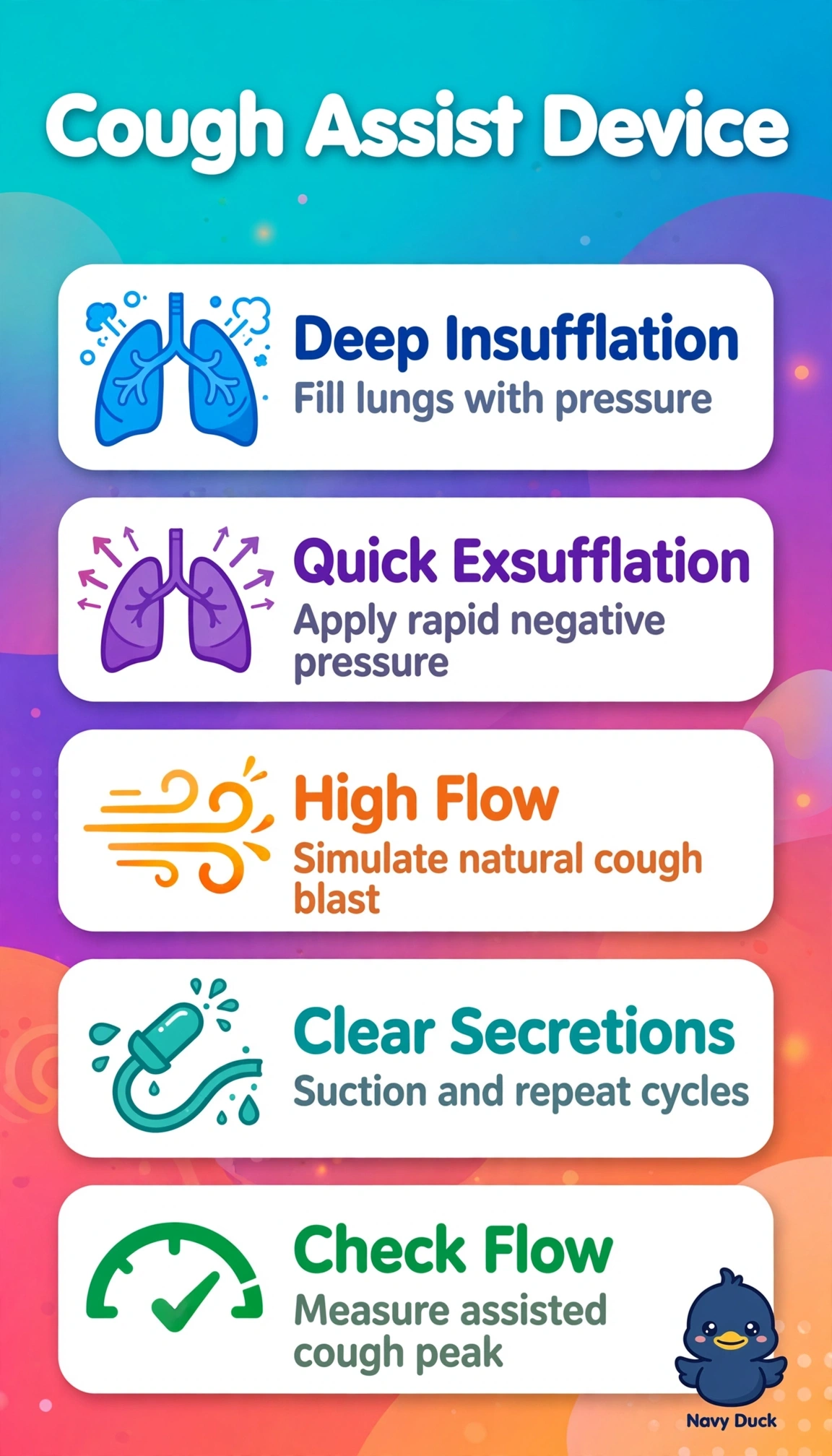
You're dealing with muscle weakness, not just sticky mucus. The vest shakes but can't create the blast you lack. Timed in-and-out pressure gives you that missing cough boost to pop secretions out.
Full Explanation
Mechanical insufflation-exsufflation is preferred because a peak cough flow of 150 L/min falls below the effective clearance threshold and signals inability to generate the rapid high expiratory flow needed to shear mucus centrally, a hallmark of advanced Duchenne muscular dystrophy where inspiratory and expiratory weakness combine to cause secretion retention, recurrent atelectasis, and decompensation during colds; the technique provides a deep controlled insufflation to optimize pre-cough lung volume followed by abrupt exsufflation that creates a high expiratory bias flow simulating natural cough, thereby expelling secretions without prolonged effort and avoiding fatigue seen with manual chest physiotherapy. High-frequency chest wall oscillation is an established method to loosen peripheral mucus and may lessen atelectasis, yet it fails by relying on vibration for mobilization without augmenting peak cough flow for final expulsion. Oscillatory positive expiratory pressure therapy commonly aids sputum clearance through expiratory oscillations and airway splinting, yet it fails because it remains effort-dependent and cannot compensate when weakness prevents adequate expiratory flow. Breath-stacking for lung volume recruitment routinely improves inspiratory capacity and helps prevent atelectasis in neuromuscular disease, yet it fails because it addresses only inspiration and provides no assisted expiratory flow to clear secretions. An examination caveat is to separate mobilization and lung-inflation strategies from true cough augmentation by anchoring on the low peak flow value rather than familiarity. Practically, confirm benefit by comparing unassisted and assisted peak cough flow, titrating pressures to comfortable chest expansion and effective secretion movement while monitoring oxygenation and caregiver technique.