
A 42-year-old with headache, confusion, and cherry-red appearance after garage exposure has ABG pH 7.40, PaCO2 40 mmHg, PaO2 92 mmHg on room air with co-oximetry showing carboxyhemoglobin 28% and oxyhemoglobin 68%. Which interpretation best explains the arterial blood gas and co-oximetry findings in suspected carbon monoxide exposure?
Select an answer to reveal the explanation.
Short Explanation
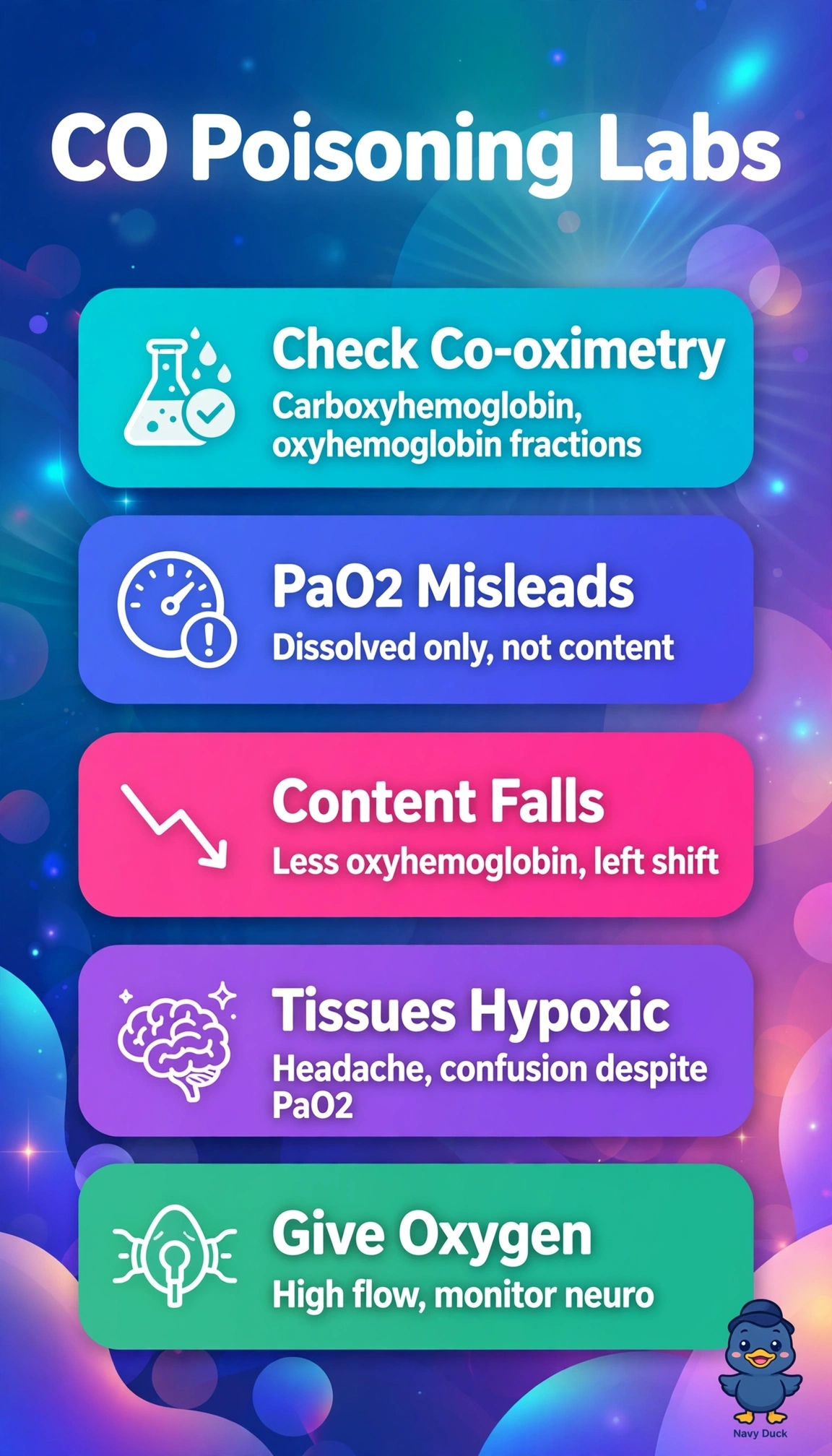
You're seeing a reassuring PaO2 that doesn't tell the whole truth because it only measures dissolved oxygen, not what's actually on hemoglobin. Your hemoglobin bus seats are already taken by carboxyhemoglobin, so your tissues can't get oxygen despite that pretty number.
Full Explanation
Carbon monoxide binds hemoglobin with far greater affinity than oxygen, forming carboxyhemoglobin that reduces oxyhemoglobin fraction and left-shifts the dissociation curve, so dissolved PaO2 measured by the blood gas electrode can remain normal while arterial oxygen content and tissue delivery fall severely and pulse oximetry overreads. The correct mechanism is dissociation between dissolved oxygen tension and hemoglobin-bound content, with 28% carboxyhemoglobin explaining headache and confusion despite PaO2 92 mmHg and normal acid-base values. Interpreting this as acute hypoxemic failure reflected by PaO2 fails by equating tension with content, missing that PaO2 does not include dyshemoglobin or oxyhemoglobin fraction. Compensated metabolic alkalosis fails by acid-base concept because pH 7.40 with PaCO2 40 mmHg indicates no primary alkalosis or meaningful bicarbonate shift and does not explain cherry appearance or exposure history. Chronic carbon dioxide retention fails by acid-base and history concepts because PaCO2 is normal without elevated bicarbonate or compensated pH pattern, and hypercapnia would lower PaO2 and pH acutely rather than produce isolated carboxyhemoglobinemia. Exam caveat is to always correlate pulse oximetry, PaO2, and co-oximetry when poisoning or smoke exposure is possible. Practical check is to obtain co-oximetry promptly, administer high-flow oxygen, and monitor neurologic status and lactate rather than titrating oxygen to SpO2 alone.