
A 64-year-old on telemetry after COPD exacerbation develops sudden palpitations, blood pressure 118/74 mm Hg, and shortness of breath. The bedside rhythm strip shows a narrow-complex tachycardia at 172/min with no visible P waves and regular R-R intervals. Which ECG interpretation should the respiratory therapist report to guide immediate management?
Select an answer to reveal the explanation.
Short Explanation
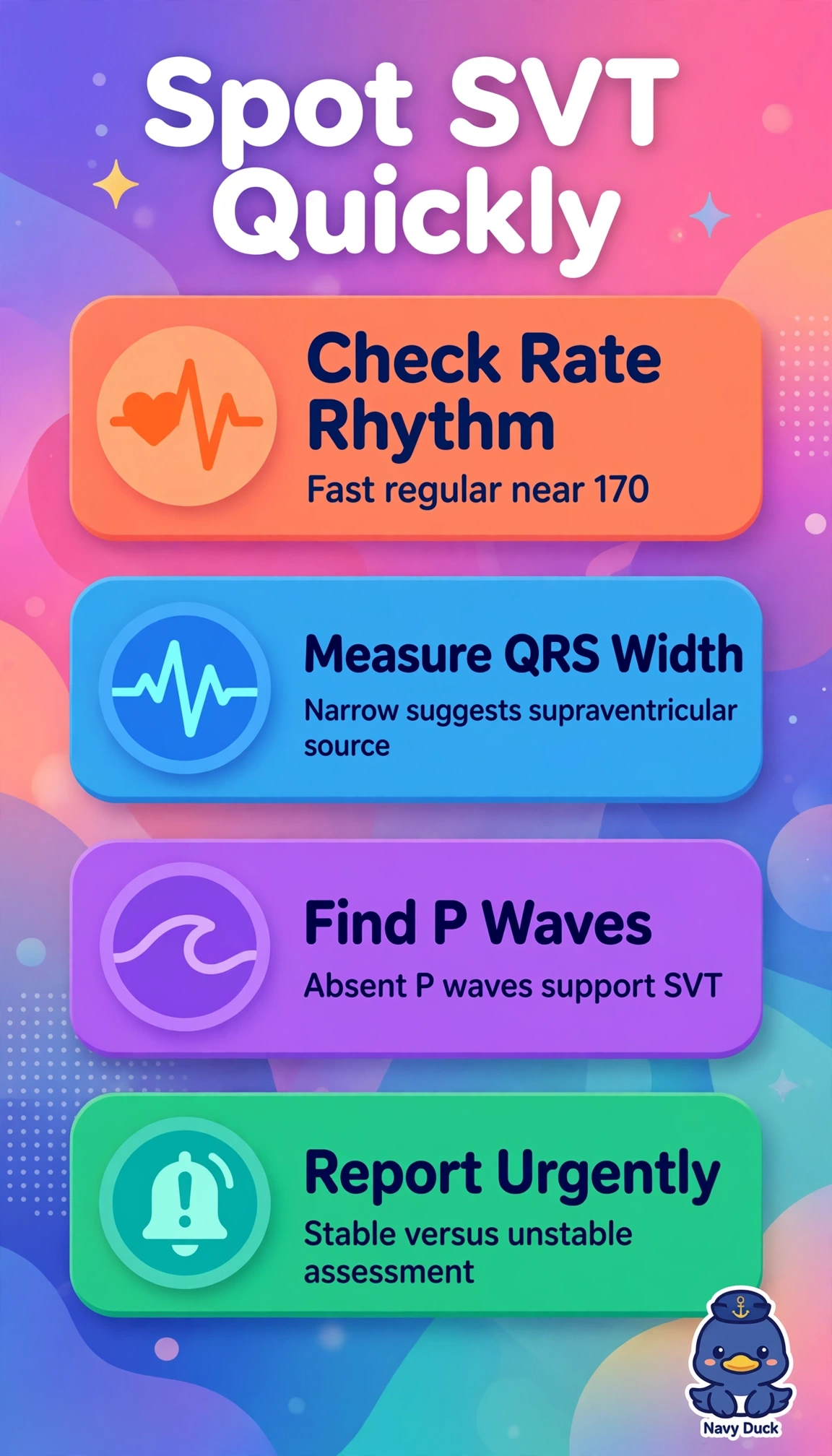
You recognize the sudden, regular narrow-complex rhythm without visible P waves as SVT, which needs urgent evaluation. Because your blood pressure is preserved, reporting it for urgent assessment—not immediate cardioversion—fits the situation.
Full Explanation
Reporting a regular narrow-complex tachycardia consistent with supraventricular tachycardia for urgent evaluation fits the sudden palpitations, dyspnea, rate of 172/min, regular R-R intervals, and absent visible P waves. Although the blood pressure is 118/74 mm Hg, the fast symptomatic rhythm warrants prompt clinician assessment for treatment rather than observation. Calling it sinus tachycardia from the COPD exacerbation does not fit the sudden onset and absent visible P waves; sinus tachycardia is driven by an underlying cause and has a sinus P wave before each QRS. Calling it atrial flutter with distinct flutter waves conflicts with the strip description, which reports no visible P waves and does not show distinct flutter waves. Reporting the same supraventricular tachycardia but directing emergent cardioversion now overstates the urgency: preserved blood pressure supports urgent evaluation, while immediate cardioversion is for hemodynamic instability. An exam caveat is that a normal blood pressure alone does not establish that a symptomatic patient is safe to leave unassessed. A practical check is to confirm the rate, regularity, QRS width, and P-wave visibility on the strip, repeat blood pressure and oximetry, maintain monitoring, and promptly communicate the findings for clinician-directed management.