
During bronchoscopy in a 54-year-old with hemoptysis, the image suddenly darkens, suction is weak, and the arterial pressure waveform on the bedside monitor is damped with loss of dicrotic notch after line flushing. Which troubleshooting action should the therapist prioritize for the devices involved?
Select an answer to reveal the explanation.
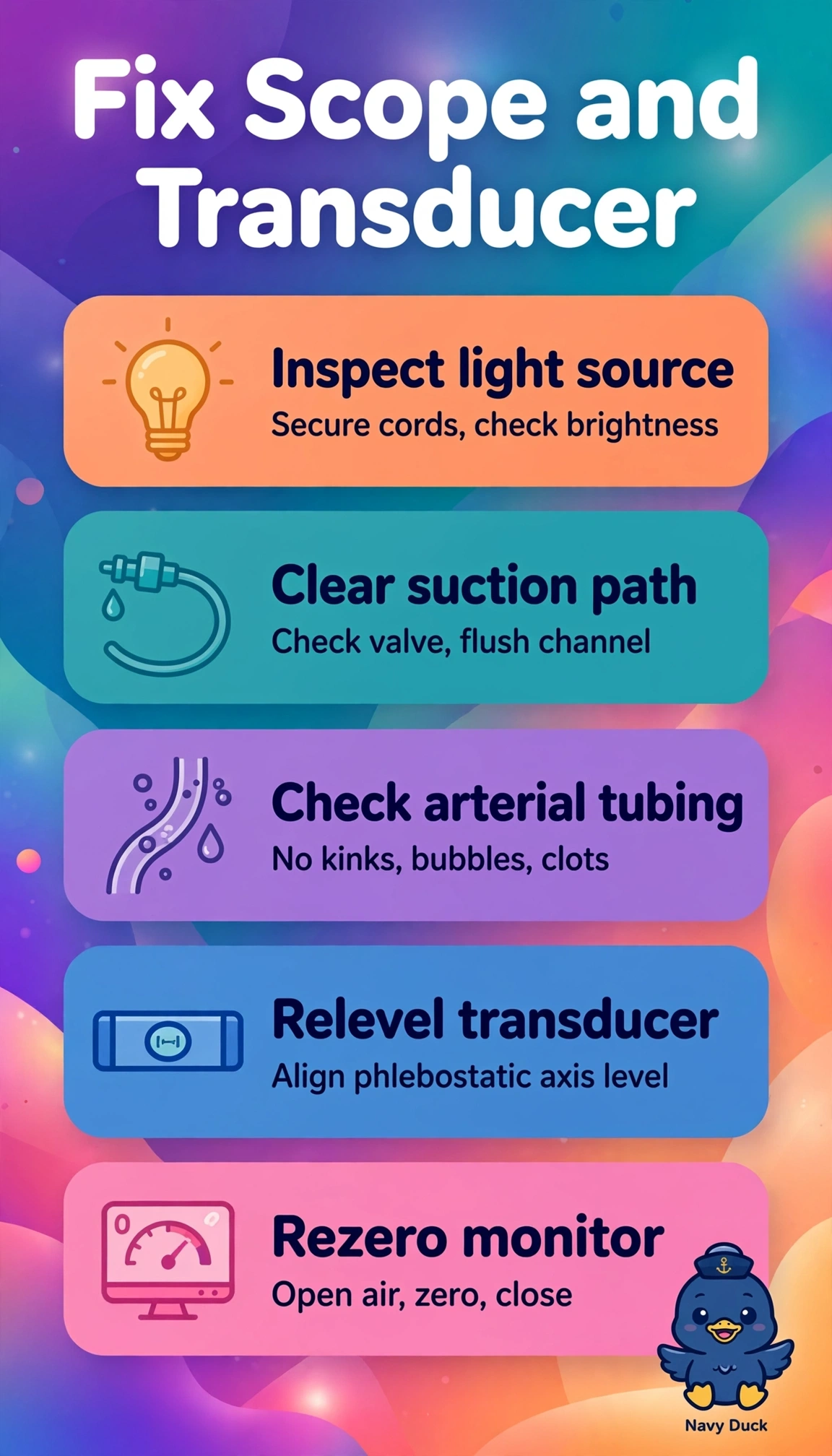
Short Explanation
You’re troubleshooting two devices at their likely failure points rather than forcing them harder. Checking the light source and suction valve, then correcting leveling and zeroing, restores the view and waveform together.
Full Explanation
The priority is to check the bronchoscope light source and suction valve for obstruction, then relevel and rezero the transducer system. In hemoptysis, blood can soil the optics or clot the suction valve, causing sudden darkening and weak suction; checking the light source and clearing and testing the valve addresses both problems. A damped arterial waveform with loss of the dicrotic notch after flushing can reflect a changed hydrostatic reference or zero drift. Releveling to the phlebostatic axis corrects height-related error, while rezeroing to air corrects atmospheric offset. Clearing blood from the valve and releveling without rezeroing leaves possible zero drift uncorrected. Checking the light source and releveling and rezeroing, without checking the suction valve, leaves a clot that can sustain weak suction and obscure the view. Clearing clots and releveling and rezeroing, without checking the light source, leaves a failed source or connection that can cause darkness despite a clear valve. Exam caveat: after flushing, a damped waveform or loss of the dicrotic notch warrants releveling, rezeroing, and square-wave testing rather than catheter manipulation or fluid changes. Practical check: look for one to two crisp oscillations with a clear notch, project the bronchoscope light onto gauze, and confirm brisk saline suction.