
A 58-year-old two days after bowel surgery develops fever to 38.6C, productive cough with purulent sputum, right basilar crackles, leukocytosis, new infiltrate on chest film, and SpO2 88% on room air with shallow breathing from incisional pain. Which respiratory management strategy best addresses pneumonia hypoxemia and secretion retention?
Select an answer to reveal the explanation.
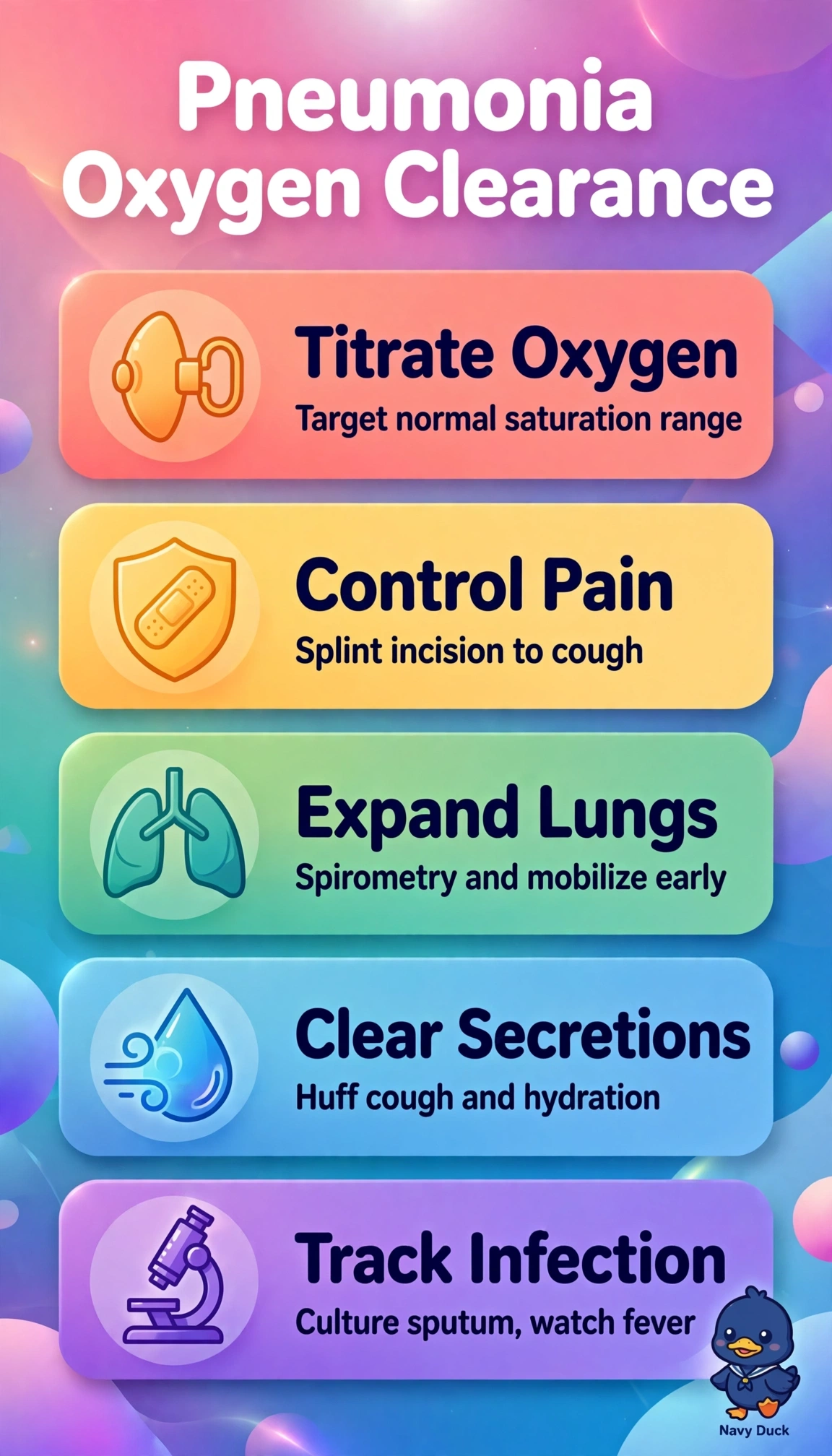
Short Explanation
You're juggling infection, low oxygen, and pain-limited breathing all together. Gentle oxygen plus splinted coughing and mobilization opens alveoli and moves pus upward. That recruitment balance treats both hypoxemia and retention at once.
Full Explanation
The correct strategy succeeds because postoperative pneumonia two days after bowel surgery combines hypoxemia with SpO2 88% requiring titrated oxygen, pain-limited shallow breathing requiring analgesia-supported lung expansion to restore tidal volumes and gas exchange, and purulent sputum with basilar crackles and infiltrate requiring active airway clearance with assisted cough and physiotherapy to prevent mucus plugging and persistent infection. Titrated oxygen with incentive spirometry, mobilization and assisted cough without dedicated pain support fails physiologically because untreated incisional pain causes splinting and weak inspiratory effort, so patients cannot achieve expansion or effective cough despite appropriate oxygen and clearance orders. Titrated oxygen with optimized analgesia and spirometry for atelectasis alone fails microbiologically because omitting targeted secretion removal leaves infected purulent secretions obstructing distal airways, sustaining fever, leukocytosis and infiltrate. Splinted breathing with assisted cough and mobilization on room air with monitoring fails oxygenation-wise because observation does not correct documented SpO2 88%, risking tissue hypoxia, impaired healing and cardiac strain after major surgery. Exam caveat is to distinguish titrated oxygen to target saturation from uncontrolled high-flow oxygen and recognize room-air monitoring only suits stable patients without significant desaturation. Practical check is reassessing SpO2 on oxygen, pain during breathing and cough, cough strength with sputum volume and color, respiratory rate and basilar auscultation.