
An adult with pulmonary hypertension on inhaled nitric oxide via the ventilator injector module develops a sudden low delivery alarm, FiO2 drift upward, and NO2 rising after a circuit change for transport, with systemic pressure dropping. Backup cylinder and battery power are available. Which device troubleshooting action best restores safe inhaled nitric oxide delivery?
Select an answer to reveal the explanation.
Short Explanation
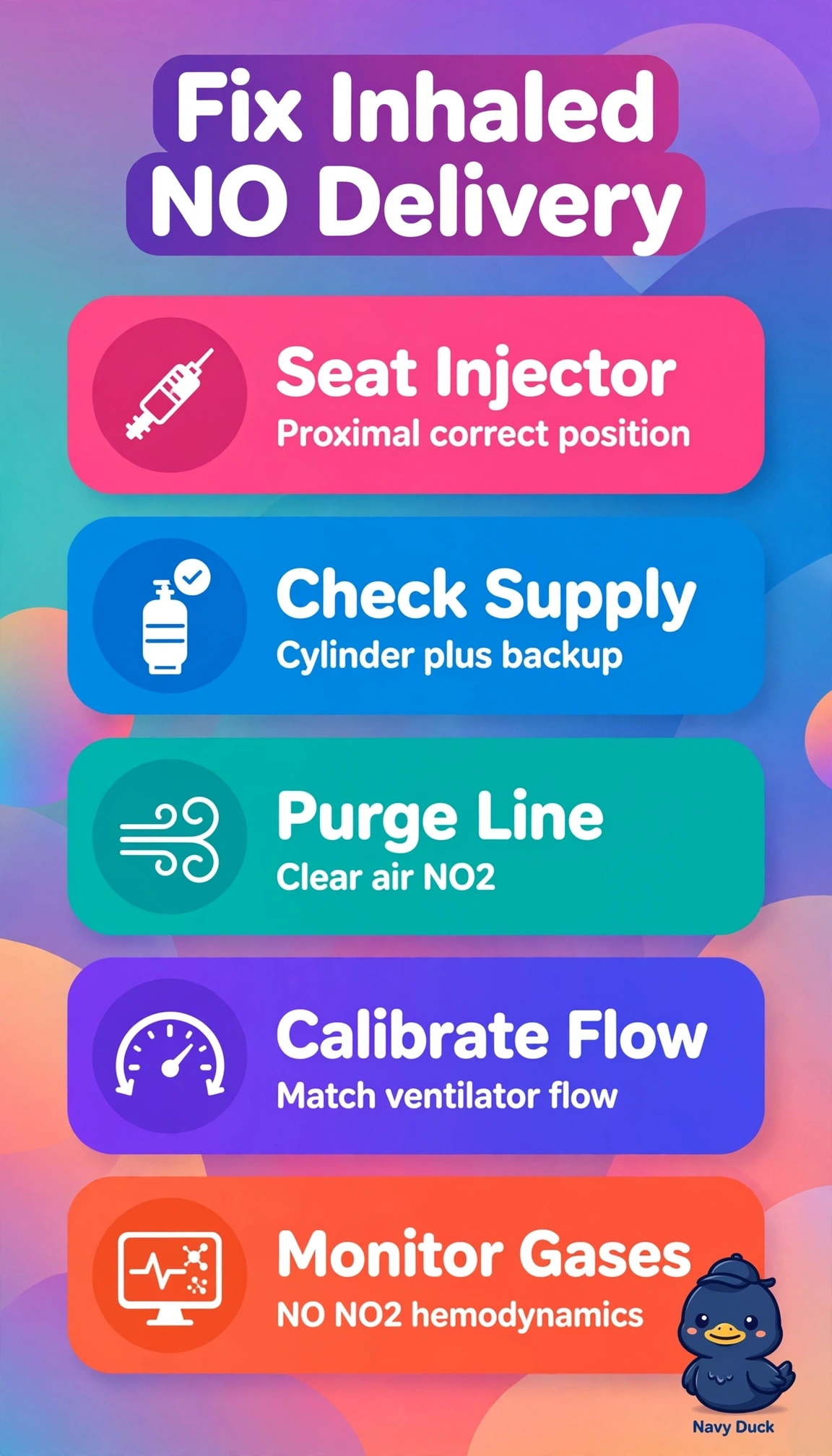
You're fixing flow sensing at the source so dosing becomes accurate again. A seated injector keeps nitric oxide proportional to ventilator flow and limits toxic dioxide.
Full Explanation
The correct troubleshooting succeeds because sudden low delivery with upward FiO2 drift and rising NO2 immediately after circuit change signals injector disconnection with loss of flow synchronization and purge rather than isolated cylinder exhaustion, so restoring the injector proximally on the dry inspiratory side, verifying cylinder pressure, then purging stagnant gas and recalibrating flow re-establishes proportional dosing, corrects oxygen measurement dilution, and clears NO2 that worsens pulmonary hypertension and hypotension. Switching to backup cylinder and battery supply is proper contingency for depletion or mains failure but fails on source control because adequate supply through a still-malpositioned injector preserves desynchrony, FiO2 error, and oxidative NO2 formation. Repositioning the injector distally and raising fresh gas flow reflects routine mixing logic but fails on placement because the module is specified upstream of the humidifier in the inspiratory limb, and distal relocation degrades flow-proportional dosing, mixing and sampling accuracy. Flushing the circuit and titrating oxygen suits transient NO2 elevation and hypoxemia but fails as definitive therapy because it clears monitors without restoring therapeutic nitric oxide, allowing rebound pulmonary hypertension and progressive hypotension. Exam caveat is to read low delivery, FiO2 drift, and NO2 rise as one delivery-system failure rather than three separate ventilator problems requiring more oxygen. Practical check is to confirm proximal orientation by flow arrow, convergence of set and measured nitric oxide and FiO2 within tolerance, NO2 below threshold, and pulmonary unloading with systemic pressure recovery before transport.