
A pulmonologist plans bedside bronchoscopy with endobronchial ultrasound for a 58-year-old outpatient with a right hilar mass, mild hypoxemia on 2 L nasal cannula, and no coagulopathy. The team asks respiratory therapy to assist with airway and sampling setup. Which assistance action best supports safe EBUS-guided sampling during the procedure?
Select an answer to reveal the explanation.
Short Explanation
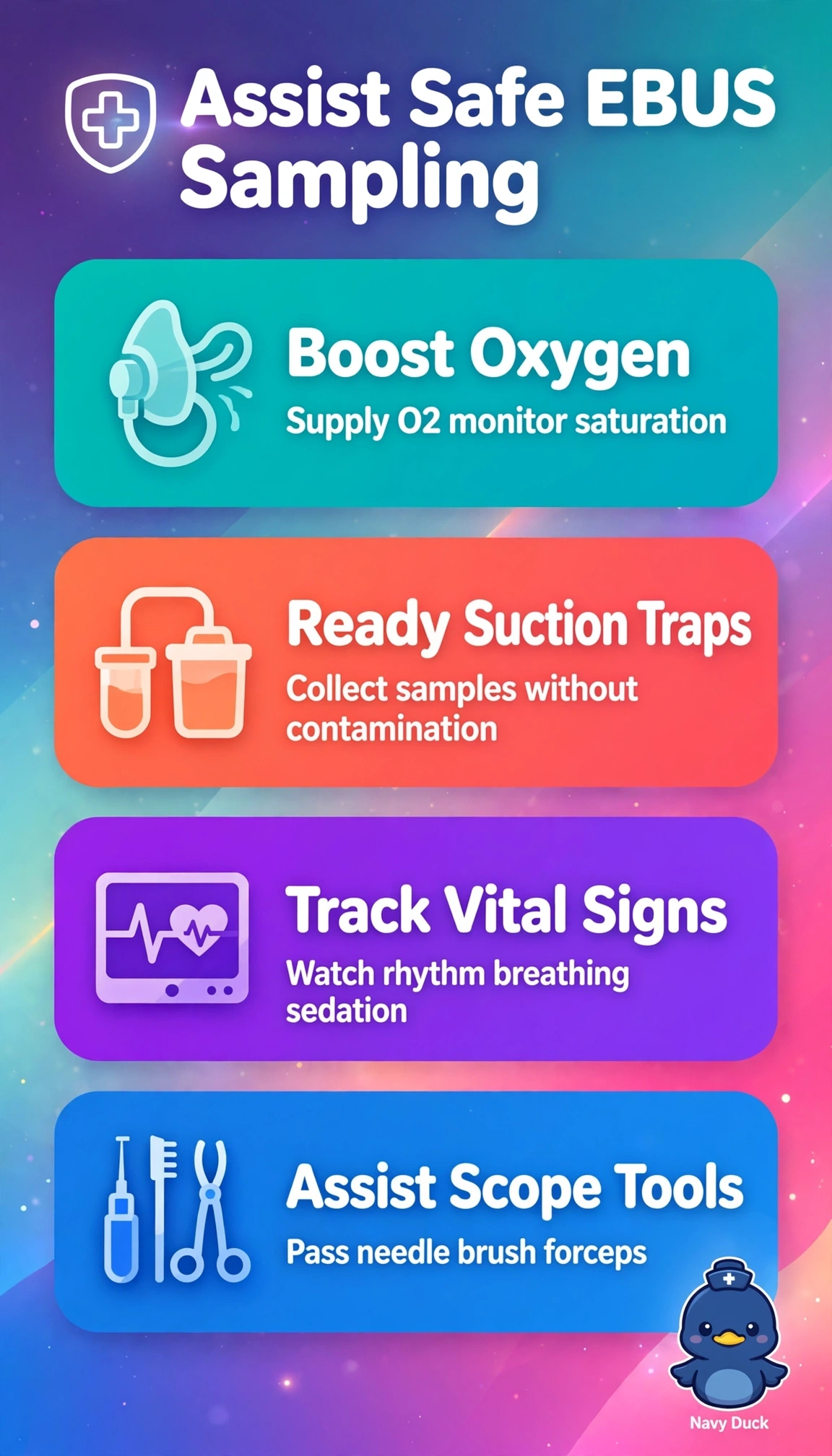
Your job is keeping oxygen up and samples clean without getting in the way. Steady monitoring plus ready suction keeps this EBUS case safe, so oxygenation comes first every time.
Full Explanation
Safe bedside EBUS-TBNA for a right hilar mass in a mildly hypoxemic outpatient on 2 L requires titrated supplemental oxygen, continuous pulse oximetry, and suction with specimen traps ready because scope-related obstruction, sedation hypoventilation, and suctioning worsen desaturation while nodal aspirates must be preserved for cytology, and respiratory therapy directly mitigates both risks by escalating FiO2, detecting desaturation early, maintaining view and airway patency, and ensuring traps and media capture diagnostic material. The topical-anesthesia plus monitored sedation approach addresses comfort, cough suppression and aspiration reduction and is routinely used, but it fails the oxygenation-monitoring and collection concept by omitting titration, continuous oximetry and suction-trap readiness needed when baseline hypoxemia predicts procedural desaturation. The fixed 2 L plus traps approach preserves sampling setup yet fails titration physiology by locking oxygen during increased shunt and hypoventilation when guidelines require escalation and close surveillance. The supplemental oxygen plus balloon-blocker approach covers hypoxemia and hemorrhage readiness but fails sampling purpose by replacing traps with massive-hemoptysis control that is disproportionate without coagulopathy and leaves aspirates without capture. Exam caveat is that absence of coagulopathy does not eliminate need for monitoring and suction, as hypoxemia and airway compromise remain leading EBUS risks. Practical check is to verify escalation interface, oximeter waveform and alarms, suction function and labeled traps, and agreed pause-recover thresholds before scope insertion.