
A 38-year-old with Guillain-Barre in the step-down ICU shows ascending weakness over 12 hours, VC falling from 28 to 16 mL/kg, MIP weakening from -45 to -22 cm H2O, and weak cough with desaturation on effort. ABGs are still normal on 2 L nasal cannula. Which ventilation timing decision based on MIP/VC monitoring best manages neuromuscular respiratory failure?
Select an answer to reveal the explanation.
Short Explanation
You've caught failure early while intubation is still controlled, and that's the win. Falling VC plus weak MIP means pump failure is coming before gases crash.
Full Explanation
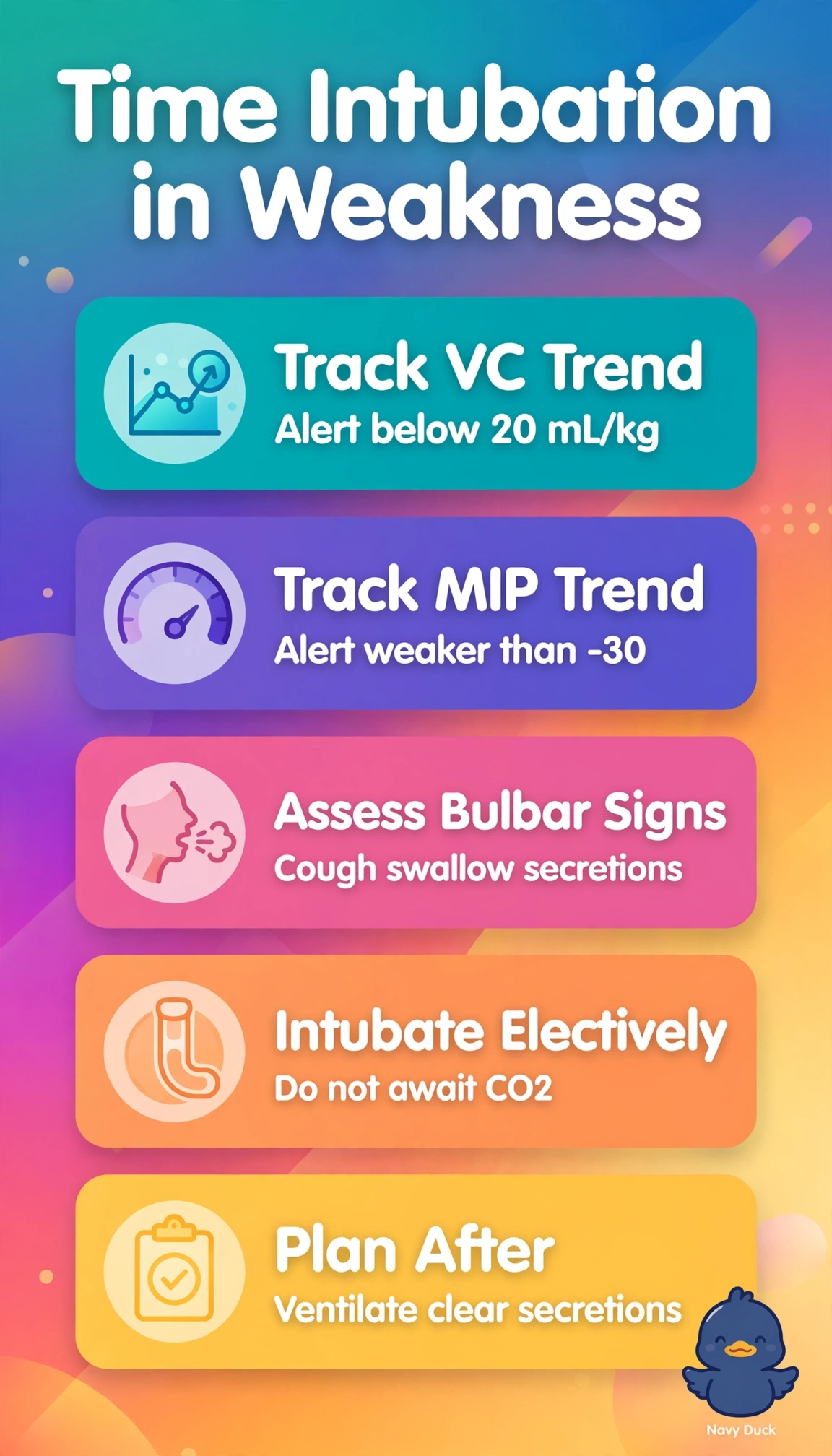
Neuromuscular failure is a pump problem, so serial VC below about 20 mL/kg, MIP weaker than -30 cm H2O, and weak cough with declining endurance signal imminent inability to ventilate and protect the airway even when ABGs are still normal because tachypnea temporarily compensates. Elective intubation uses that trend to secure the airway before emergency decompensation, aspiration, or arrest, then allows lung-protective ventilation and secretion management. Waiting for daytime ABG retention misses the stated trajectory and invites nocturnal collapse when staffing and airway expertise are thinner. Nocturnal bilevel support can briefly unload work but does not reverse rapidly progressive weakness with bulbar involvement and aspiration risk, and delay violates the timing cue. Lung expansion and cough coaching improve volume in atelectasis or post-op weakness but cannot restore demyelinated neuromuscular strength during active decline. Exam caveat is to act on trends and bulbar signs, not a single normal gas, and practical check is to repeat VC upright and supine, MIP/MEP, cough peak flow, and swallow and secretion handling while preparing difficult-airway backup.