
A 68-year-old patient is intubated in the medical ICU on day 2 for pneumonia, stable on assist-control ventilation with continuous sedation and a standard endotracheal tube without subglottic port. The head of bed is flat for a procedure and oral secretions are pooling. Which VAE prevention protocol should the respiratory therapist initiate first to reduce aspiration risk?
Select an answer to reveal the explanation.
Short Explanation
You nailed the priority when you keep secretions out of the lungs first. Gravity is your free helper here, so head-elevation beats fancy tubes or later steps for this flat patient.
Full Explanation
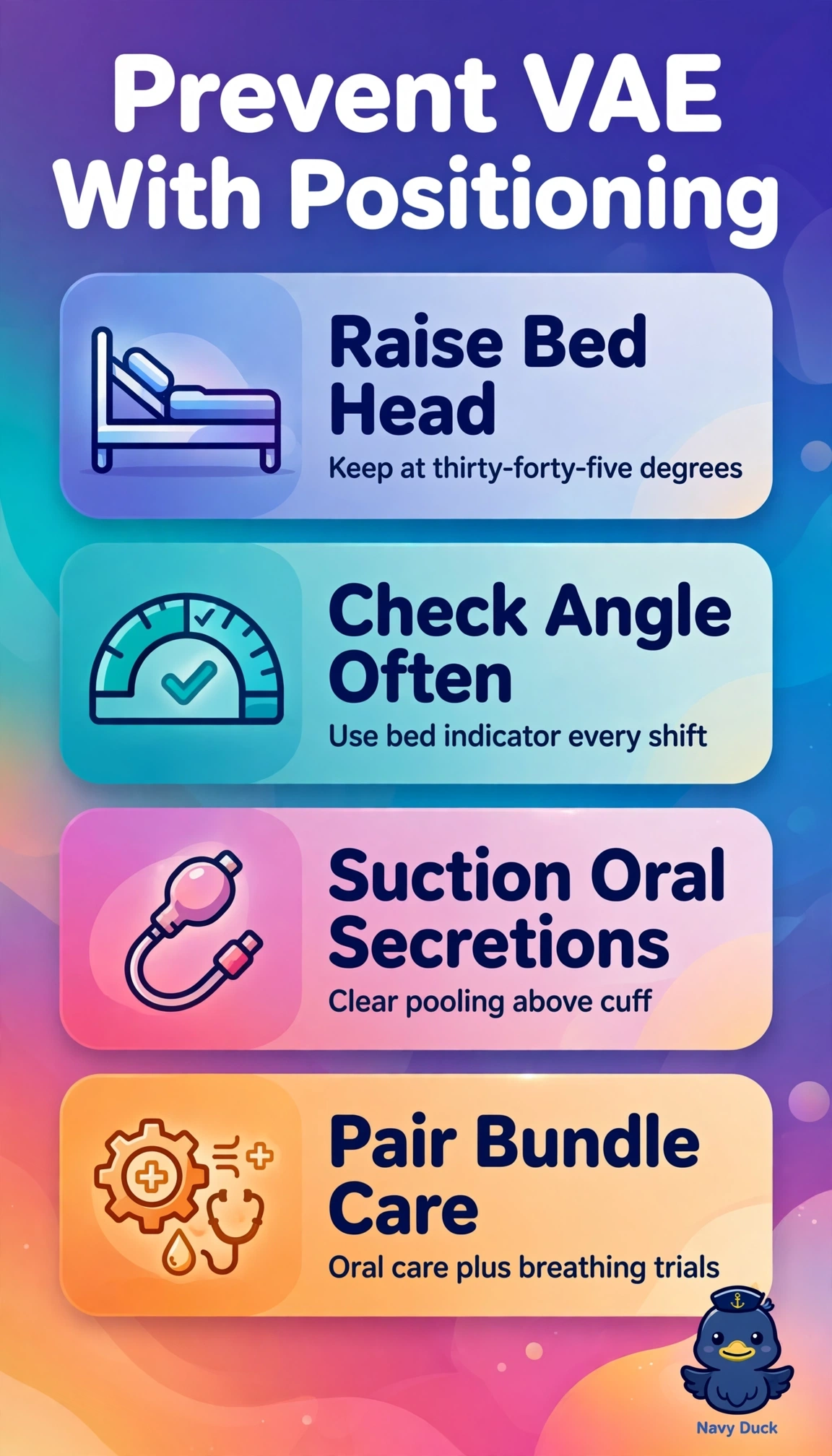
Ventilator-associated events are driven largely by microaspiration of oropharyngeal secretions around the cuff, and semirecumbent positioning at 30-45 degrees uses gravity to reduce reflux and pooling toward the airway, which is why it is a core element of every VAE bundle alongside oral care, sedation vacations, and DVT and ulcer prophylaxis. The flat bed plus visible pooling makes elevation the immediate correct action because it directly addresses the stated aspiration risk without orders, equipment changes, or delay. Providing oral care with suction is also bundle care and reduces bacterial load but does not correct the flat position that promotes aspiration in the moment, so it fails on immediacy. Requesting a sedation interruption and breathing trial is essential for liberation and VAE reduction but applies to duration of ventilation rather than the acute aspiration hazard and requires physician coordination. Recommending a subglottic suction tube is effective for longer-term secretion management but requires reintubation with risk and is not first-line on day 2 with a standard functioning tube. Exam caveat: NBRC expects semirecumbent positioning unless contraindicated by hypotension, spinal injury, or procedure, and practical check is to measure angle with the bed indicator and document adherence every shift.