
A 70-year-old with bronchiectasis was started on twice-daily postural drainage with percussion 3 days ago for copious purulent sputum. Today sputum is less than 5 mL per day, breath sounds are clear, cough is nonproductive, and SpO2 is 96% on room air. Which change to airway clearance therapy should the therapist recommend based on this response?
Select an answer to reveal the explanation.
Short Explanation
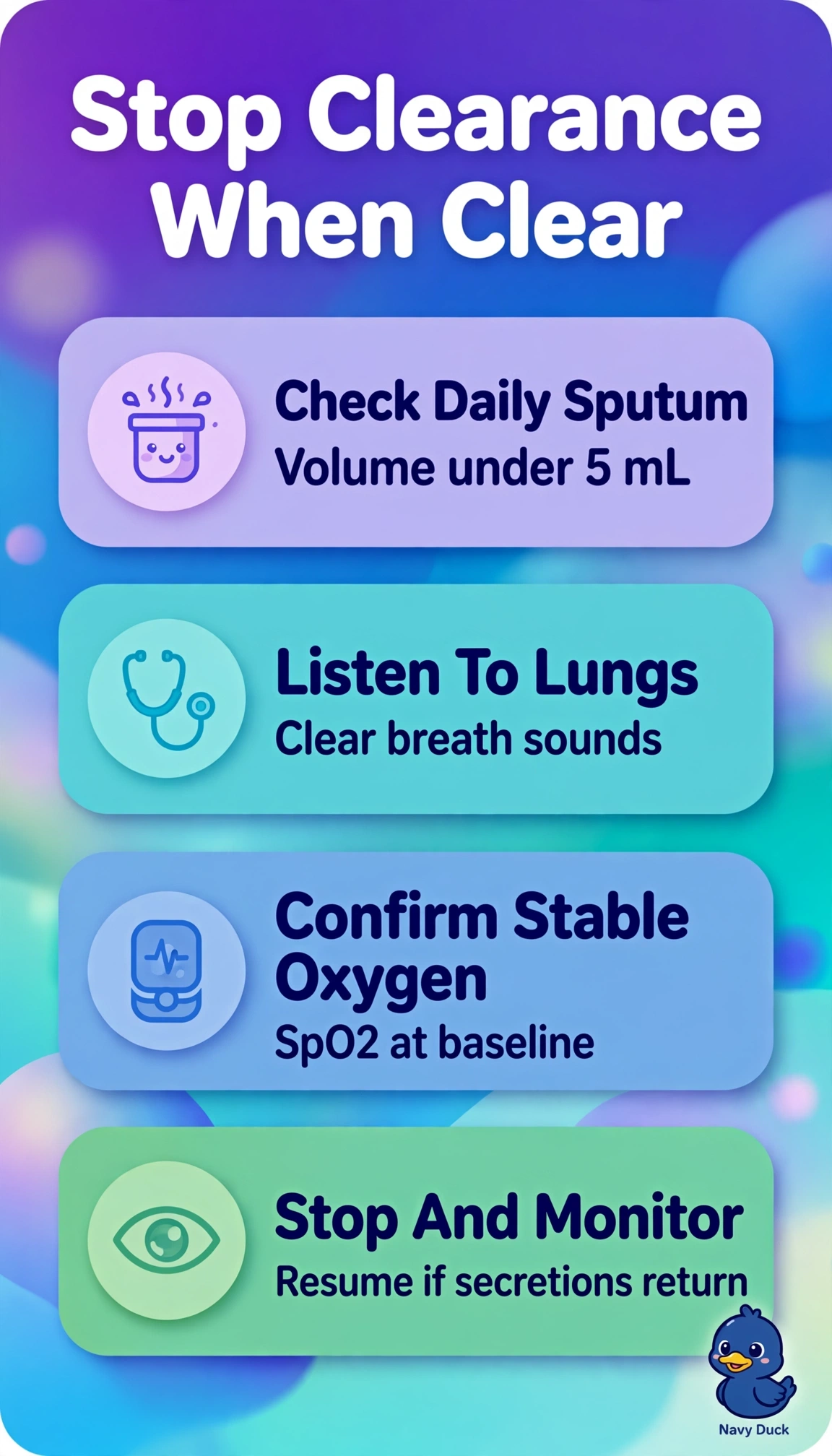
You've cleared the backlog, so stepping back is smart stewardship. Continuing drainage when secretions have dried up wastes energy like mopping a dry floor, so de-escalation with close monitoring is the best call.
Full Explanation
Airway clearance is indicated for retained secretions, and response is judged by sputum volume, breath sounds, cough effectiveness, and oxygenation; when sputum falls to minimal levels with clear lungs and stable oxygenation, the therapy has achieved its goal and should be discontinued with ongoing reassessment rather than continued indefinitely. Continuing twice-daily drainage unchanged ignores the documented resolution and exposes the patient to unnecessary fatigue, time burden, and cost without benefit. Increasing frequency to four times daily is appropriate only for worsening retention, increased sputum, or deteriorating gas exchange, which is the opposite of this improving course. Switching to continuous bronchodilator therapy confuses airway clearance with bronchospasm management and is not indicated when wheezing and obstruction are not described and stability has been achieved. For the exam, expect to titrate therapy to objective response rather than fixed durations, and in practice verify 24-hour sputum volume, auscultation, and tolerance before recommending discontinuation with a clear plan to resume if secretions recur.