
A 5-year-old with severe viral croup and inspiratory stridor shows increased work of breathing, barky cough, and poor nebulizer tolerance on room air, and the team requests a low-density gas to reduce airway resistance while maintaining oxygenation. Which heliox and nitric oxide administration setup should the therapist select to relieve obstruction?
Select an answer to reveal the explanation.
Short Explanation
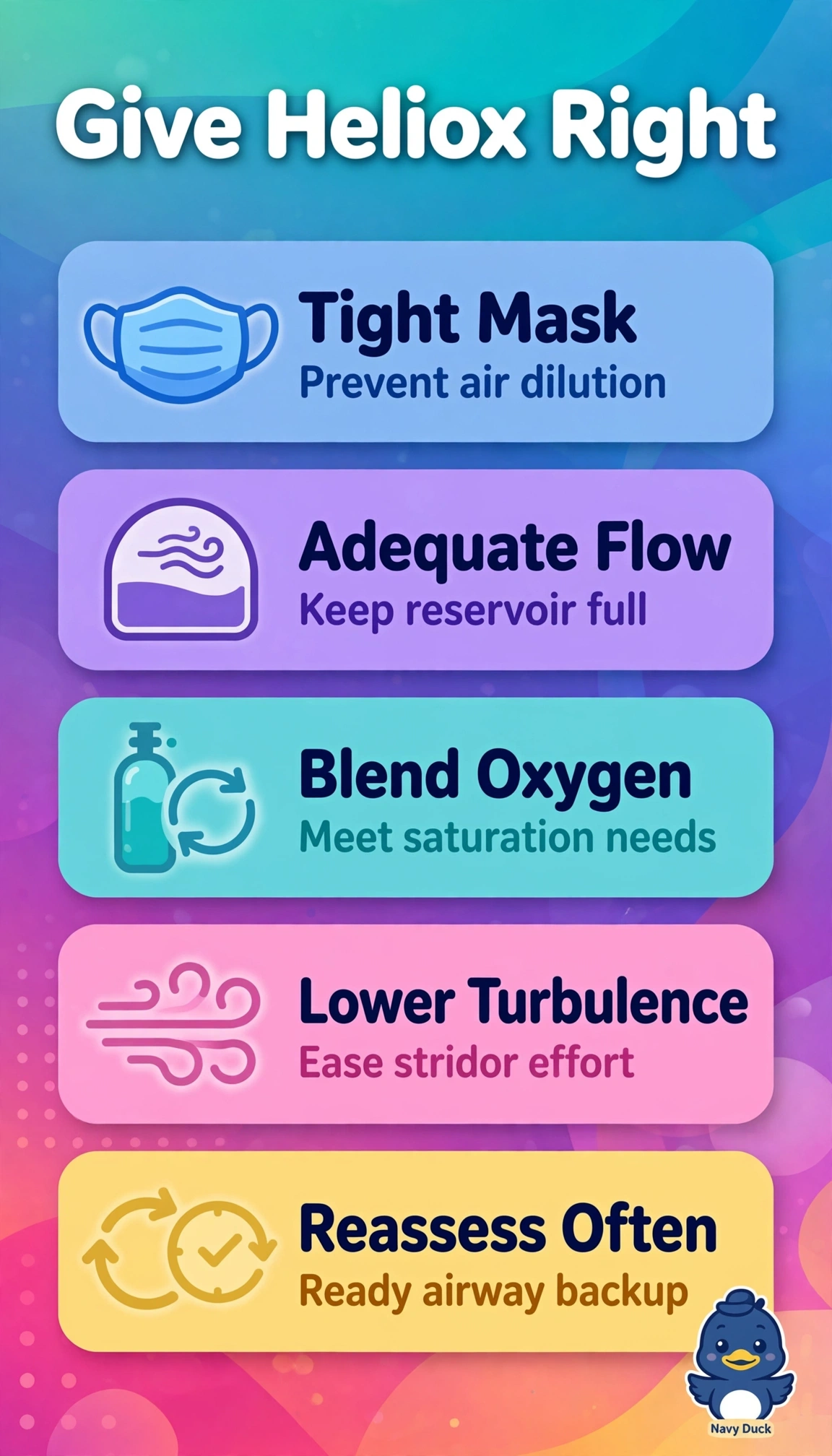
You've got to keep that light gas nice and concentrated for it to work, so you'll want a snug nonrebreather with plenty of flow to block room air leaks. It's like keeping a balloon tied shut so it stays floaty, and you'll watch that stridor ease as breathing gets easier.
Full Explanation
Severe viral croup causes subglottic edema and turbulent flow through a narrowed upper airway, and heliox with 70-80% helium lowers gas density and Reynolds number to favor laminar flow and reduce resistance and work of breathing while blended oxygen sustains oxygenation, so a tight nonrebreather with adequate flow is essential to prevent room-air entrainment and preserve helium fraction while close monitoring of stridor and distress guides escalation. High-flow nasal cannula with humidity and oxygen blending is ideal for comfort and hypoxemia but fails here as an open system that entrains air and dilutes helium below therapeutic levels, losing the density benefit needed for stridor. Inhaled nitric oxide via closed ventilator circuit with scavenging and monitoring is definitive for pulmonary hypertension through selective pulmonary vasodilation, but it does not alter gas density or relieve extrathoracic obstruction, so it mismatches the pathophysiology of croup. Heliox with 60% oxygen in a tight system preserves seal and oxygenation but fails because oxygen above about 40% leaves helium near 40% and density near air, yielding minimal turbulence reduction. For exams remember heliox requires oxygen needs low enough to keep helium above 60% and never confuse vasodilation with low-density flow; at bedside verify tight seal, reservoir bag inflation, continuous stridor score, retractions and oximetry, and remain ready for epinephrine or escalation if obstruction progresses.