
A 49-year-old tracheostomized patient in a long-term unit produces scant saliva-like secretions from suction, has a cuff pressure of 12 cm H2O with audible air leak, and new low-grade fever with questionable infiltrate. Which evaluation of sputum sample characteristics and cuff status best guides next action?
Select an answer to reveal the explanation.
Short Explanation
You're sorting spit from deep lung juice while guarding the windpipe. Nailing adequacy is like checking apple juice versus cider — source matters, and seals need just enough puff.
Full Explanation
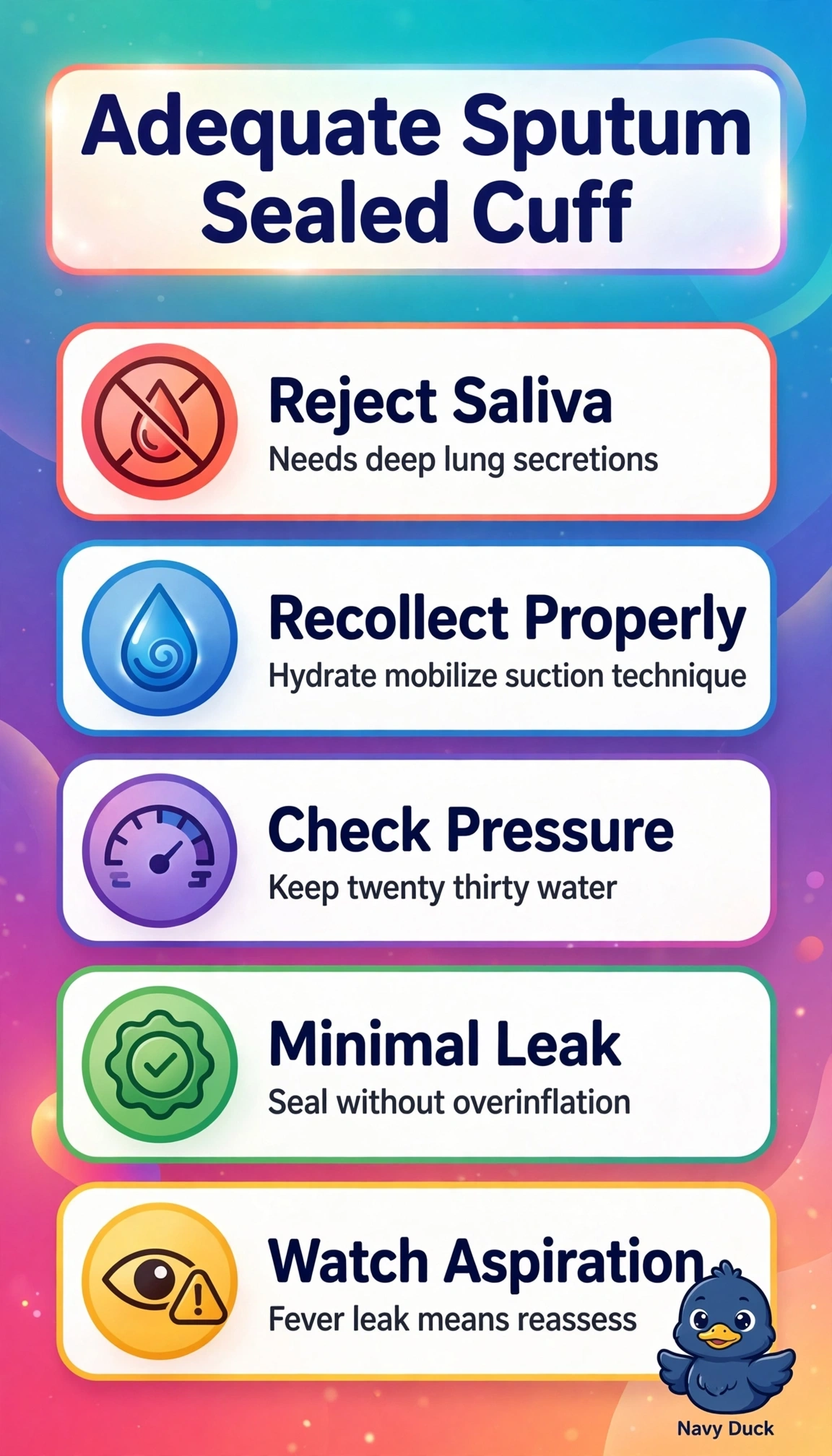
The correct action integrates sputum adequacy and aspiration prevention because saliva-like, scant secretions indicate squamous-rich oropharyngeal contamination rather than neutrophil-rich lower airway infection, so culture would reflect colonization and mislead therapy despite fever and questionable infiltrate, requiring rejection and recollection by deep tracheal suction. A cuff at 12 cm H2O with audible leak is below the 20-30 cm H2O target and permits microaspiration around the cuff, so reinflation to minimal leak seal restores protection without mucosal injury. Submitting the thin secretions for stain and culture while restoring seal addresses aspiration but violates quality criteria by culturing saliva, risking false-positive results and unnecessary antibiotics. Discarding the poor sample while keeping the cuff low to facilitate speech correctly applies rejection criteria but leaves an active leak uncorrected during suspected aspiration-related infection, prioritizing phonation over protection. Rejecting the sample and inflating to fully eliminate leak with added margin correctly rejects contamination but abandons minimal-leak technique, inviting tracheal ischemia and pressure injury. An exam caveat is that fever plus infiltrate never validates a saliva-like sample, and quality must precede culture. A practical check is to measure with a manometer, inflate to leak only at peak inspiration, then collect thick purulent aspirate.