
In an outpatient clinic a 58-year-old smoker reports chronic cough with sputum for three winters, progressive exertional dyspnea, and wheezing relieved partly by albuterol with no acute fever or chest pain. Which evaluation best establishes a new diagnosis of chronic lung disease?
Select an answer to reveal the explanation.
Short Explanation
You've got the classic story, but your lungs still need to show the receipts. Like checking tire pressure instead of just hearing a hiss, spirometry after albuterol proves the blockage sticks around.
Full Explanation
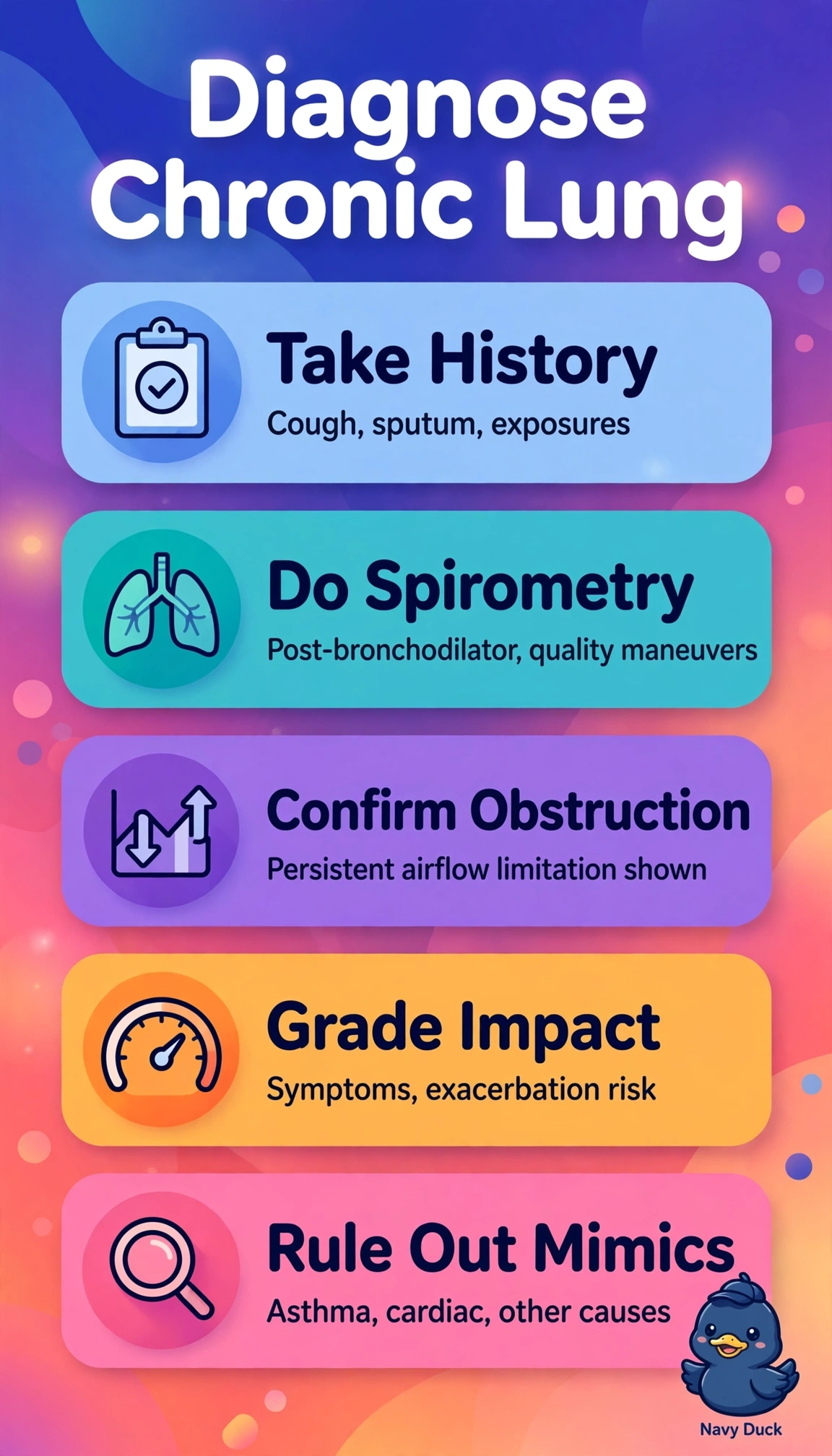
The correct evaluation establishes COPD by confirming persistent airflow limitation in stable state with clinical correlation and risk stratification, fitting a 58-year-old smoker with three winters of productive cough, progressive exertional dyspnea and partly responsive wheeze without fever or chest pain, where post-bronchodilator FEV1/FVC reduction proves fixed obstruction and symptom-exacerbation assessment guides therapy. The pre-bronchodilator-only approach fails by reversibility because baseline obstruction cannot separate fixed COPD from reversible asthma, critical with partial relief, since post-bronchodilator persistence is definitional. Post-bronchodilator spirometry during acute febrile illness fails by stability because infection and transient bronchospasm depress function and exaggerate symptoms, so chronic diagnosis must await stable baseline. Post-bronchodilator spirometry with low-dose CT without symptom assessment fails by management because CT addresses cancer risk but not dyspnea burden or exacerbation history needed for grouping and treatment. Exam caveat: symptoms, wheeze relief, hyperinflation or oximetry alone never establish COPD and normal imaging or oximetry does not exclude it; persistent post-bronchodilator obstruction in compatible context is required. Practical check: verify acceptable repeatable spirometry with proper hold when safe, record pack-years, exacerbations, CAT or mMRC, eosinophils and comorbidities, and pair diagnosis with cessation, vaccination and inhaler review.