
A 34-year-old with Guillain-Barre syndrome shows progressive limb weakness, dysphagia, vital capacity falling from 38 to 22 mL/kg, MIP weakening to -28 cm H2O, and tachypnea with weak cough over 6 hours. Blood gases remain near normal. Which monitoring and ventilation timing decision best manages impending neuromuscular respiratory failure?
Select an answer to reveal the explanation.
Short Explanation
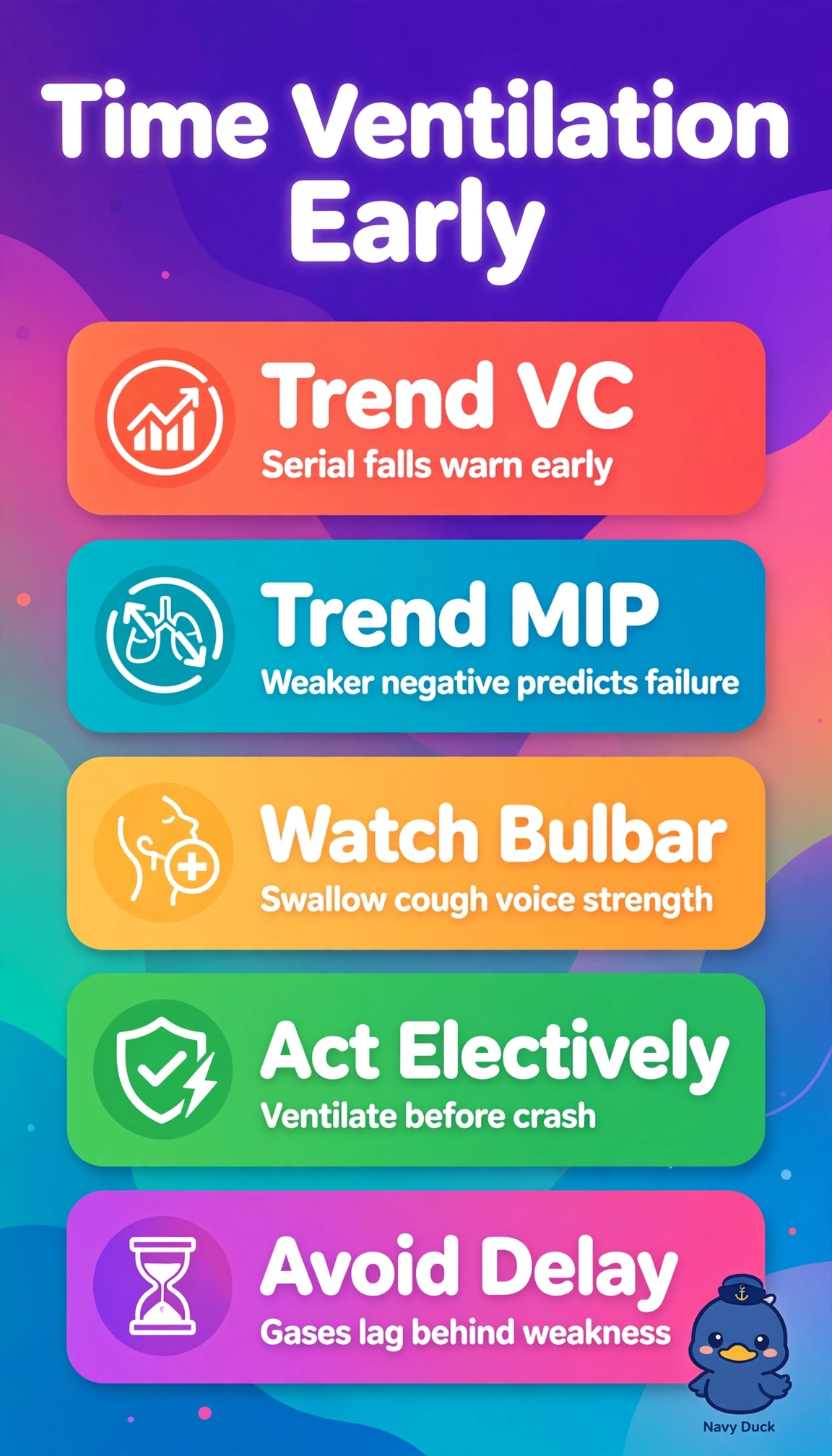
You're watching muscles tire like a phone battery draining fast, so don't trust that reassuring gas. You'll stay ahead when you follow your trends in VC and MIP and line up breathing support before things crash.
Full Explanation
This is rapidly progressive Guillain-Barre syndrome with bulbar involvement and impending neuromuscular failure, with vital capacity falling from 38 to 22 mL/kg toward the 20 mL/kg intubation threshold, MIP weakening to -28 cm H2O toward the -30 cm H2O threshold, plus dysphagia, tachypnea and weak cough over 6 hours, so trending serial vital capacity and MIP closely with elective ventilation before abrupt decompensation is correct because pump failure advances while arterial gases remain normal until late exhaustion and sudden arrest. Interval gas monitoring with nocturnal bilevel for hypercapnia fails by monitoring concept because hypercapnia is a late insensitive trigger in acute weakness and noninvasive support does not prevent aspiration with dysphagia and ineffective cough. Once-daily spirometry deferring intubation while gases and mentation stay normal fails by timing concept because a 16 mL/kg fall in 6 hours demands reassessment every 2-4 hours in ICU, and waiting 24 hours invites nocturnal deterioration. Cough-assist with humidified oxygen while trending vital capacity fails by airway-protection concept because it helps secretions and hypoxemia without definitive alveolar ventilation or bulbar protection, and oxygen can mask hypoventilation. Exam caveat is normal PaCO2 never excludes impending failure and 20-30-40 thresholds for vital capacity, MIP and MEP trigger elective intubation, not observation, especially with bulbar signs and autonomic lability. Practical check is monitored head-up positioning, nil per os or protected swallow plan, repeated vital capacity, MIP/MEP, cough peak flow and bulbar exams, with anesthesia, neurology and critical care ready for controlled intubation anticipating dysautonomia and avoiding prolonged depolarizing blockade complications.