
A 28-week preterm infant on mechanical ventilation has increasing FiO2 needs with classic ground-glass appearance and low lung compliance, and the neonatologist orders surfactant replacement through the endotracheal tube during a sterile bedside procedure. Which endotracheal instillation technique should the therapist perform to deliver surfactant?
Select an answer to reveal the explanation.
Short Explanation
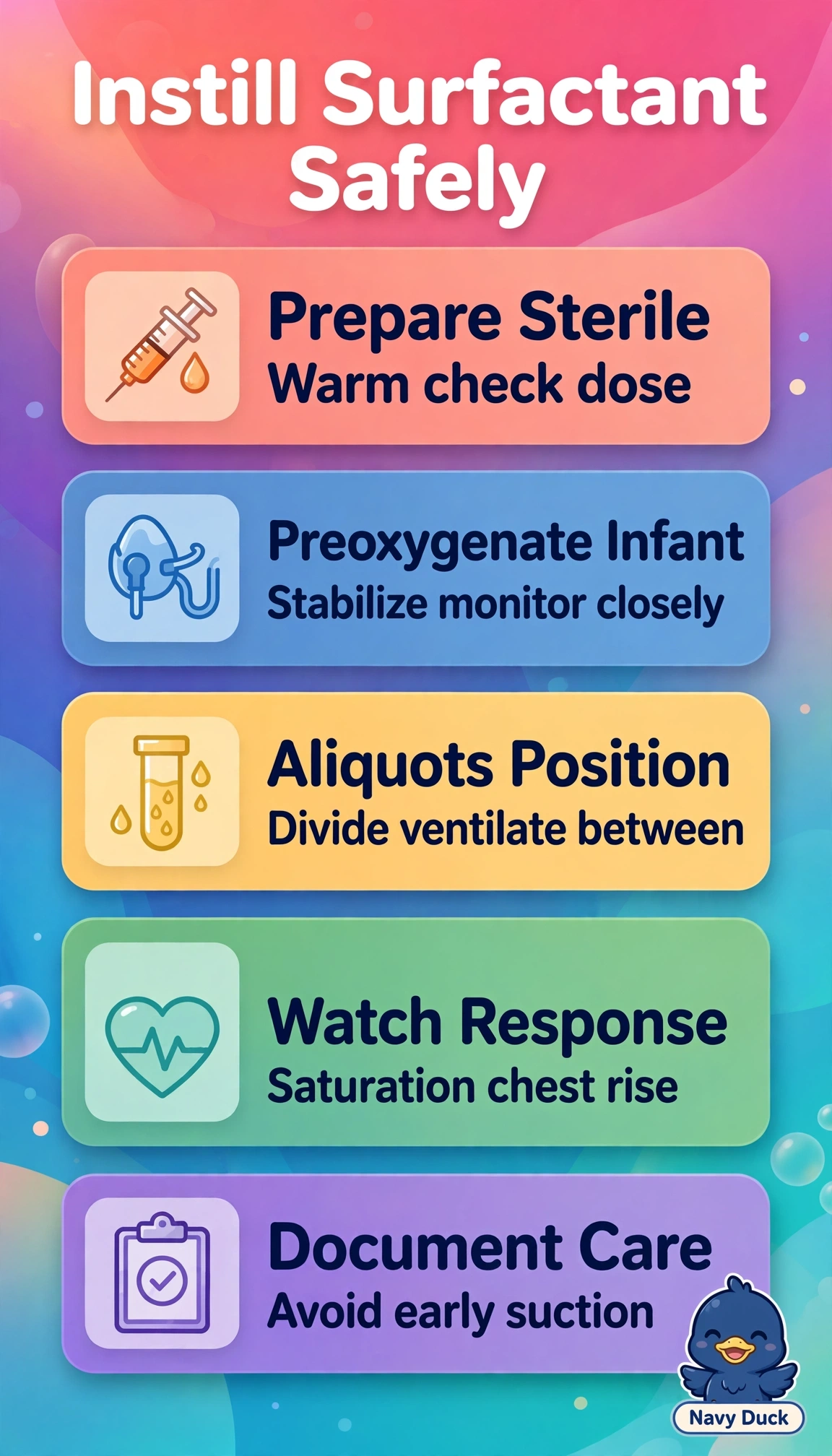
First, you’ll preoxygenate and stabilize your little patient before treating those stiff lungs. Then you’ll instill sterile surfactant in divided aliquots with brief positioning and ventilation, helping it spread evenly for better coverage.
Full Explanation
The correct technique is preoxygenation and stabilization followed by sterile surfactant in divided aliquots, with brief positioning and ventilation. Prematurity, ground-glass opacities, rising FiO₂ and low compliance point to surfactant deficiency; stabilization helps prevent hypoxemia and bradycardia during airway handling, sterility limits infection risk, and aliquots with positioning and ventilation support even distal spread and recovery between doses. A single rapid bolus fails because delivering the full dose without repositioning or ventilation intervals can favor dependent areas, cause obstruction or desaturation, and reduce uniform recruitment. Sterile saline lavage in divided aliquots fails because saline does not provide the phospholipids and proteins needed to lower surface tension, restore functional residual capacity, or durably improve compliance and oxygenation. A metered-dose inhaler with spacer and mask during spontaneous breathing fails because that delivery method suits bronchodilators, not liquid surfactant delivered through an endotracheal tube to atelectatic alveoli under sterile conditions. Exam caveat: connect prematurity, ground-glass appearance, and an endotracheal surfactant order to aliquots rather than suction, lavage, or bronchodilator routines. Practical check: confirm the order, dose, warming, sterility, monitors, suction, tube patency, preoxygenation, and positioning plan; then assess saturation, compliance, and chest expansion and document.