
An emergency physician prepares for ultrasound-guided thoracentesis on a dyspneic adult with a large right pleural effusion, with consent signed, platelets borderline low, and SpO2 90% on 2 L nasal cannula. You are asked to assist. Which assisting action best supports safe thoracentesis and chest drainage preparation?
Select an answer to reveal the explanation.
Short Explanation
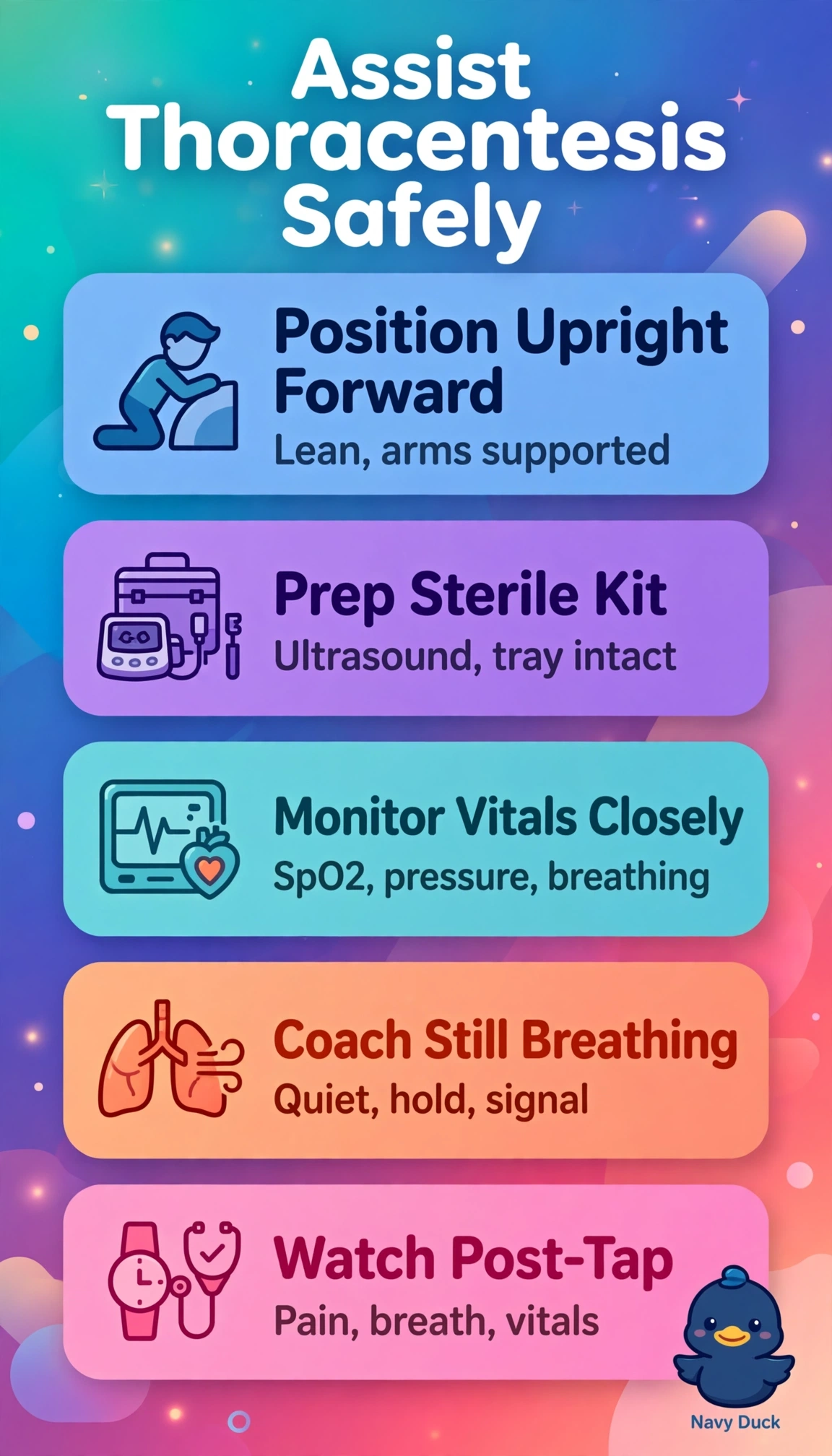
You’re creating stillness, sterility, and watchfulness around a needle near the lung. Like holding a ladder steady, your positioning helps keep the target safe when you prepare the sterile kit, monitor vital signs, and coach calm breathing and stillness.
Full Explanation
Positioning upright and leaning forward, preparing the sterile kit, monitoring vital signs, and coaching quiet breathing and stillness together support safe ultrasound-guided thoracentesis in a dyspneic, hypoxemic patient with a large effusion. Upright posture allows fluid to collect dependently for ultrasound localization, improves posterior intercostal access, and eases breathing. Sterile preparation helps prevent pleural infection; monitoring oxygen saturation and other vital signs can reveal deterioration in a patient already at 90% on 2 L, with borderline platelets and bleeding risk. Coaching calm breathing and stillness limits pleural movement and the risk of pneumothorax or vessel injury during needle passage. Semi-recumbent positioning may offer comfort, but it does not provide the same dependent pooling and posterior access. Checking vital signs only after drainage delays recognition of hypoxia, vagal reactions, re-expansion pulmonary edema, or bleeding. Clean rather than sterile equipment fails to provide the asepsis needed when entering the pleural space and raises infection risk. Exam caveat: prioritize upright positioning, ongoing observation, and sterile technique when oxygen needs and thrombocytopenia coexist. Practical check: confirm upright posture, an intact sterile field, alarms set, the cannula secure, the site marked, and that the patient can follow quiet-breathing and stillness cues before insertion.