
A 58-year-old with severe COPD exacerbation in a 15-bed rural emergency department shows worsening hypercapnia, obtundation, and paradoxical breathing despite bronchodilators, steroids, and a failed BiPAP trial due to aspiration risk and copious secretions. Which intubation and invasive ventilation strategy best balances ventilation with air-trapping risk?
Select an answer to reveal the explanation.
Short Explanation
You're ventilating lungs that empty slower than they fill, so patience wins. Embracing expiration time is like letting a crowded elevator empty before piling more folks in.
Full Explanation
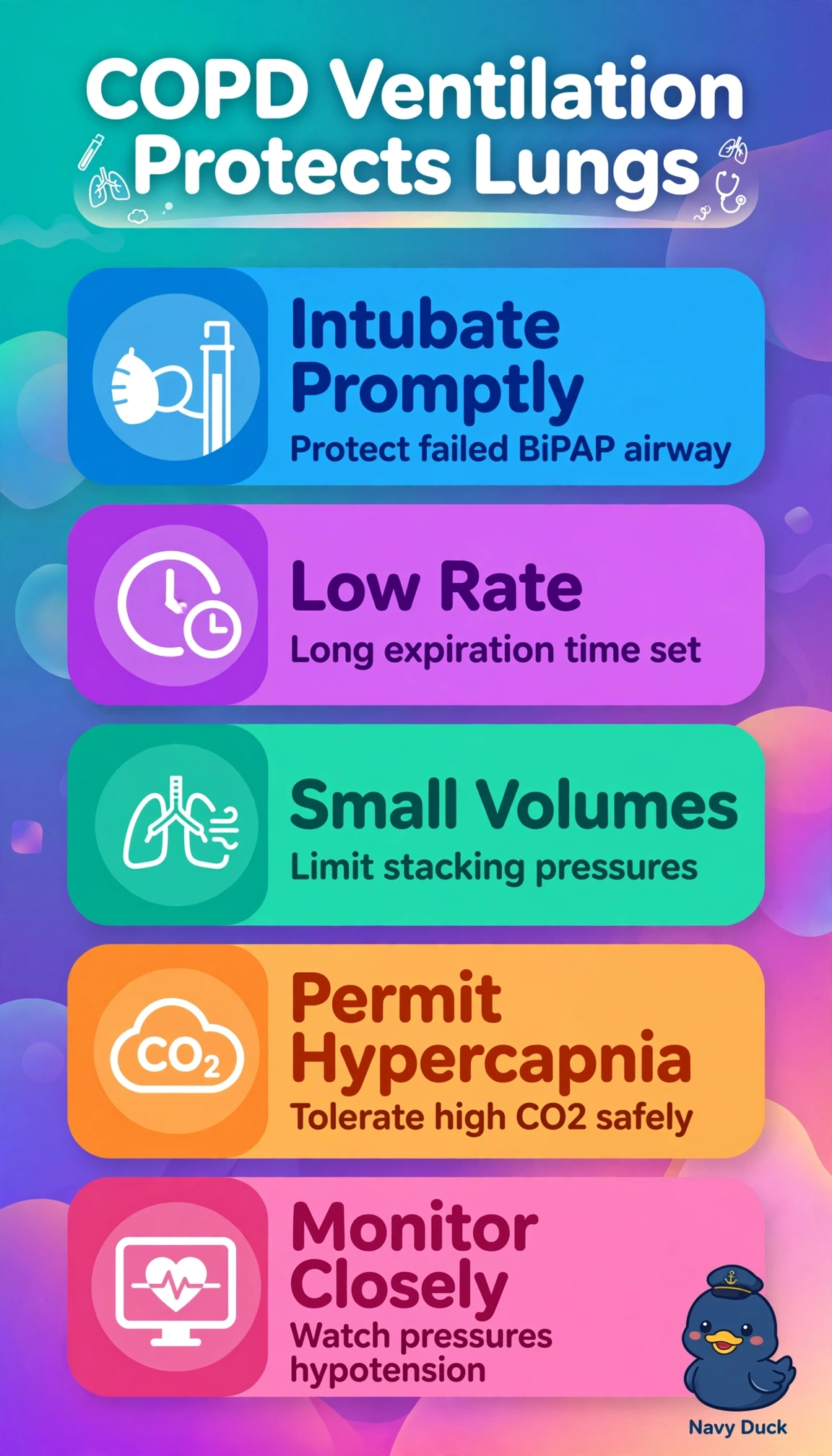
COPD exacerbation with altered mentation, inability to protect airway, copious secretions, and BiPAP failure meets criteria for intubation, after which severe airflow limitation demands low respiratory rate, smaller tidal volumes, prolonged expiratory time, judicious PEEP to offset auto-PEEP, permissive hypercapnia provided pH remains acceptable and oxygenation is maintained, plus bronchodilators, steroids, and vigilant monitoring for breath stacking, hypotension, and barotrauma. High-rate large-volume ventilation to normalize PaCO2 rapidly worsens dynamic hyperinflation, auto-PEEP, hypotension, and barotrauma in obstructed lungs and ignores safe permissive hypercapnia strategy. Continuing BiPAP despite obtundation and aspiration risk violates airway protection principles and delays definitive control when noninvasive support has failed. Zero PEEP with frequent deep suctioning destabilizes recruitment and airway tone while aggressive suctioning causes hypoxemia, mucosal trauma, and vagal effects without addressing expiratory flow limitation. Exam caveat: allow full expiration, watch plateau pressure and flow not returning to zero, and disconnect briefly if stacking with hypotension occurs. Practical check: confirm tube placement, set alarms, monitorABGs, auto-PEEP, hemodynamics, and sedation with ventilator synchrony.