
A 42-year-old after a motor vehicle crash has right-sided rib fractures with paradoxical chest motion, severe pleuritic pain, shallow breathing, hypoxemia, and suspected pulmonary contusion in a monitored trauma unit. Which chest trauma management approach best stabilizes ventilation for flail chest?
Select an answer to reveal the explanation.
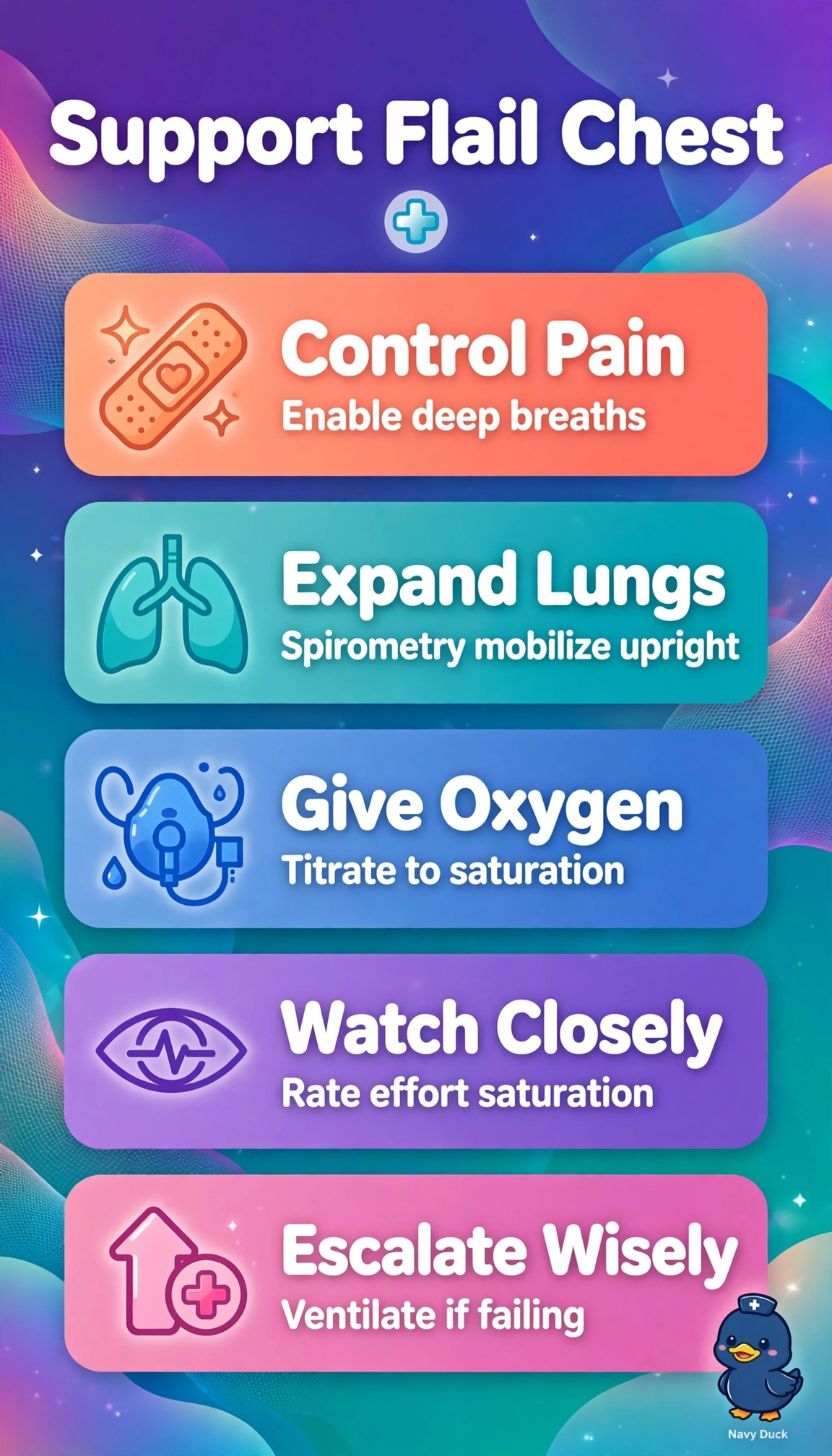
Short Explanation
Pain is driving the shallow breathing here. Easing pain to let lungs expand keeps ventilation steady like loosening a tight belt so you can breathe deeply.
Full Explanation
The correct approach works because flail chest with paradoxical motion plus severe pleuritic pain drives splinting, shallow tidal volumes, atelectasis and hypoxemia, worsened by underlying contusion, so relieving pain to restore deep breathing and cough while preserving spontaneous ventilation under surveillance directly addresses pathophysiology. Multimodal analgesia reduces splinting and permits lung expansion therapy with incentive spirometry, physiotherapy and oxygen to recruit alveoli, improve ventilation-perfusion matching and prevent pneumonia, while continuous monitoring detects fatigue or evolving contusion failure requiring escalation. The low-dose acetaminophen strategy fails on analgesia because a single mild agent cannot control severe pleuritic pain, so shallow breathing and atelectasis persist despite oxygen and observation. The early elective intubation strategy fails on ventilation stewardship because routine intubation for stable spontaneous breathing introduces sedation, ventilator-associated pneumonia and barotrauma risks and is reserved for refractory hypoxemia, fatigue or inability to protect airway rather than to abolish visible paradox. The urgent operative fixation strategy fails on sequencing because surgical stabilization is selective and not initial care without a trial of optimized analgesia, pulmonary toilet and monitoring to clarify necessity and operative risk. Exam caveat is that contusion and paradoxical inefficiency may worsen over 24 to 48 hours, so an initially stable patient still needs trauma monitoring. Practical check is to track pain scores, respiratory rate and effort, oximetry, spirometry volumes and blood gases and escalate promptly for worsening work, hypoxemia or hypercapnia.