
In the ICU a comatose patient after catastrophic brain injury has absent brainstem reflexes, is normothermic and normotensive, and is preoxygenated on 100% oxygen with baseline ABG documented before testing for brain death. Which apnea test procedure best gathers valid clinical information for brain death determination?
Select an answer to reveal the explanation.
Short Explanation
No breaths at high CO2 seals the answer, but safety comes first. Preoxygenation plus passive oxygen keeps tissues alive while you watch — disconnection lets the brainstem speak for itself.
Full Explanation
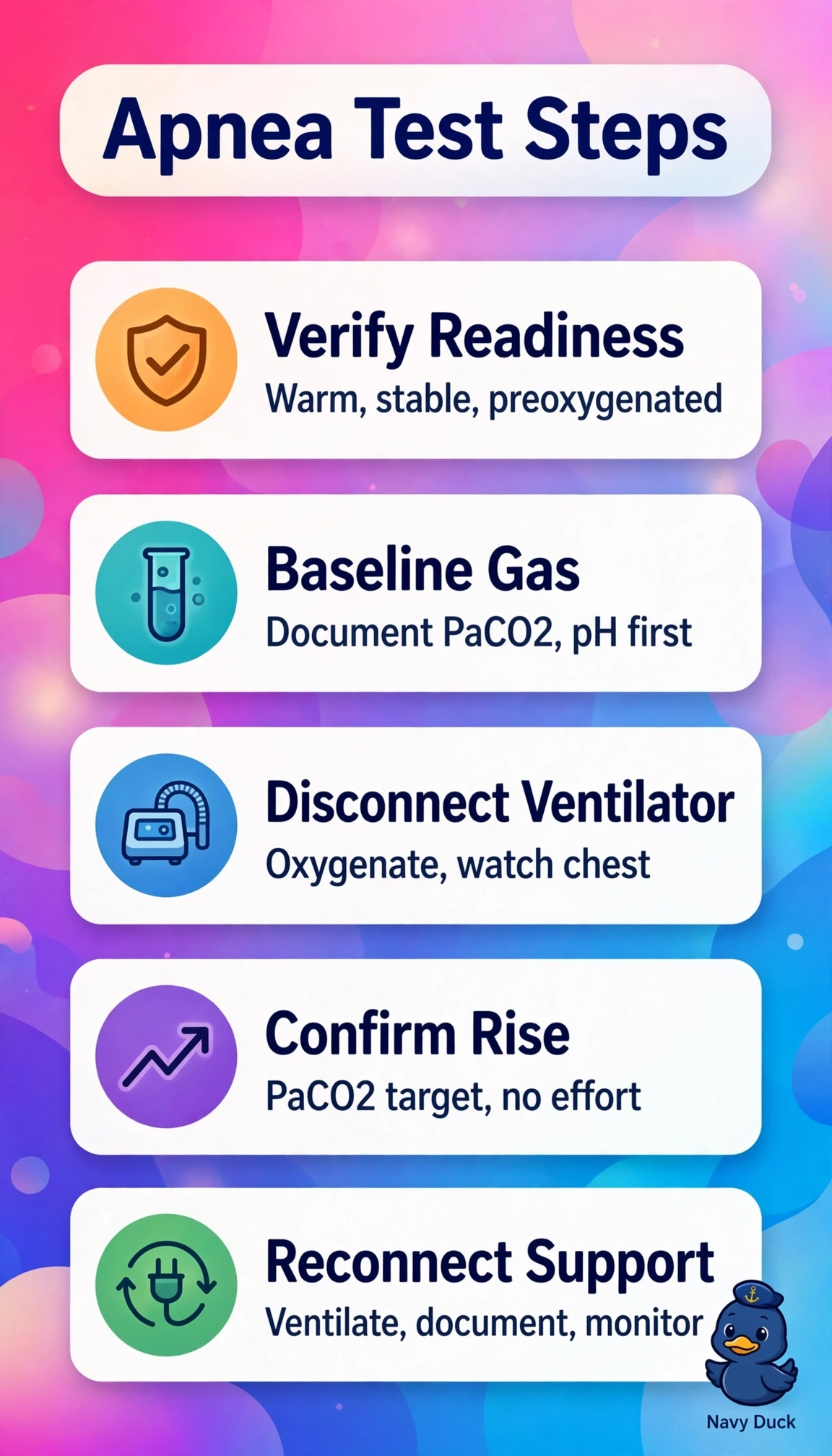
The correct procedure succeeds because apnea testing must prove absent medullary drive despite a sufficient hypercapnic stimulus while avoiding hypoxemia, so after verifying deep coma, absent brainstem reflexes, normothermia, normotension, euvolemia and no sedative or neuromuscular confounders, preoxygenation on 100% oxygen with baseline gases, disconnection with oxygen insufflation, close observation for chest or abdominal effort, and paired gases showing PaCO2 at least 60 mmHg and 20 mmHg above baseline together establish validity. Continued pressure-support ventilation with oxygen monitoring for triggered breaths fails because machine-assisted breaths mask spontaneous effort and prevent interpretation of true apnea despite an adequate carbon dioxide rise. Disconnection with oxygen insufflation for a fixed time without post-test gases fails because elapsed time alone cannot confirm stimulus adequacy, and formal thresholds for absolute and incremental PaCO2 increase must be met to accept absent breathing. Brief hyperventilation to hypocapnia before disconnection fails because lowering starting carbon dioxide prolongs apnea time, delays threshold attainment, and increases risk of hypotension, hypoxemia and instability without improving diagnostic accuracy. An exam caveat is that any respiratory effort, sustained desaturation, hypotension or arrhythmia invalidates the attempt and mandates termination with consideration of an ancillary test. A practical check is to record temperature, pressure, saturation, oxygen flow, observation duration, pre-test and post-test PaCO2 and pH, and continuous bedside monitoring.