
A 6-year-old with severe upper airway obstruction in a pediatric emergency bay needs heliox to reduce work of breathing, and a neonate with persistent pulmonary hypertension in the NICU nearby is prescribed inhaled nitric oxide with methemoglobin monitoring. Which administration principle best ensures safe heliox and inhaled nitric oxide delivery?
Select an answer to reveal the explanation.
Short Explanation
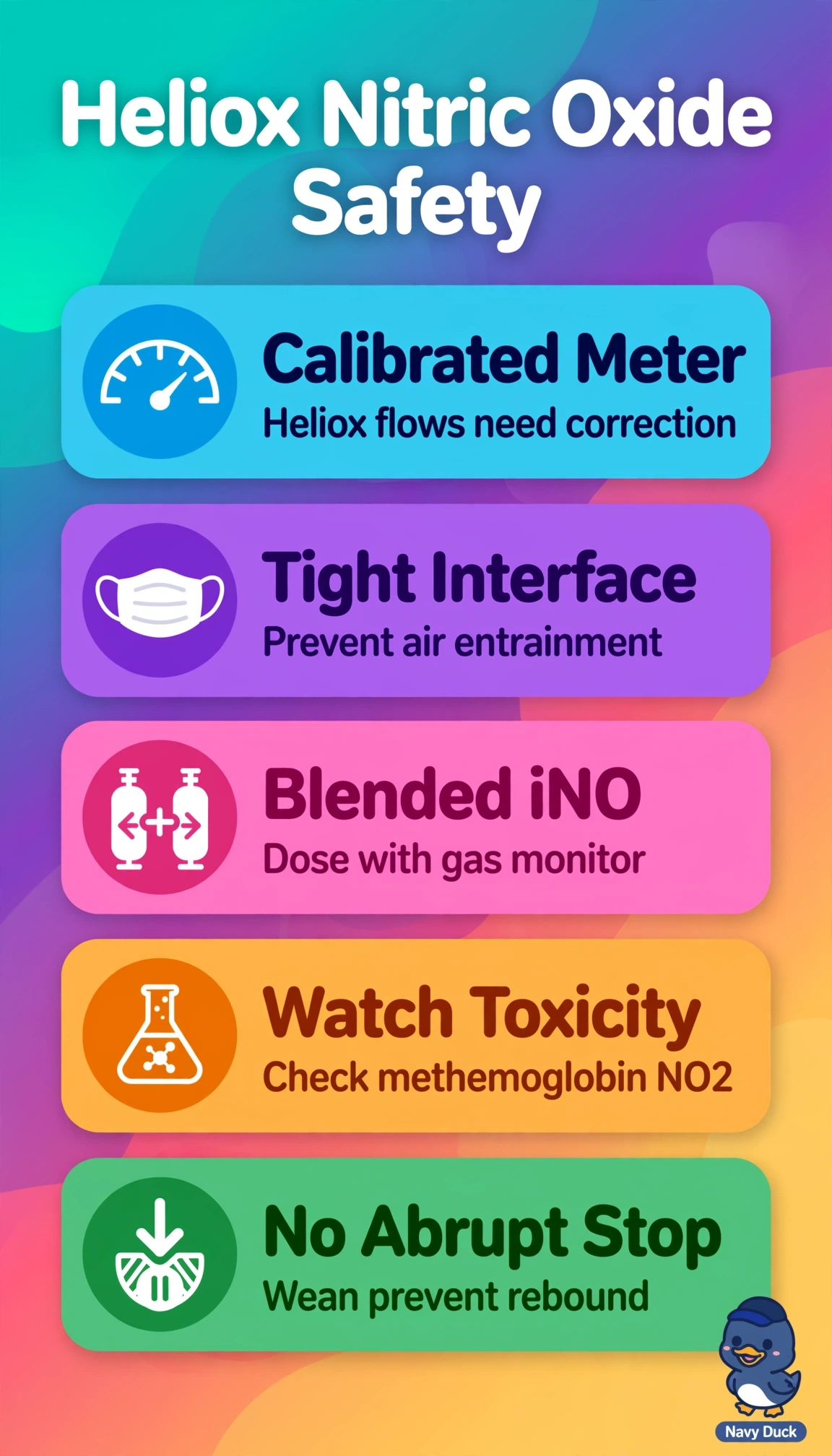
You’re handling gases that don’t play by air rules, so calibration is key. Safe delivery means using a calibrated heliox flowmeter with air-entrainment precautions and a blended monitor for nitric oxide.
Full Explanation
Safe delivery depends on gas density and precise microdosing. Heliox is much less dense than oxygen, so standard flowmeters can misread flow; a calibrated heliox flowmeter, with air-entrainment precautions, helps maintain the prescribed helium-oxygen ratio and reduce airway resistance, promote laminar flow, and lower work of breathing. Inhaled nitric oxide acts selectively on pulmonary vessels at parts-per-million doses but can form nitrogen dioxide and methemoglobin, so a blended delivery monitor supports flow-proportional dosing and continuous sensing of nitric oxide, nitrogen dioxide, and oxygen, with alarms to support prescribed methemoglobin surveillance. Using a standard oxygen flowmeter with validated conversion charts is a commonly taught backup when calibrated meters are unavailable, but it does not meet the calibrated-device and entrainment-control requirements and risks helium dilution. A calibrated heliox flowmeter paired with nitric oxide titration by pulse oximetry alone handles heliox appropriately, but saturation cannot quantify nitric oxide dose, detect nitrogen dioxide, or reveal methemoglobinemia reliably. A calibrated flowmeter with air precautions paired with manual nitric oxide addition to the ventilator circuit cannot ensure stable proportional dosing across changing flows or provide the required monitoring. Exam caveat: improved saturation never confirms safe gas delivery. Practical check: confirm helium-oxygen percentage, nitric oxide and nitrogen dioxide readings, methemoglobin trend, tight connections, active alarms, and scavenging at bedside.