
A postoperative patient in a four-bed step-down unit has a chest tube to water-seal drainage with tidaling absent, continuous bubbling in the water-seal chamber, and a pulse oximeter showing intermittent low signal with poor waveform during shivering. Which troubleshooting sequence best addresses chest drainage and noninvasive monitor function?
Select an answer to reveal the explanation.
Short Explanation
You’re a detective first and a fixer second when equipment signals trouble. Leak-checking the chest tube before changing suction, then moving the probe to a warm, still site, helps you find the cause and get a clearer signal.
Full Explanation
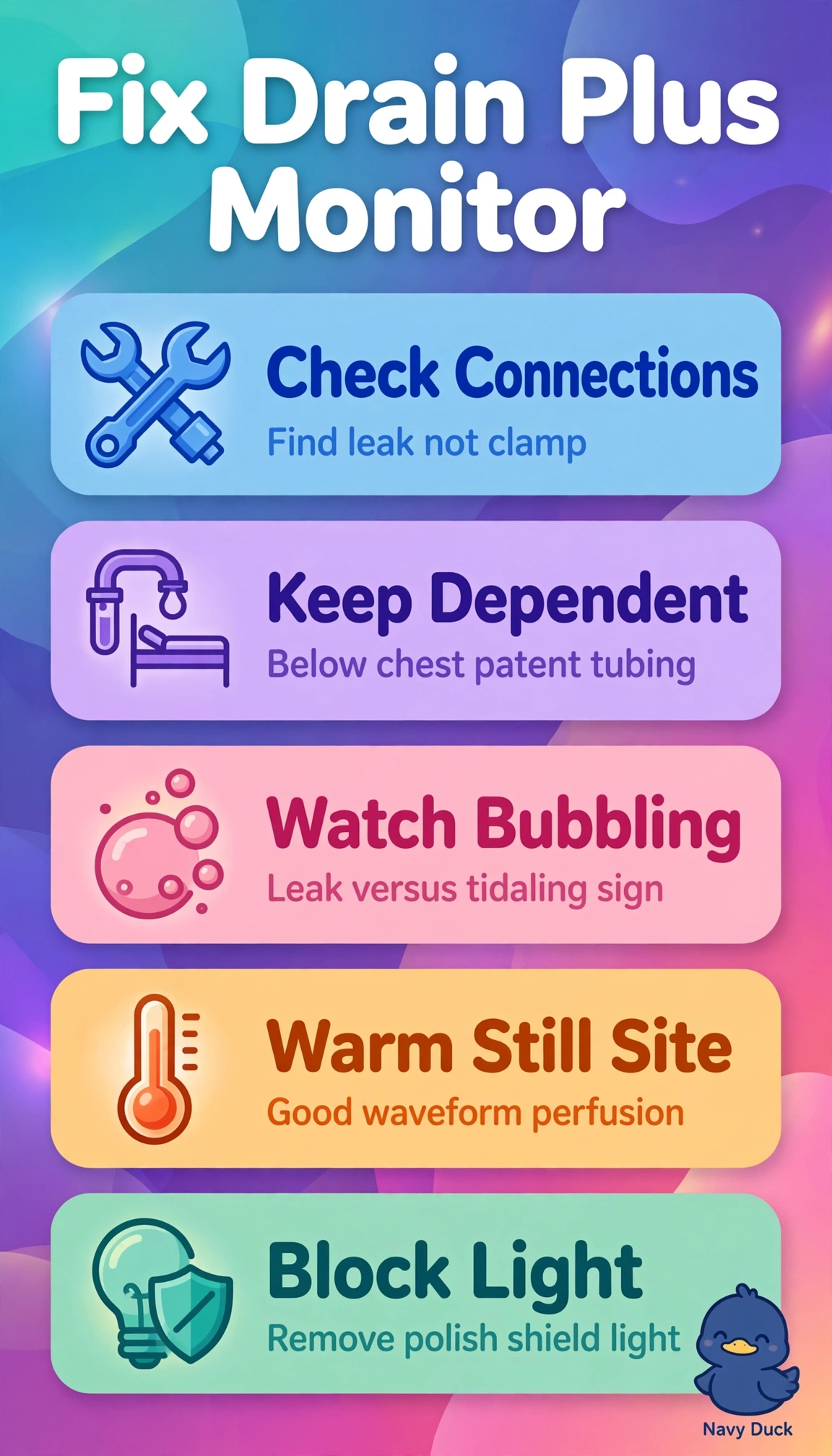
The correct sequence pairs two priority assessments: absent tidaling with continuous bubbling in the water-seal chamber signals air entry from a leak or disconnection, so inspect the tubing and connections to identify the source without interrupting drainage. Intermittent low signal and a poor waveform during shivering reflect motion artifact and peripheral vasoconstriction; repositioning the probe to a warm, well-perfused, still site improves signal quality. Warming the cold finger while leaving the probe on it fails because warmth alone cannot eliminate shivering artifact. Applying additional suction to stop bubbling fails because increased negative pressure does not seal an air leak and may exaggerate bubbling, obscuring leak assessment. Straightening dependent tubing loops may address a kink or impaired drainage, but does not resolve the ongoing air entry indicated by continuous bubbling. An exam caveat: distinguish expected respiratory tidaling from continuous bubbling, which signals a leak; do not clamp the tube, elevate the unit, or use uncontrolled suction as a fix. A practical check is to trace the circuit from the insertion site to the unit, confirm tight connections and an upright unit below chest level, then verify a strong oximeter waveform and appropriate alarm limits after repositioning the probe.