
A 68-year-old with a cuffed tracheostomy on day 3 has thick tenacious secretions, crusted stoma, low tidal volume alarms on the ventilator, and dry inspired gas. The inner cannula is disposable and humidification is bypassed. Which tracheostomy care routine best restores patency, humidification, and infection control?
Select an answer to reveal the explanation.
Short Explanation
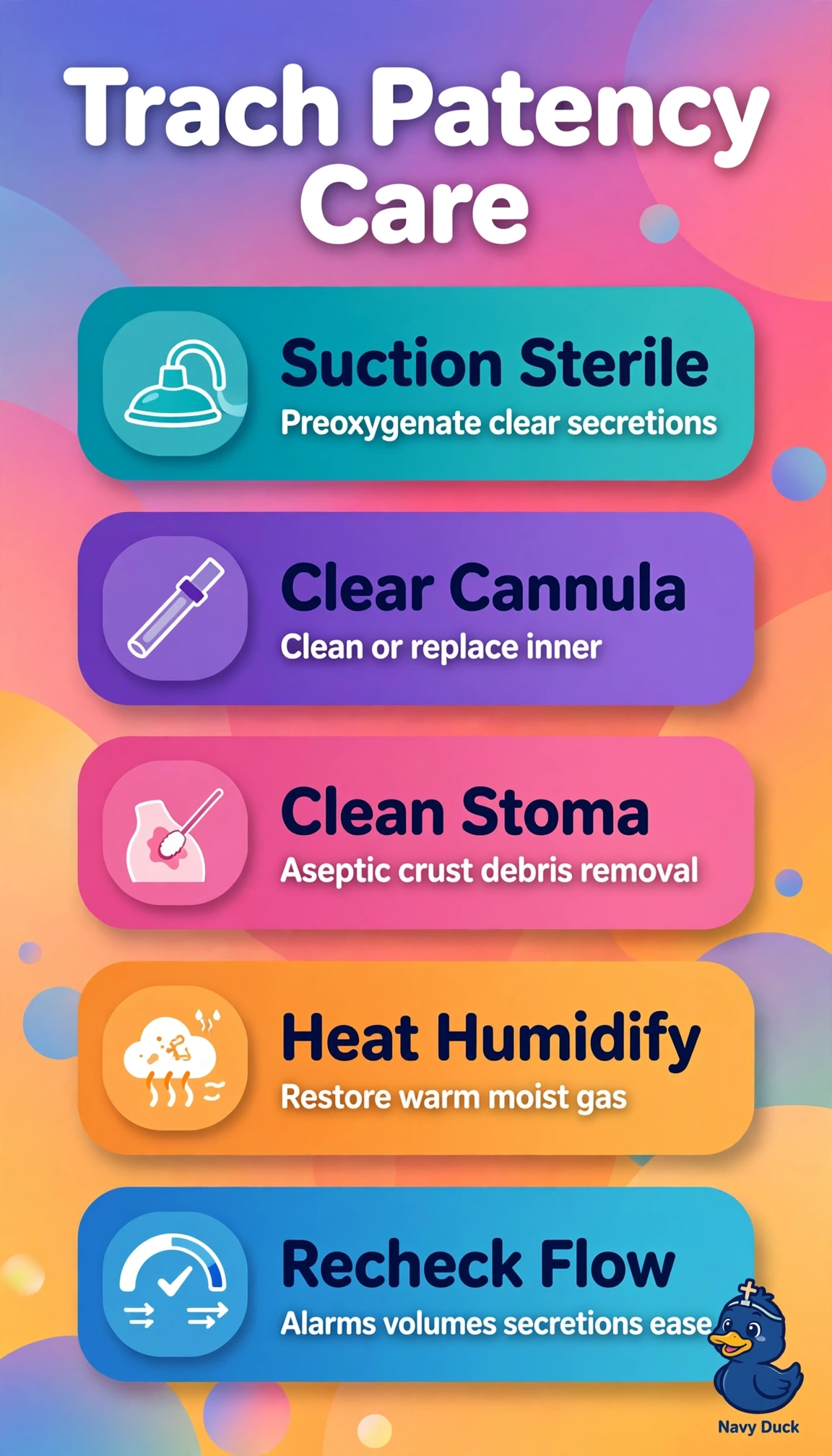
You're keeping that airway open like you're clearing a clogged straw so air can move freely again. When you've suctioned sterilely, freshened the inner cannula, cleaned the stoma, and restored humidification, you'll loosen those thick secretions and keep infection risks down.
Full Explanation
The correct routine matches pathophysiology to intervention for a day-3 ventilated cuffed tracheostomy with obstruction and dry gas: sterile suctioning immediately restores lower airway patency and resolves low tidal volume alarms while protecting a fresh tract, discarding and replacing the disposable inner cannula restores internal diameter and removes inspissated biofilm that suction alone cannot clear, stoma cleaning removes crusts that seed infection, and restoring heated humidification rehydrates inspired gas, thins tenacious secretions, and prevents recurrent plugging. The routine using clean suctioning with otherwise complete care fails on infection-control concept because early postoperative status with mechanical ventilation and a cuffed airway requires sterile technique, whereas clean technique suits only stable chronic home care. The routine substituting a heat-moisture exchanger for heated humidification fails on humidification physiology because passive exchangers add dead space and deliver insufficient moisture when secretions are already thick and active humidification is bypassed. The routine relying on cannula replacement, stoma care, humidification, and coughing instead of suctioning fails on patency urgency because plugs causing ventilator alarms in a cuffed patient cannot be mobilized by cough and hydration alone. An exam caveat is to not equate any humidification device with adequate humidification and to not treat disposable and reusable cannulas identically, recalling the tract is immature before day seven. A practical check is to confirm restored tidal volumes without alarms, easy catheter passage, thinner secretions, a moist non-crusted stoma, correct cuff pressure, and a warm heated circuit with condensate.