
A 62-year-old in the ICU after mitral valve repair has pulmonary hypertension, RV dilation on echo, hypoxemia on lung-protective ventilation, and no active bleeding. The team orders a trial of inhaled nitric oxide with continuous monitoring. Which delivery principle should guide inhaled nitric oxide for pulmonary hypertension in this ventilated patient?
Select an answer to reveal the explanation.
Short Explanation
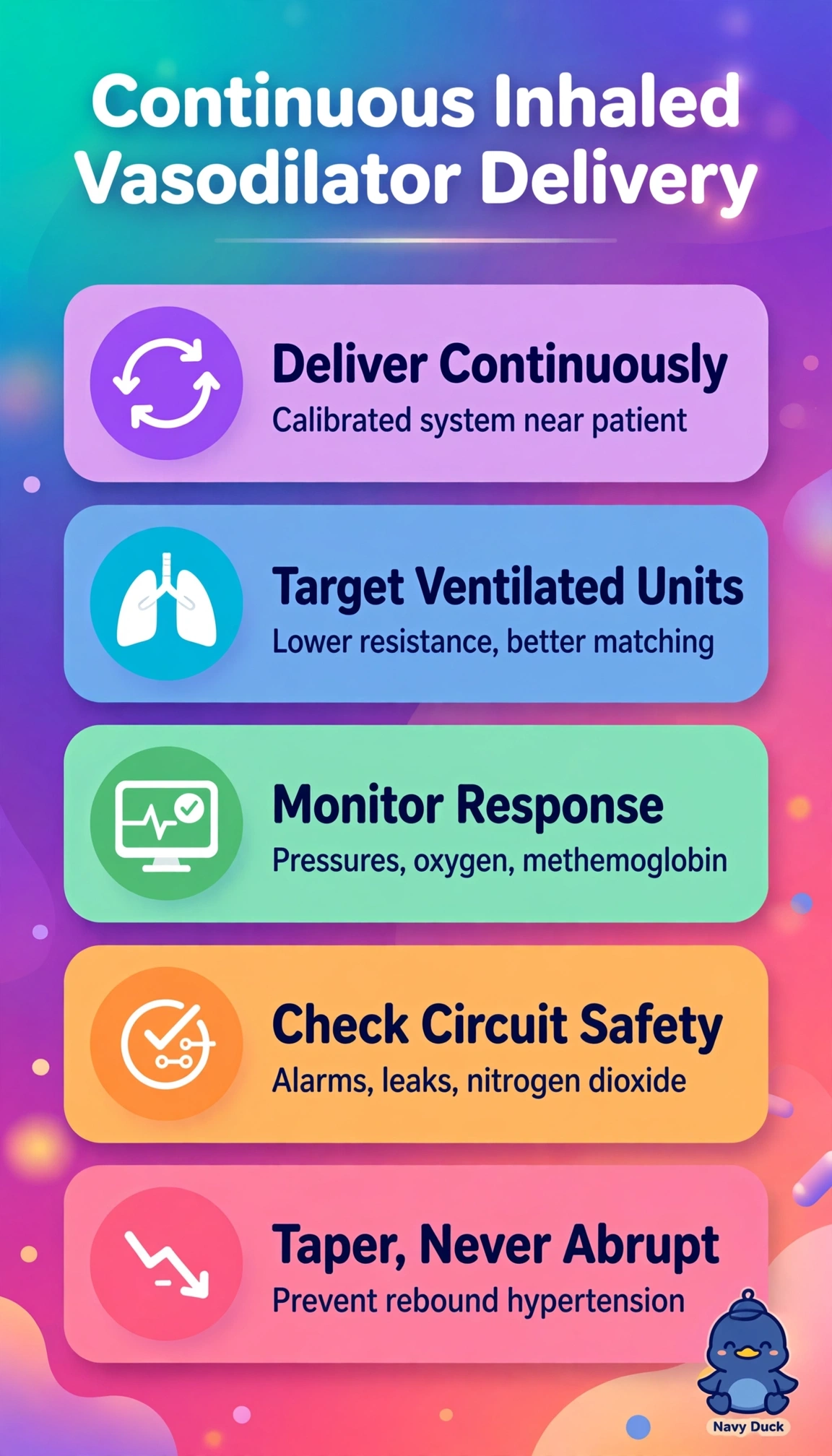
You’ve got this—inhaled vasodilators work where air goes. Keep nitric oxide continuous in the ventilator circuit with monitoring, and taper it so pressures don’t rebound when you stop.
Full Explanation
Inhaled nitric oxide causes selective pulmonary vasodilation through cyclic GMP and is rapidly inactivated by hemoglobin. Continuous delivery into the ventilator circuit maintains a steady alveolar concentration, improves ventilation-perfusion matching, and reduces RV afterload without systemic hypotension. Continuous surveillance of pressures, oxygenation, methemoglobin, nitrogen dioxide, and ventilator function can detect toxicity or maldelivery; tapered weaning limits rebound pulmonary hypertension when vasodilation is withdrawn. High-flow nasal cannula delivery is intended for spontaneously breathing patients and cannot ensure calibrated concentration and synchronized distribution during lung-protective ventilation. Continuous nebulized epoprostenol is an accepted alternative inhaled therapy, but it is a different agent with distinct dosing, nebulizer setup, stability, and monitoring, so it does not provide the ordered nitric oxide trial. Abruptly stopping nitric oxide after normalization risks rebound hypertension, RV decompensation, and hypoxemia despite appropriate prior delivery. An exam caveat is to distinguish selective inhaled therapy from systemic vasodilators, which can lower systemic pressure, and from intermittent dosing, which may not sustain the effect. At the bedside, verify the analyzer-measured dose, circuit integrity, pulmonary pressures, RV size, oxygenation, methemoglobin and nitrogen dioxide levels, and a documented taper before reducing the dose.