
A pulmonology team plans bedside bronchoscopy with endobronchial ultrasound in a procedure suite for a middle-aged adult with a right hilar mass, requiring topical anesthesia, moderate sedation monitoring, and multiple needle passes with rapid onsite evaluation. You are assigned to assist. Which assisting action best supports safe intubation-style airway management and EBUS sampling?
Select an answer to reveal the explanation.
Short Explanation
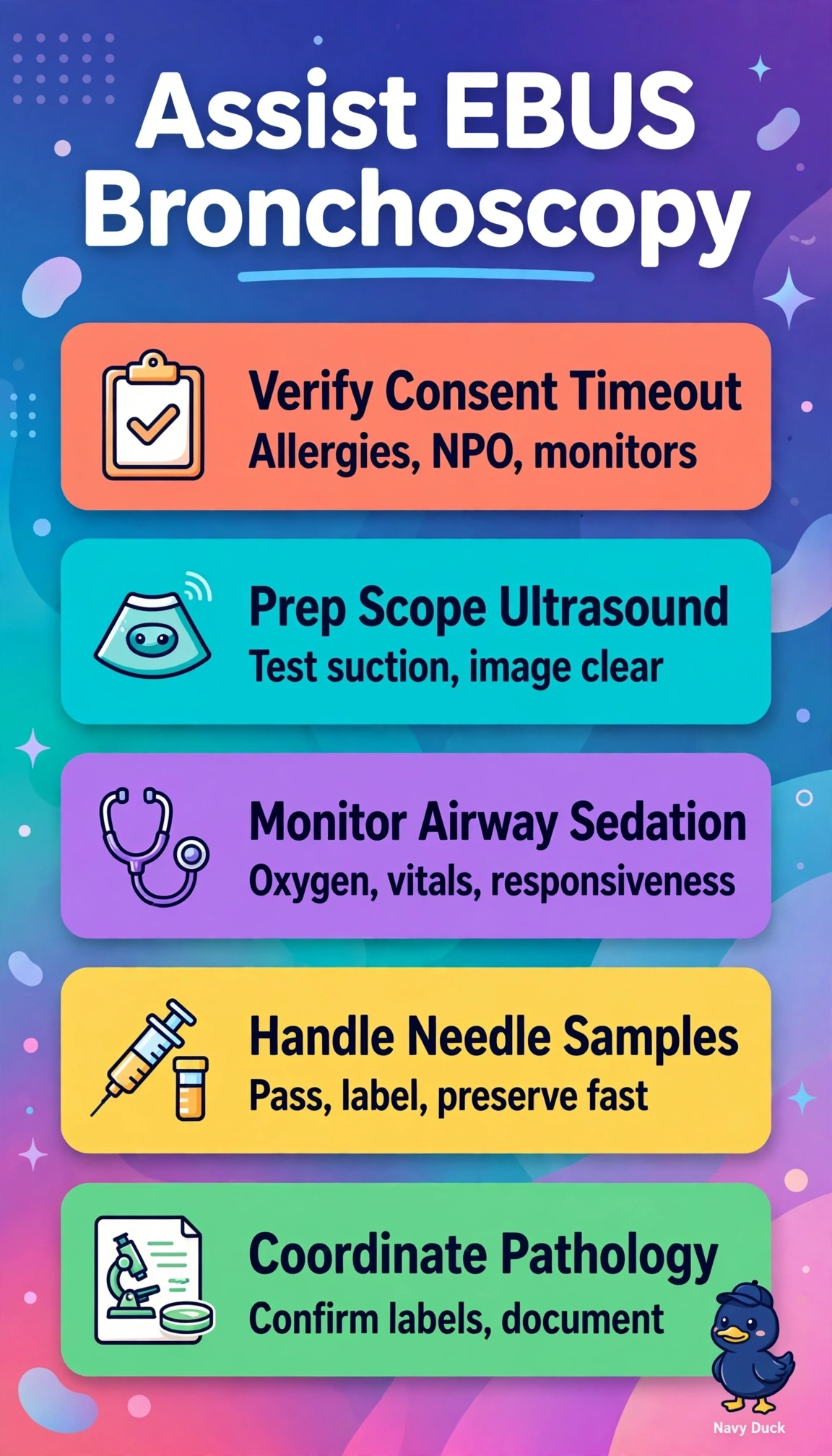
You're the pit crew keeping airway, image, and samples moving smoothly. Great assisting is like stage managing a live show — gear ready, cues sharp, and your readiness prevents delays and harm.
Full Explanation
The correct response succeeds because it bundles real-time EBUS visualization, tested suction, topical anesthesia, continuous airway and moderate sedation surveillance, and a prepared needle sampling kit with coordinated rapid onsite evaluation, matching the hilar mass target, procedure suite setting, and need for multiple passes. The general anesthesia with ventilator support response reflects standard operative care for unstable airways yet fails on sedation concept for this scenario, as it replaces the ordered topical anesthesia plus moderate sedation monitoring with deeper anesthesia and different recovery expectations. The deferred ultrasound setup response reflects familiar sequential inspection workflows yet fails on imaging immediacy, since postponing ultrasound prevents real-time localization of the right hilar lesion, increases blind passes, prolongs sedation, and undermines yield. The lavage with routine laboratory submission response reflects sound evaluation of diffuse processes yet fails on sampling concept, as it substitutes bronchoalveolar lavage for the required multiple needle passes with adequacy assessment during rapid onsite evaluation. Exam caveat is that stems listing four linked requirements demand preservation of all four, so any otherwise strong workflow missing one element is incorrect. Practical check is to confirm before insertion that scope function and ultrasound image, suction vacuum, sedation score with capnography and oximetry, topical dose, needle number with slides and fixatives, and pathologist communication are ready and verbalized with the team.