
On a step-down unit a 58-year-old with a week-old tracheostomy has thick dried crusting at the stoma, low-volume thick secretions, and a soiled reusable inner cannula with intact skin and stable vitals. Which tracheostomy care and humidification action best maintains a patent airway?
Select an answer to reveal the explanation.
Short Explanation
Crusty and clogged means you clean the path and moisten the air. Fresh inner tubes plus humidity work like clearing a dry straw — patency returns without risky tube changes.
Full Explanation
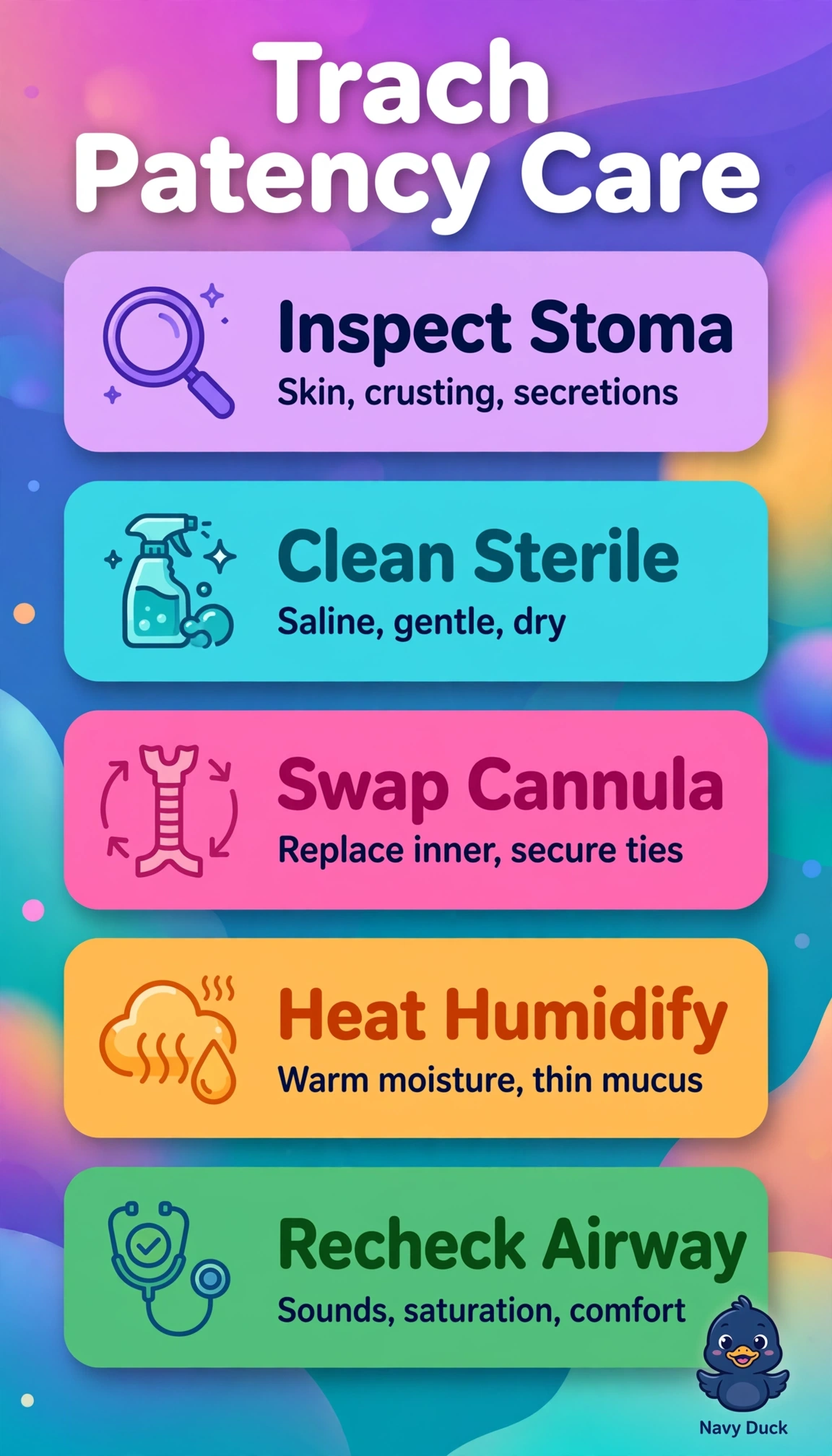
The correct action works because thick dried crusting and a soiled reusable inner cannula together narrow the lumen and promote mucus plugging, so gentle stoma cleaning plus removing and replacing the inner cannula directly restores patency, while adding heated humidification compensates for bypassed upper-airway warming and moistening to thin low-volume thick secretions and deter further crusting. Irrigating the soiled cannula in place while adding heated humidity fails on device patency because in-situ rinsing leaves adherent biofilm and dried debris within the reusable lumen and does not reliably restore full caliber despite appropriate stoma care and humidification. Using only passive humidity with a heat-moisture exchanger after cleaning and exchanging the cannula fails on humidification intensity because passive exchangers require adequate tidal volume and exhaled moisture and are insufficient to rehydrate already thick, scant secretions and established crusting compared with active heated gas. Exchanging the entire outer tube while adding heated humidity fails on indication versus risk because a week-old stoma with intact skin, stable vitals, and no tube dysfunction provides no reason for full outer-tube replacement, which so early and on a step-down unit risks tract disruption, false passage, and bleeding. Exam caveat is to match the intervention to the secretion description, since thick low-volume crusting signals need for active heated hydration rather than any humidification label. Practical check is to confirm easy suction-catheter passage, unlabored breathing, proper flange tension, and softening crusts with more mobilizable secretions after heated humidity is established.