
You arrive by ambulance to a rural home where a school-age child with asthma has severe wheeze, accessory-muscle use, and SpO2 89% on room air, and the parent reports a depleted albuterol inhaler and a long driveway blocking quick hospital return. Oxygen and a transport nebulizer are available. Which out-of-hospital judgment best stabilizes the child for transport and emergency response?
Select an answer to reveal the explanation.
Short Explanation
You're buying lung opening before bumpy miles, not racing while tight. Field care is like clearing a blocked road before driving it, and your sequence of treat then transport protects the airway.
Full Explanation
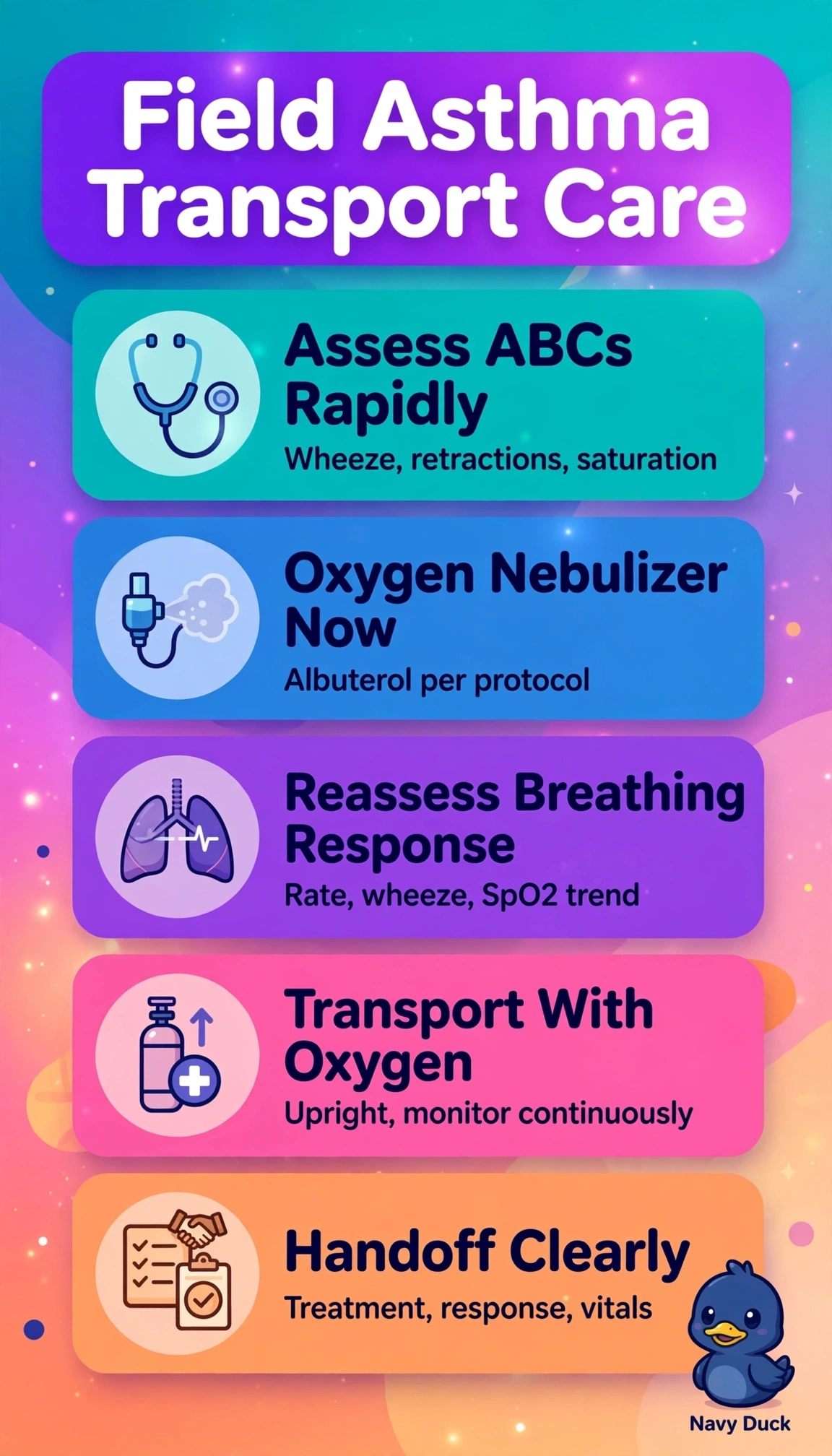
The correct judgment succeeds because severe pediatric asthma with accessory-muscle use and SpO2 89% on room air combines bronchospasm with significant hypoxemia, and a depleted inhaler plus a long driveway with available field equipment make on-scene oxygen-driven nebulized albuterol with reassessment followed by monitored oxygenated transport the stabilizing bridge to emergency care. Deferring nebulized albuterol until hospital arrival while providing only oxygen and monitoring fails by bronchodilation concept because oxygen improves saturation but does not reverse airway smooth-muscle constriction, so work of breathing and air trapping persist and worsen during prolonged rural transport. Leaving the child at home after initial treatment fails by disposition and risk-stratification concept because transient improvement does not resolve a severe exacerbation, rebound fatigue and deterioration are common in children, and severe signs plus delayed access mandate movement toward higher care. Using air-driven nebulization without supplemental oxygen fails by oxygenation concept because aerosol delivery while still hypoxemic at 89% leaves tissue hypoxia uncorrected during treatment and increases stress from heightened work of breathing. An exam caveat is that partial improvement after albuterol tempts selection of observation or oxygen alone, but stems emphasizing severe retractions, low saturation, depleted rescue medication, and delayed return cue combined bronchodilator plus oxygen plus reassessment plus transport. A practical check is to repeat SpO2, respiratory rate, retractions, air entry, speech ability, and mental status after the neb, confirm oxygen supply and pulse oximetry for the ride, keep the child upright with a parent present, and report response and ETA to the receiving team.