
A 63-year-old with a 35 pack-year history reports daily productive cough for the last three winters, exertional dyspnea, and repeated bronchitis, with no known asthma and normal alpha-1 testing pending, and post-bronchodilator spirometry scheduled today. Which diagnostic evaluation best confirms a new diagnosis of chronic lung disease?
Select an answer to reveal the explanation.
Short Explanation
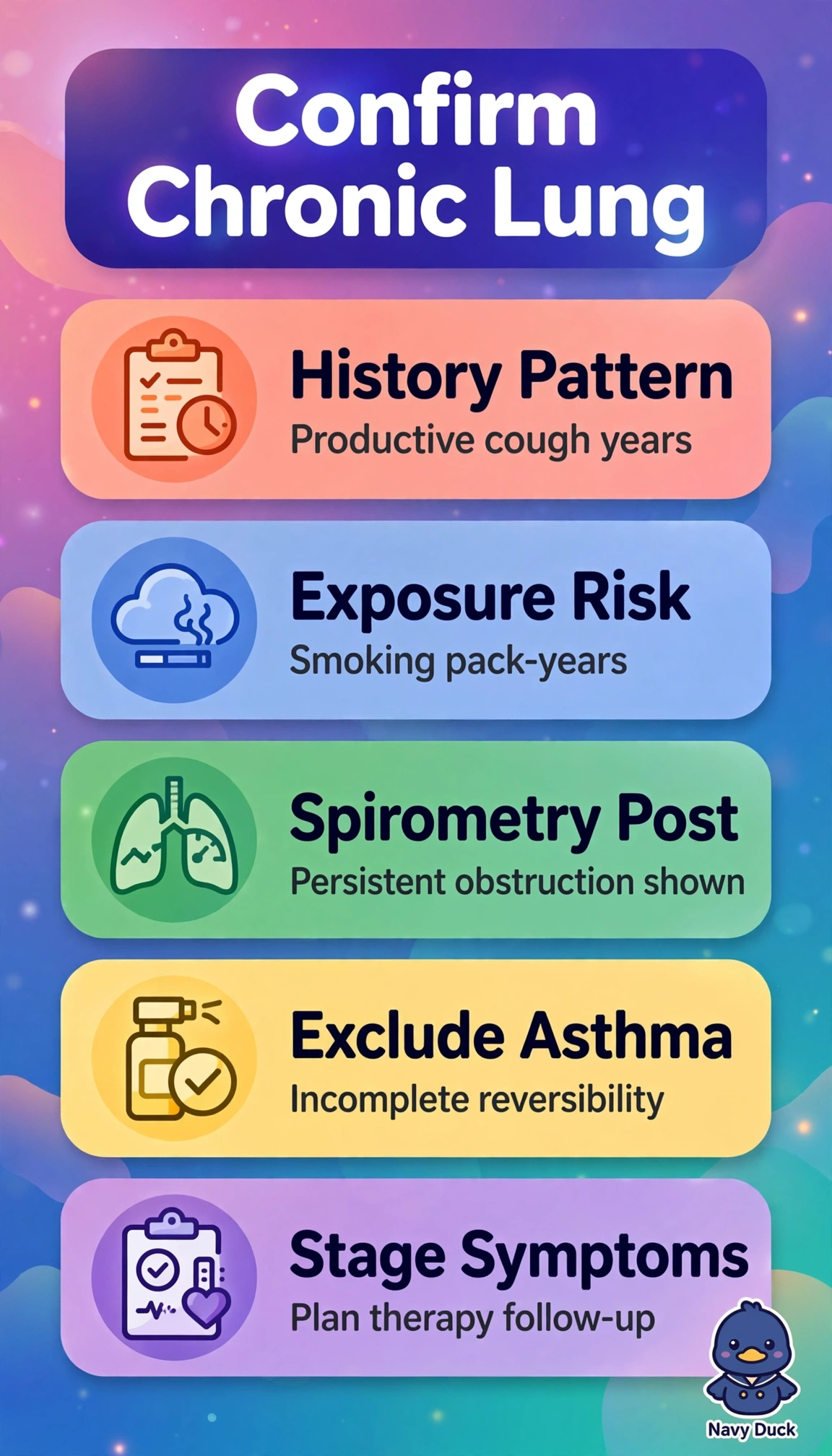
You have a classic story that calls for proof. Pairing the chronic cough history with post-bronchodilator spirometry gives you confirmation before diagnosing COPD.
Full Explanation
The COPD evaluation is supported by daily productive cough for at least two consecutive years, exertional dyspnea, and a heavy smoking history together with persistent airflow obstruction on adequate post-bronchodilator spirometry. This combines the clinical history with physiologic evidence rather than relying on symptoms alone. Fully reversible obstruction points conceptually toward asthma, not COPD, which requires persistent obstruction after bronchodilator; smoking and dyspnea can overlap, but the patient has no known asthma. Pending alpha-1 testing cannot confirm deficiency-related emphysema today: testing is indicated in COPD, but the genetic cause remains unproven until results are available. High-resolution CT airway changes may explain productive cough and repeated bronchitis, but they do not establish the persistent airflow limitation needed to confirm COPD. An exam caveat is that cough history, pre-bronchodilator limitation, oximetry, or imaging alone does not confirm COPD; the key finding is a reduced post-bronchodilator FEV1/FVC with clinical correlation. A practical check is to verify spirometry effort and repeatability, document smoking burden and symptom timeline, confirm bronchodilator withholding and safety, and follow up alpha-1 results alongside cessation, vaccination, and action planning.