
A 62-year-old ICU patient with a known difficult airway needs exchange of a damaged 7.5 endotracheal tube but must maintain continuous airway access and oxygenation. The team has a video laryngoscope, bougie, and airway exchange catheter available. Which adjunct technique best facilitates safe endotracheal tube exchange in a difficult airway?
Select an answer to reveal the explanation.
Short Explanation
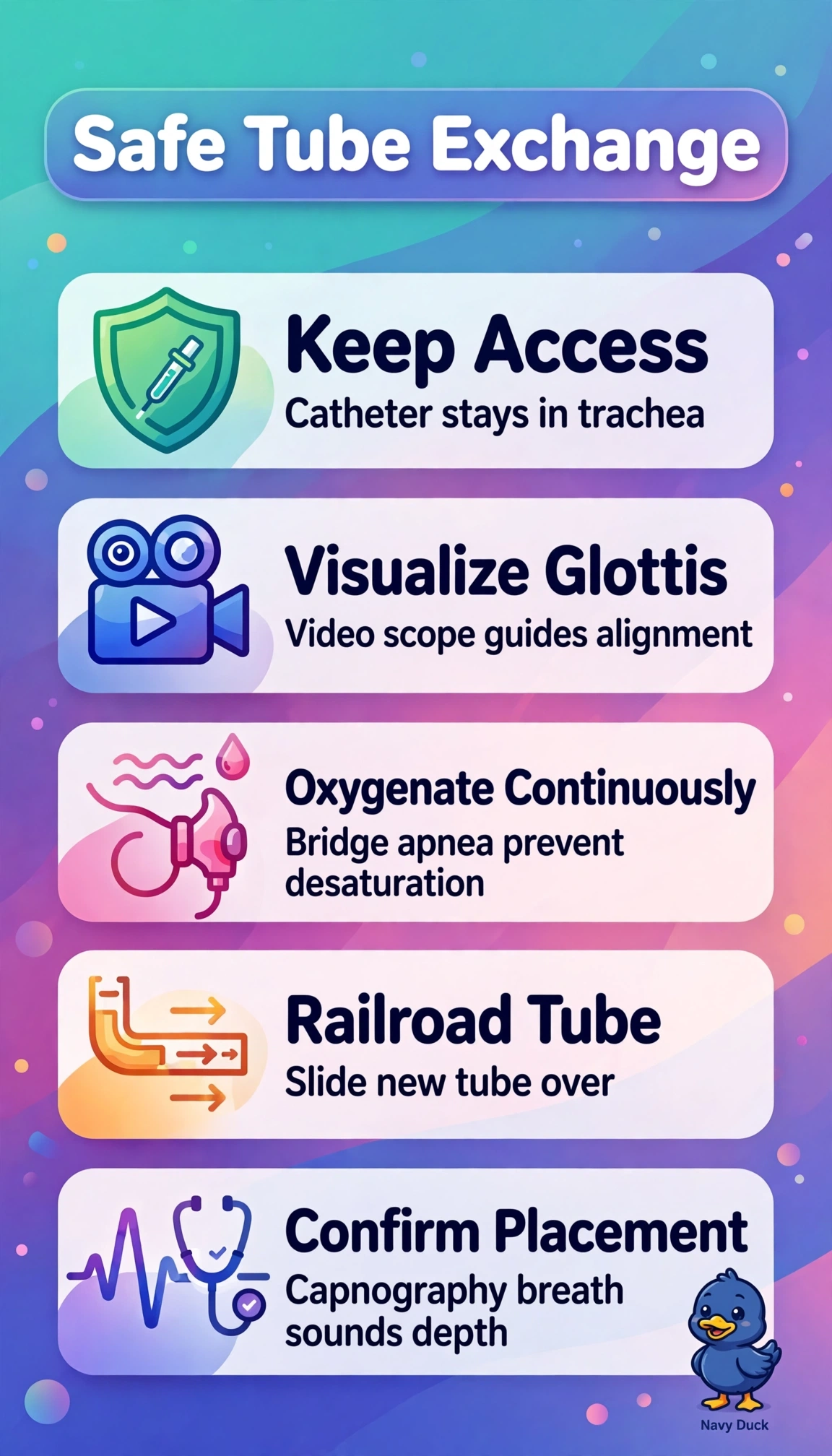
You keep continuous airway access by passing an oxygenating exchange catheter through the old tube under laryngoscopic view. That lets you maintain oxygenation and guide the new tube while watching its passage.
Full Explanation
Passing an airway exchange catheter through the old tube under laryngoscopic view preserves the key safety measures: the hollow catheter maintains tracheal access as a rail, its lumen permits oxygen insufflation during the vulnerable apneic period, and visualization helps confirm position and avoid trauma or misplacement. A gum elastic bougie placed through the old tube can guide the new tube, but it is solid and cannot deliver oxygen, leaving a high-risk patient vulnerable to rapid desaturation. Removing the damaged tube before inserting an exchange catheter briefly gives up tracheal access; if reintubation then fails, access may be lost entirely. Blindly railroading a new tube over an oxygenating catheter lacks visualization in distorted anatomy, risking arytenoid catching, catheter displacement, excessive depth, or barotrauma. Remember that a bougie and an exchange catheter are not interchangeable: the bougie aids initial intubation, while the longer, hollow, depth-marked catheter is designed for oxygenation and tube exchange. At the bedside, note catheter depth at the teeth, do not advance beyond 26 cm or against resistance, check oxygen ports and capnography, and have suction and difficult-airway backup ready. Confirm new-tube position with end-tidal CO2 and direct view before removing the catheter.