
A 54-year-old intubated patient in a busy emergency department needs topical anesthesia before fiberoptic bronchoscopy through the endotracheal tube, with copious secretions cleared, preoxygenation completed, and monitoring in place. Which endotracheal instillation technique best delivers medication while preserving oxygenation and sterility?
Select an answer to reveal the explanation.
Short Explanation
You're threading precision through a narrow tube, so sterile and past-the-tip matters. That sterility step works like using clean gloves for contacts — it keeps bugs out while medicine lands right.
Full Explanation
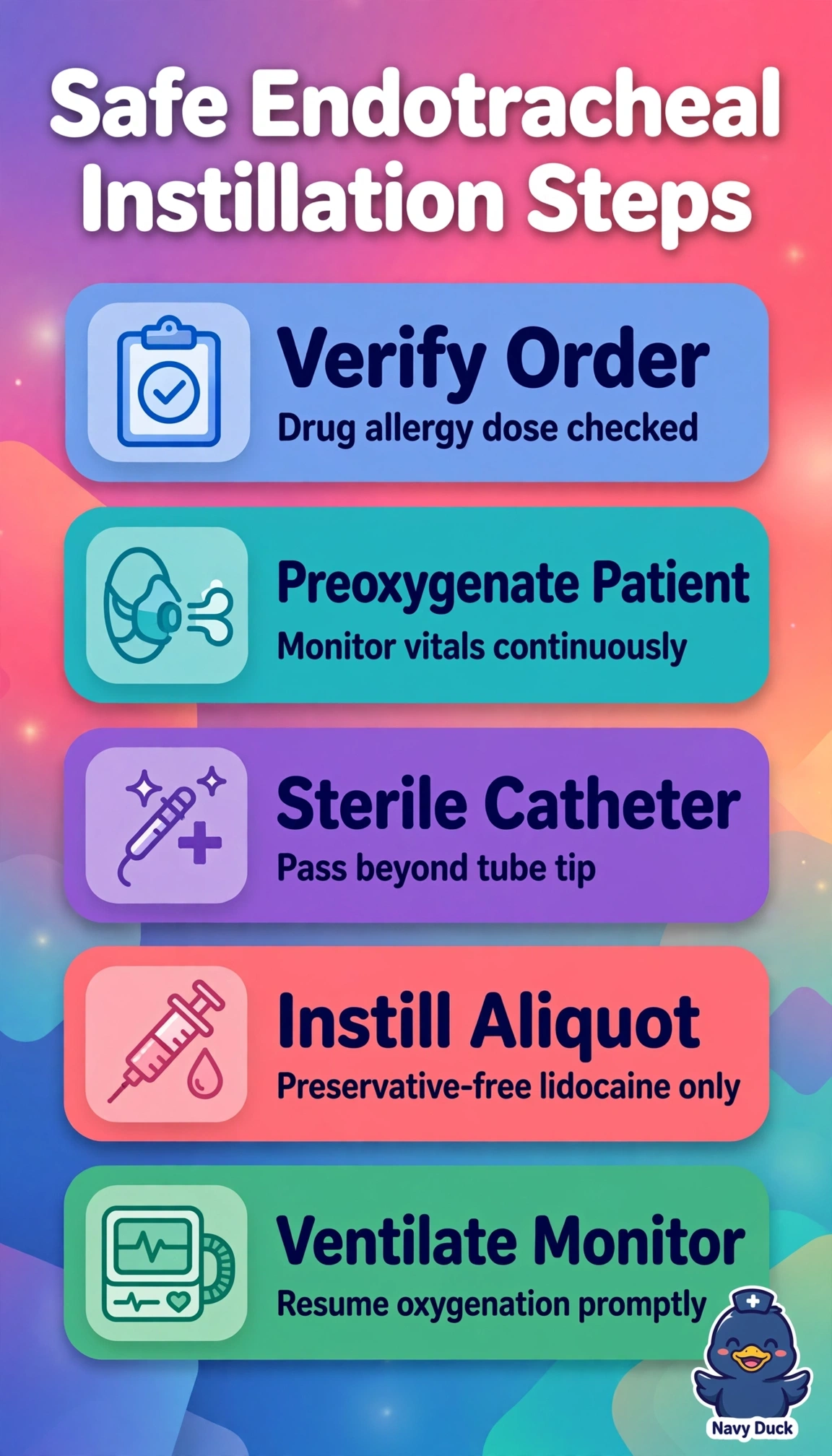
The correct technique balances effective topical anesthesia with preserved oxygenation and asepsis during fiberoptic bronchoscopy through an endotracheal tube, as preservative-free lidocaine provides mucosal anesthesia without additive-related irritation, a sterile catheter advanced past the tube tip deposits drug directly onto tracheal mucosa rather than leaving it in the tube lumen, and brief hyperoxygenation with continuous monitoring compensates for interrupted ventilation and suction-related desaturation. The preserved formulation fails by pharmacologic concept because parabens and other additives suitable for infiltration can irritate lower airway mucosa, provoke bronchospasm or hypersensitivity, and are discouraged for endobronchial use even when dose and delivery are otherwise appropriate. The connector-level delivery fails by distribution concept because instillation proximal to the tube coats plastic and secretions without reaching cough receptors below the carina, producing inadequate anesthesia, persistent coughing, and difficult scope passage despite correct drug, sterility, and oxygenation. The routine ventilation approach fails by physiologic concept because catheter insertion, fluid instillation, and bronchoscope occupancy narrow the airway and interrupt gas exchange, so without transient hyperoxygenation a busy emergency patient with limited reserve rapidly desaturates. An exam caveat is that completed preoxygenation does not replace periprocedural oxygen augmentation, and stems often test continuation of hyperoxygenation and monitoring during instillation itself. A practical check is to verify preservative-free labeling, sterile single-use catheter integrity, ventilator FiO2 transiently at 100 percent, dose calculated by weight within toxicity limits, and pulse oximetry, ventilation, and resuscitation equipment confirmed before instillation.