
A 62-year-old is on day 3 of ventilation for pneumonia in a 12-bed ICU, now on pressure support 5 with PEEP 5 and FiO2 0.40 for 30 minutes. Rate 22, tidal volume 480 mL, RSBI 46, SpO2 94%, hemodynamically stable, and continuous apnea monitoring shows no central apnea alarms. Which SBT outcome interpretation best integrates apnea monitoring and apnea test readiness?
Select an answer to reveal the explanation.
Short Explanation
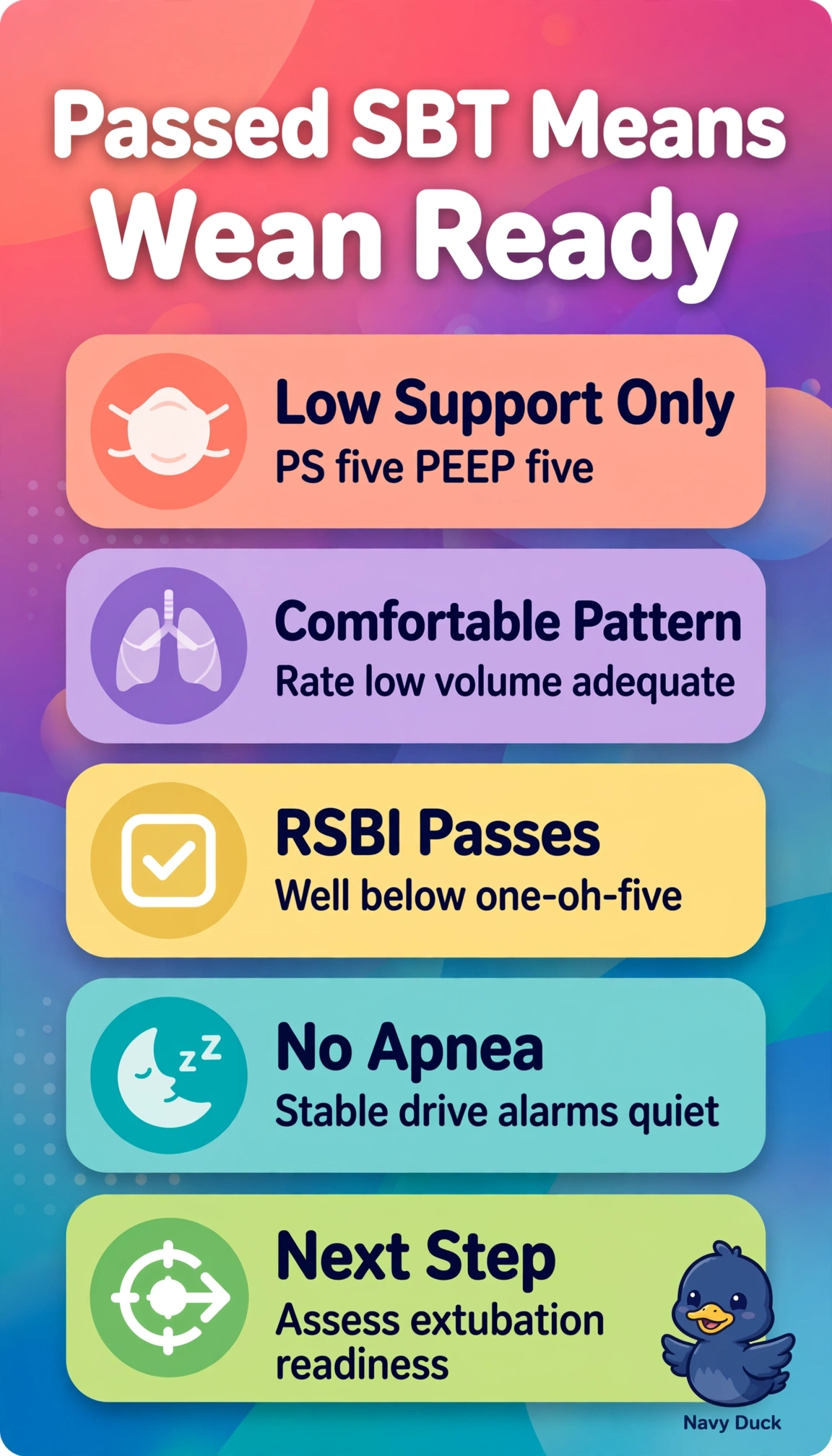
You’ve read the weaning signs well: stable vitals and a low RSBI support a passed SBT. Your readiness call is the next step—a formal assessment before extubation, not an automatic clearance to remove the tube.
Full Explanation
The SBT is appropriately documented as passed with stable central drive: the patient tolerated 30 minutes on minimal support (pressure support 5, PEEP 5, FiO2 0.40), with respiratory rate 22, tidal volume 480 mL, RSBI 46, SpO2 94%, hemodynamic stability, and no central apnea alarms on continuous monitoring. A passed SBT shows tolerance of reduced support; it does not by itself establish extubation readiness. The appropriate next step is a weaning readiness assessment that considers mentation, cough strength, secretion burden and volume, airway patency, and airway protection after pneumonia. Recommending extubation now based only on favorable RSBI and oxygenation mistakes ventilatory tolerance for complete airway readiness. Recommending continued ventilation until FiO2 is below 0.40 applies an unnecessarily restrictive threshold: FiO2 0.40 with SpO2 94% meets usual readiness cutoffs, and prolonging ventilation can cause harm without benefit. Calling the SBT inconclusive despite stable vitals overlooks that brief low-level pressure support with PEEP is an accepted SBT method; zero support is not required for a valid trial. For examinations, no central apnea alarms supports stable drive during weaning, but does not substitute for brain-death apnea testing or guarantee post-extubation airway competence. At the bedside, confirm effective cough, manageable secretions, alertness, and appropriate cuff-leak and airway assessment before proceeding toward extubation.