
A 58-year-old with severe asthma exacerbation is intubated after failing bronchodilators, magnesium and BiPAP with pH 7.18 and PaCO2 78. Peak pressures are high, wheezing is diffuse, and auto-PEEP is 12 cm H2O. Which invasive ventilation strategy best limits dynamic hyperinflation while maintaining safe oxygenation?
Select an answer to reveal the explanation.
Short Explanation
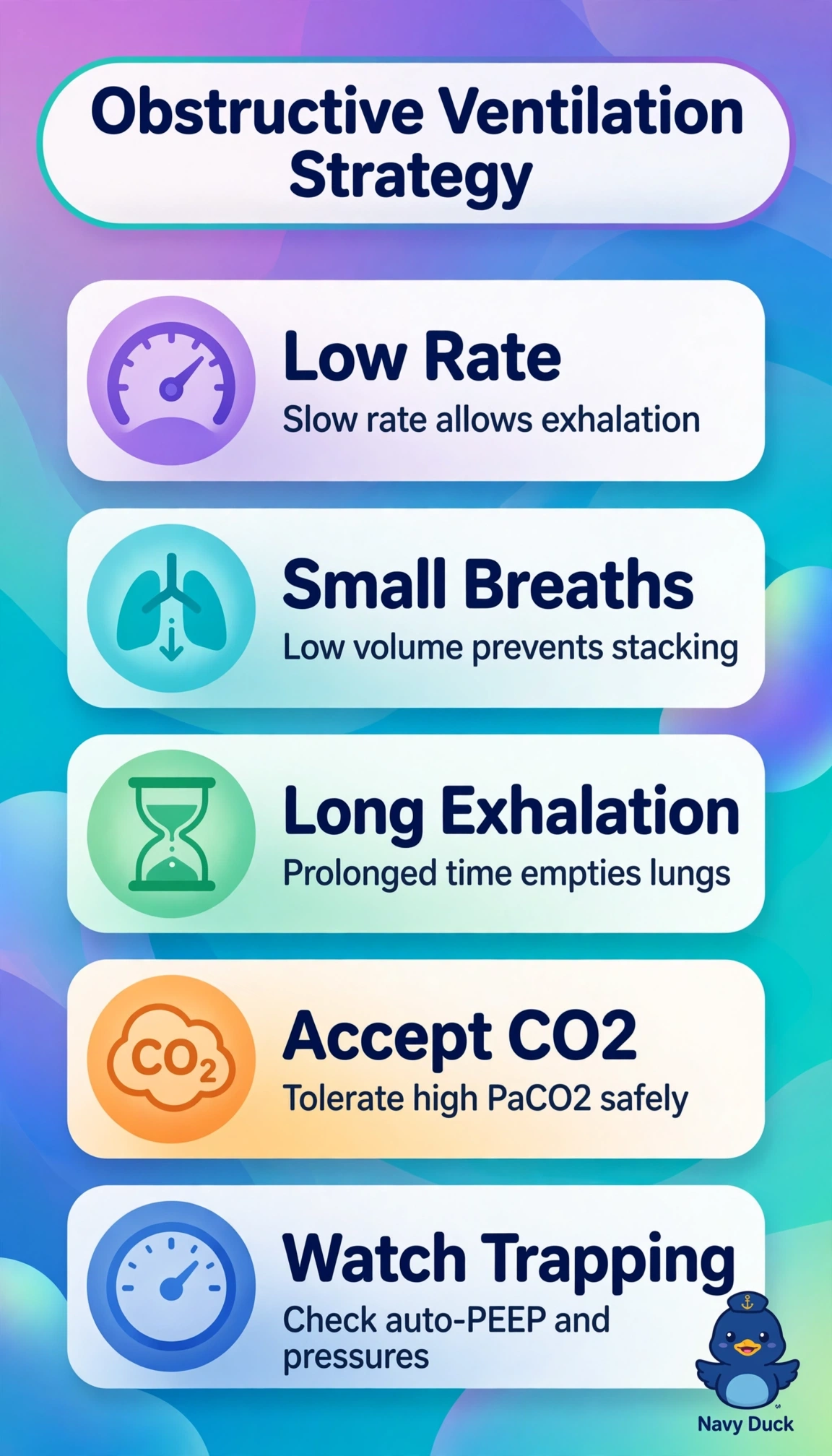
You’re buying time for those tight airways to exhale fully. Permissive hypercapnia lets you accept a higher CO2 to avoid breath stacking and barotrauma in severe obstruction.
Full Explanation
Severe asthma and COPD exacerbations cause expiratory flow limitation, so short expiratory time traps gas, creates auto-PEEP, raises intrathoracic pressure, impairs venous return, and risks barotrauma and hypotension, and controlled hypoventilation with low respiratory rate, low tidal volume around 6 mL/kg predicted body weight, prolonged I:E ratio, minimal applied PEEP, and tolerance of elevated PaCO2 corrects the mechanism by maximizing emptying time. Using high tidal volume with fast rate to normalize CO2 worsens trapping and is the opposite physiologic approach despite sounding corrective. Using high PEEP with rapid rate to recruit airways applies ARDS logic to obstructive disease where added PEEP increases hyperinflation unless carefully titrated to offset triggering. Using pressure support with high sensitivity leaves control with a dyspneic patient and promotes tachypnea and stacking rather than guaranteed rest. Exam caveat is to distinguish obstructive hyperinflation strategy from ARDS lung-protective PEEP/FiO2 tables, and practical check is to watch flow waveform reaching zero before next breath and monitor plateau pressure, auto-PEEP, and blood pressure after each change.