
A 66-year-old with severe COPD is ready for discharge after an exacerbation, still dyspneic on exertion, on inhalers with poor technique, smoking, and anxious about home management. Which outpatient discharge and rehabilitation plan best supports long-term chronic lung disease management?
Select an answer to reveal the explanation.
Short Explanation
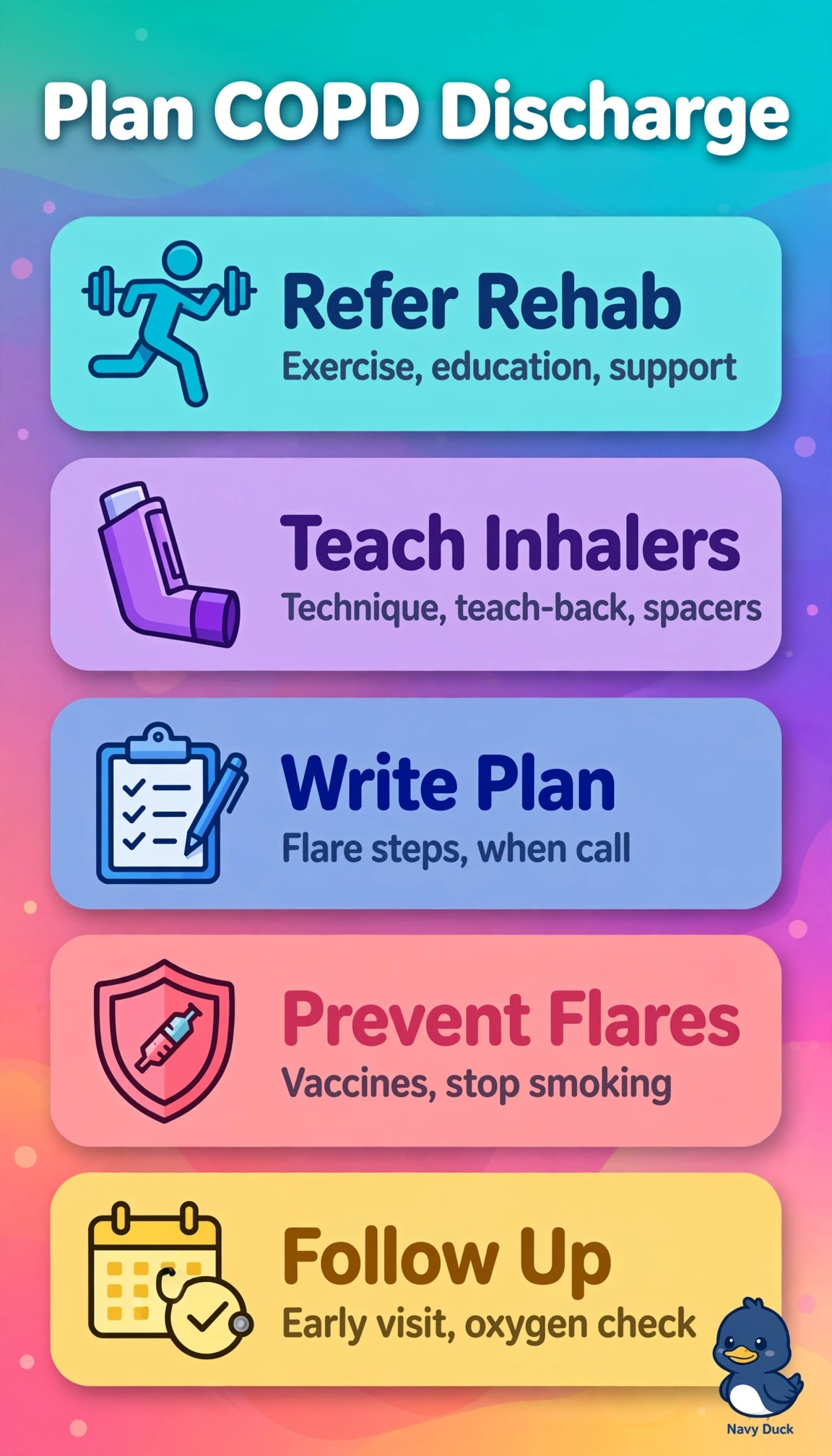
You're building a safety net that keeps them out of the hospital. Rehab plus skills turns self-management into daily confidence rather than fear of the next flare.
Full Explanation
The comprehensive discharge plan is preferred because severe COPD after exacerbation requires simultaneous attention to exertional dyspnea and deconditioning, poor inhaler technique, ongoing smoking, exacerbation risk, and anxiety about self-management, and supervised pulmonary rehabilitation combined with hands-on inhaler education, a personalized written exacerbation action plan, indicated respiratory vaccines, and structured cessation counseling together improves exercise capacity, drug delivery, self-efficacy, prevention, and disease progression. A program offering supervised exercise, vaccines, cessation support and an action plan but omitting systematic inhaler retraining fails on drug delivery because poor technique leaves otherwise optimal therapy ineffective and exacerbation risk unchanged despite fitness gains. Community nursing with inhaler training, action plan, vaccines and cessation support but without formal pulmonary rehabilitation fails on functional restoration because intermittent home visits cannot replicate progressive exercise prescription, dyspnea desensitization, and anxiety reduction that benefit a still-dyspneic patient. Rehabilitation with inhaler training, action plan, exercise and cessation support but without reviewing indicated vaccines fails on prevention because vaccine-preventable infections remain a leading trigger for readmission and mortality in severe COPD. The exam caveat is to avoid a strong single-domain intervention when the stem cues deficits across technique, function, mood, addiction and prevention that require a bundled answer, and the practical check is to confirm rehabilitation acceptance, perform inhaler teach-back, document vaccine status and quit plan, and provide written thresholds for rescue therapy and seeking care.