
A 58-year-old smoker with 30 pack-years reports progressive exertional dyspnea, chronic productive morning cough for three years, prolonged expiration with wheezes, and two winter bronchitis episodes yearly without prior spirometry. Which evaluation best establishes a new diagnosis of chronic lung disease?
Select an answer to reveal the explanation.
Short Explanation
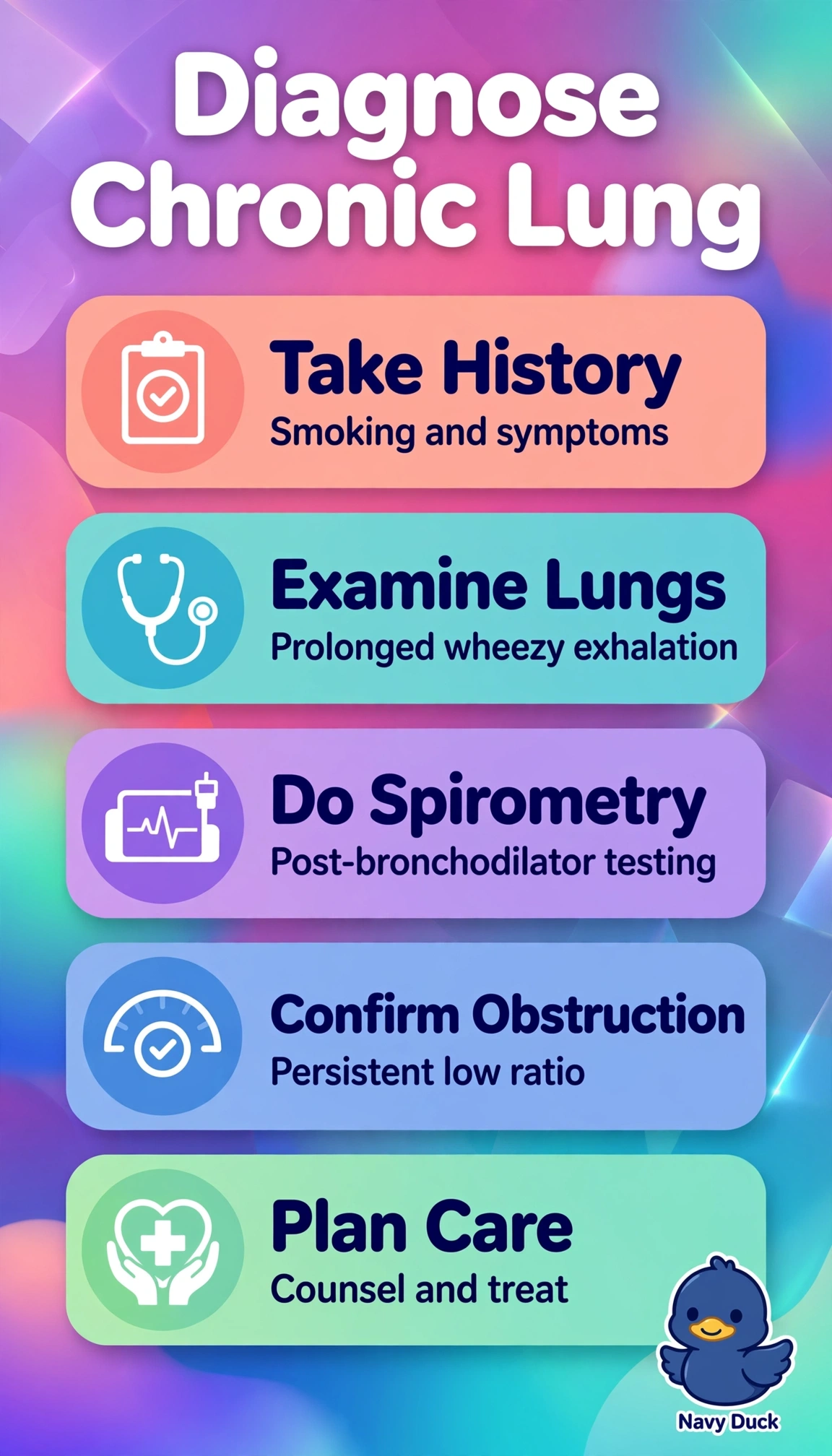
You are proving persistent airflow blockage, not guessing from symptoms. Quality spirometry after bronchodilator gives your obstructive pattern real backbone. History plus numbers seals the diagnosis.
Full Explanation
In a 58-year-old with 30 pack-years, progressive dyspnea, productive morning cough for three years, wheezes with prolonged expiration, and recurrent winter bronchitis without prior spirometry, post-bronchodilator spirometry with clinical correlation and smoking assessment best establishes chronic lung disease by objectively demonstrating persistent airflow limitation with reduced FEV1/FVC, excluding reversible asthma, and linking function to symptoms, exposures, and exacerbation risk for staging and treatment. Pre-bronchodilator spirometry alone fails on reversibility because baseline obstruction can normalize after bronchodilator, so persistent limitation required for COPD cannot be confirmed and asthma overlap cannot be assessed. Chest CT with clinical and smoking review fails on physiology because it characterizes emphysema and alternative pathology but cannot measure obstruction or replace spirometric diagnosis. Serial peak flow tracking fails on variability because it monitors diurnal variation useful for asthma control but cannot quantify FEV1/FVC, bronchodilator response, or COPD severity. An exam caveat is that productive cough for three months in two consecutive years defines chronic bronchitis clinically but does not alone diagnose COPD without obstruction. A practical check is to confirm acceptable repeatable spirometry after bronchodilator, correlate results with dyspnea, pack-years, and oximetry, and arrange cessation, vaccination, and follow-up.