
A 55-year-old with ARDS and echocardiographic right-ventricular strain remains hypoxemic with elevated pulmonary pressures despite lung-protective ventilation, prone positioning, and stable systemic pressure. The team requests an inhaled pulmonary vasodilator trial. Which delivery method should the therapist select to improve ventilation-perfusion matching?
Select an answer to reveal the explanation.
Short Explanation
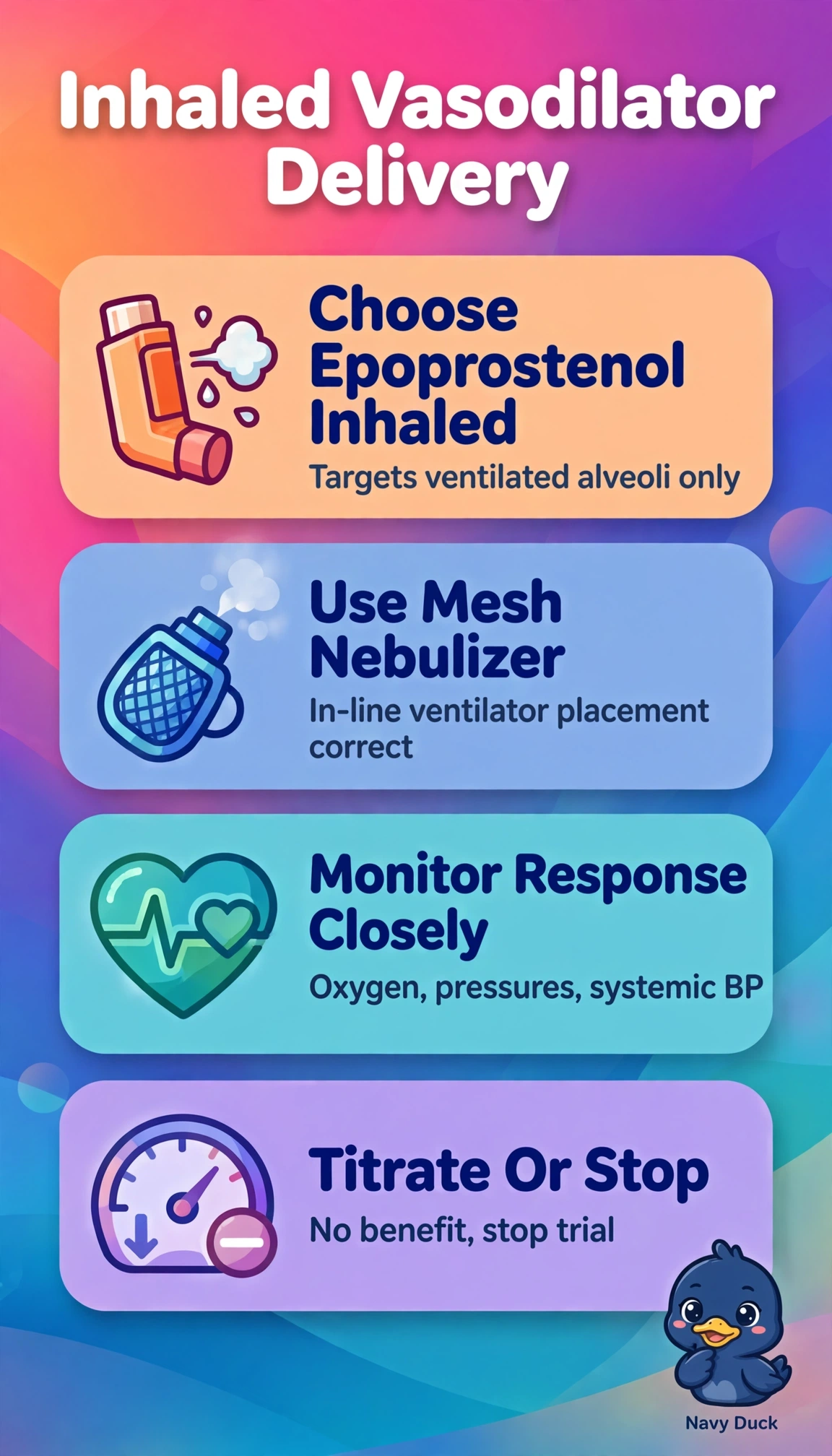
You've already got the lungs open and the patient flipped, so you're sending help right where the air flows like opening extra lanes only where traffic's moving. You'll use continuous vibrating-mesh epoprostenol with close monitoring to boost matching without dropping systemic pressure.
Full Explanation
Correct delivery provides selective vasodilation in ventilated alveoli, improving ventilation-perfusion matching, lowering pulmonary vascular resistance and right ventricular afterload, and raising arterial oxygenation without systemic hypotension, while continuous in-line vibrating-mesh delivery preserves positive end-expiratory pressure and lung recruitment during lung-protective ventilation and prone positioning and monitoring tracks oxygenation and hemodynamics. Continuous intravenous epoprostenol fails by selectivity because systemic distribution dilates ventilated and unventilated vessels and systemic arterioles, worsening shunt and lowering systemic pressure rather than redirecting flow to ventilated units. Intermittent iloprost by jet nebulizer with ventilator disconnection fails by continuity because circuit breaks cause derecruitment and desaturation and episodic dosing cannot maintain steady matching in severe ARDS. In-line aerosolized albuterol fails by drug-target concept because bronchodilation improves airway resistance but provides no meaningful pulmonary vasodilation to reduce pulmonary pressures or unload the strained ventricle. Exam caveat is that familiar pulmonary hypertension or inhaled therapies are incorrect unless they meet all stem conditions of inhaled, selective, continuous, in-line vasodilator delivery that preserves systemic pressure. Practical check is to verify inspiratory-limb placement without disconnection, confirm continuous nebulization, and trend oximetry, arterial gases, pulmonary pressures, echocardiographic function, and systemic pressure for improved oxygenation without hypotension.