
A 55-year-old in the ICU needs an endotracheal tube exchange for a cuff leak with a known anterior airway, full stomach, and SpO2 93% on FiO2 0.60. The team has a video laryngoscope, bougie, and tube exchanger available. Which adjunct strategy should the therapist recommend to use tube exchangers, video laryngoscopes and bougies safely?
Select an answer to reveal the explanation.
Short Explanation
You're facing a risky exchange with low reserves, so you'll want eyes on the cords and oxygen still flowing. Using video plus a hollow exchanger keeps your guide in place, like keeping a spare air hose connected while you swap parts.
Full Explanation
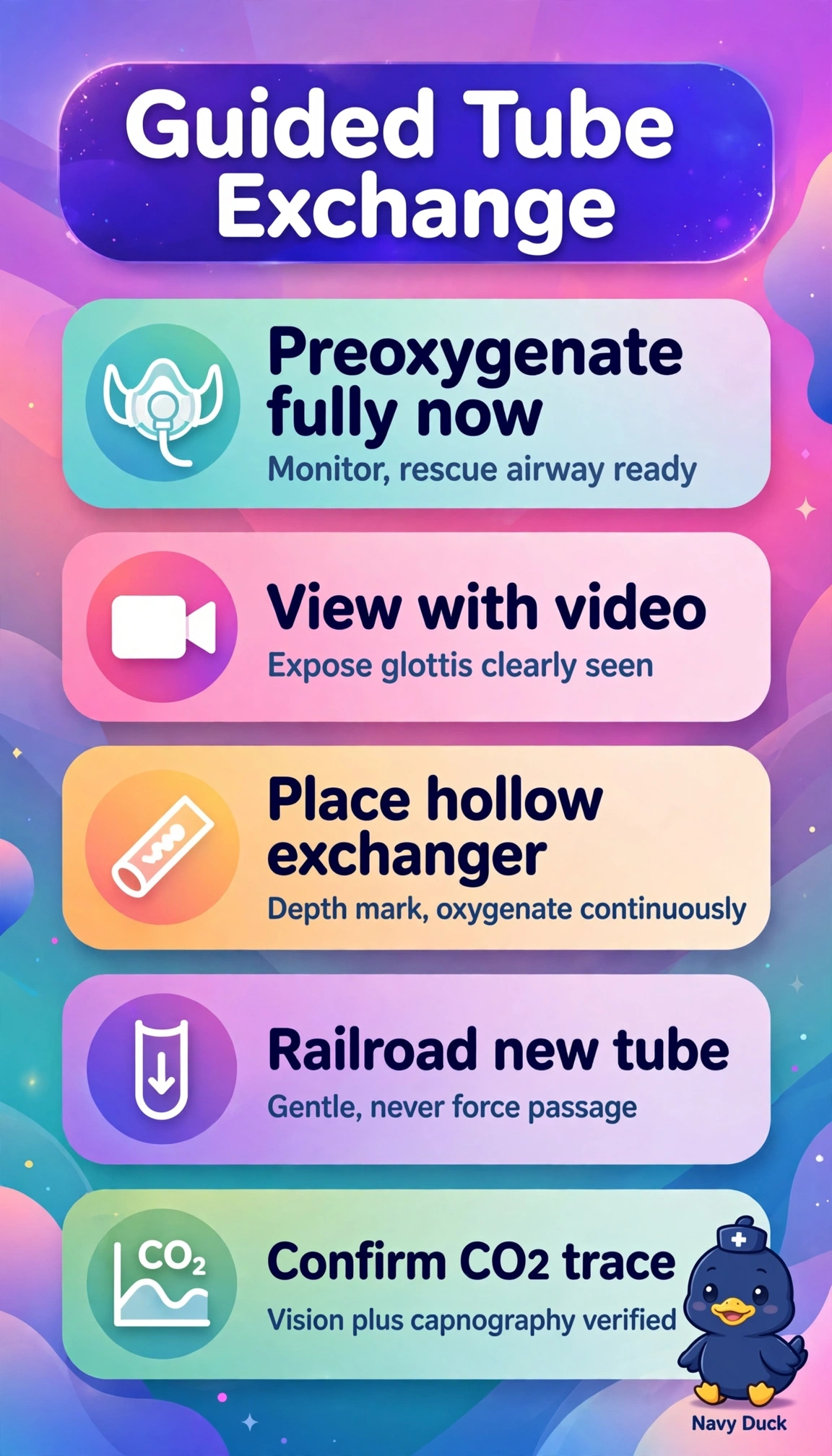
The correct strategy is right because it simultaneously addresses all three risks in this ICU exchange: video laryngoscopy provides continuous glottic visualization for the known anterior airway and allows the operator to watch the exchanger and new tube pass while maintaining aspiration precautions for the full stomach, and a hollow tube exchanger with side ports maintains a patent stent plus a route for insufflation and oxygenation which is essential with SpO2 93% on FiO2 0.60 and a cuff leak that precludes reliable ventilation. The video plus solid bougie approach fails by oxygenation concept because a bougie is a solid introducer without a lumen for oxygen delivery, so despite excellent anterior view and railroading guidance it leaves a hypoxemic patient without apneic oxygenation during the exchange. The direct laryngoscopy plus hollow exchanger approach fails by visualization concept because it preserves oxygenation through the lumen but sacrifices the magnified continuous view needed for an anterior airway, increasing first-pass failure, esophageal placement, and prolonged laryngeal exposure with aspiration risk in a full stomach. The video plus hollow exchanger then removed before railroading approach fails by continuity of control concept because withdrawing the stent before advancing the new tube converts a guided exchange into a blind reintubation, losing depth-mark guidance against distal airway trauma, losing the rescue conduit for reoxygenation and reinsertion, and inviting complete airway loss. An exam caveat is to never equate bougies and exchangers: bougies are solid stylet-like aids for initial intubation while exchangers are longer hollow catheters with centimeter markings and adapters for oxygenation that must not be advanced beyond the safe depth limit or against resistance and must be secured during railroading. A practical bedside check is to preoxygenate, set head-up positioning with suction and capnography ready, confirm exchanger depth by markings and laryngoscopic view without jetting against obstruction, maintain topical oxygen flow within pressure limits, railroad the new cuff-deflated tube over the stabilized exchanger under continuous video view, then confirm placement by visualization, capnography, auscultation and SpO2 before removing the exchanger.