
A 58-year-old with moderate ARDS on 6 mL/kg predicted body weight has PaO2/FiO2 135 on FiO2 0.70 and PEEP 10 cm H2O, plateau 27 cm H2O, and no pneumothorax or hypotension. The team considers recruitment. Which lung-protective ventilation approach best supports oxygenation during ARDS with recruitment precautions?
Select an answer to reveal the explanation.
Short Explanation
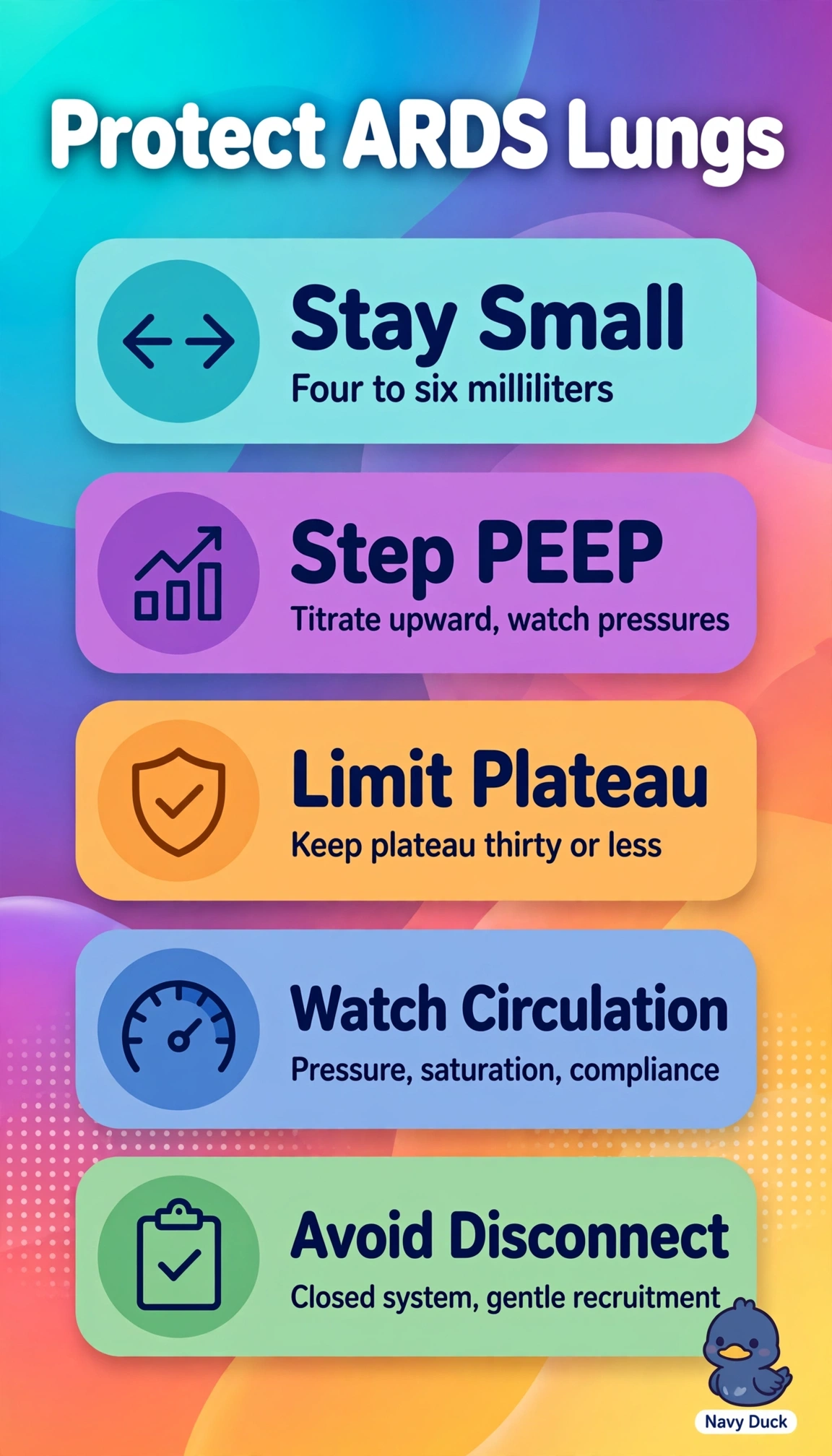
You've got fragile lungs that need gentle opening, not forceful popping. Careful PEEP titration balances recruitment against overdistention and circulation in every step.
Full Explanation
The correct approach aligns with lung-protective ventilation for moderate ARDS where 6 mL/kg predicted body weight prevents volutrauma while stepwise PEEP titration recruits atelectatic alveoli to improve PaO2/FiO2 of 135 on FiO2 0.70, and because plateau is already 27 cm H2O near the 30 cm H2O safety limit and PEEP can reduce venous return, continuous plateau and hemodynamic monitoring makes recruitment safe and reversible, which is reasonable given absence of pneumothorax or hypotension. Raising FiO2 to 1.0 while holding PEEP at 10 cm H2O is standard for simple hypoxemia and avoids barotrauma, but it fails by concept of recruitment versus oxygen supplementation because it leaves shunt and atelectasis untreated and prolongs hyperoxia risk when added PEEP could improve compliance. Raising PEEP stepwise while accepting higher plateau pressures reflects a maximal-recruitment mindset, but it fails by concept of overdistension limits because starting at 27 cm H2O any further rise above 30 cm H2O increases barotrauma and ventilator-induced lung injury despite better aeration on imaging. Increasing tidal volume to 8 mL/kg with PEEP titration and monitoring is common outside ARDS to improve ventilation, but it fails by concept of baby-lung protection because larger strain raises driving and plateau pressures and negates low-volume benefit. Exam caveat is that FiO2-only or higher-volume answers look attractive for hypoxemia but ARDS questions test PEEP with plateau under 30 cm H2O, and practical check is to pause after each PEEP step to record plateau, compliance, SpO2, arterial pressure and vasopressor need and reverse the last step if deterioration occurs.