
A 68-year-old in septic shock has blood pressure 90/60 mm Hg, heart rate 112, central venous pressure 14 mm Hg, and cool mottled extremities despite fluids and norepinephrine. The team asks whether perfusion pressure is adequate. Which hemodynamic evaluation should the therapist provide using cardiopulmonary calculations?
Select an answer to reveal the explanation.
Short Explanation
You turned numbers into perfusion meaning instead of memorizing formulas. MAP near target plus mottling still warns of shock, and perfusion assessment links pressure to tissue signs.
Full Explanation
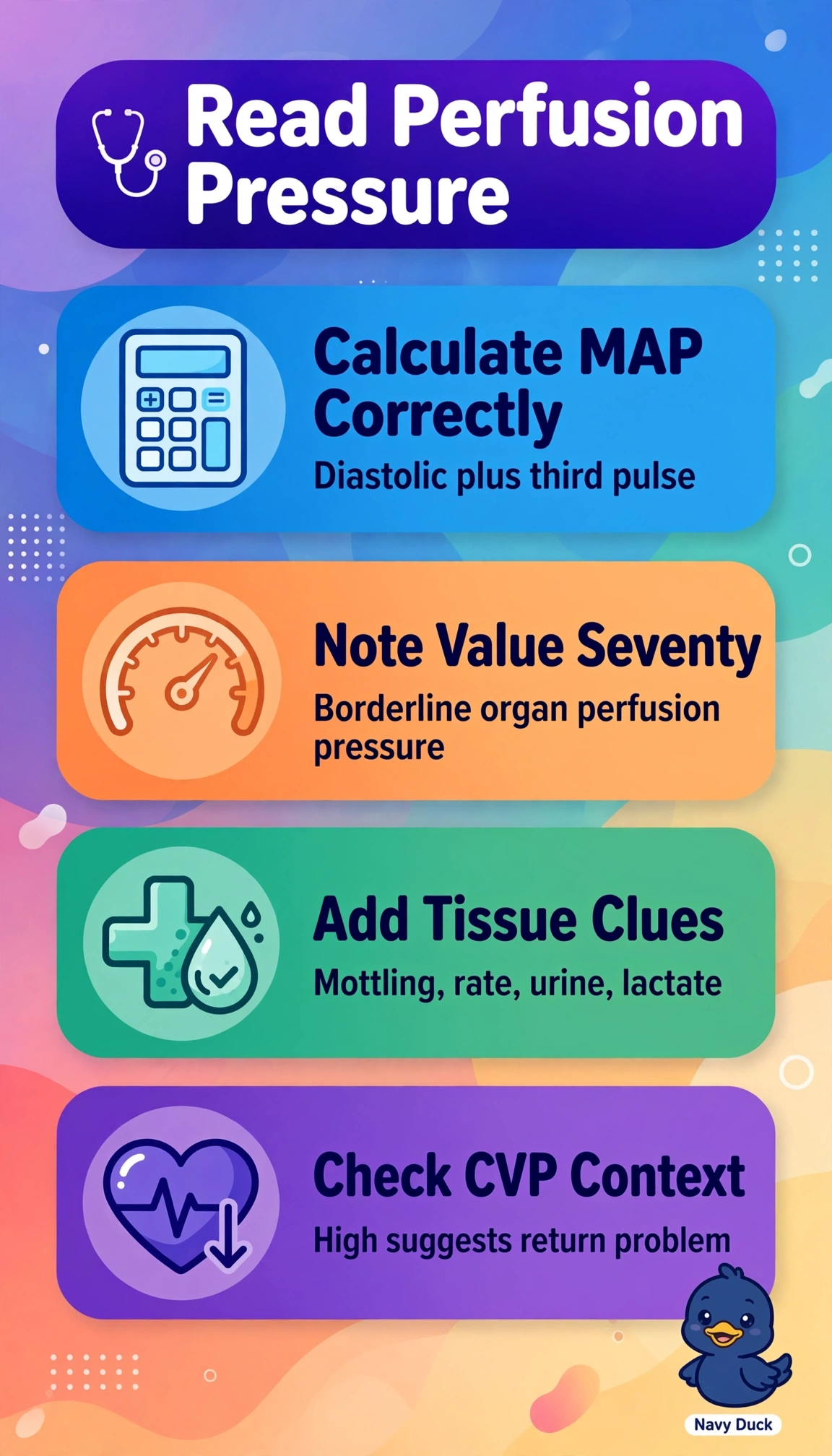
The correct evaluation calculates mean arterial pressure as diastolic plus one-third pulse pressure, yielding approximately 70 mm Hg from 90/60, and crucially integrates persistent cool mottled extremities despite fluids and norepinephrine as evidence of inadequate tissue perfusion pressure rather than relying on the numeric target alone, since septic shock often requires higher individualized goals and assessment of microcirculation. Maintaining norepinephrine simply to hold mean arterial pressure at 70 as sufficient fails by ignoring clinical perfusion, because numeric adequacy does not override ongoing mottling, refractory hypotension, and elevated central venous pressure suggesting impaired organ flow. Tracking pulse pressure near 30 mm Hg for stroke volume trends fails by substituting a volume-responsiveness surrogate for perfusion pressure adequacy, because pulse pressure reflects stroke volume and arterial compliance rather than downstream tissue perfusion. Quantifying cardiac workload with rate-pressure product from heart rate and systolic pressure fails by addressing myocardial oxygen demand during catecholamine support rather than systemic perfusion pressure, because tachycardia and systolic load do not answer whether organs are perfused. Exam caveat is to never select a blood pressure target in isolation when the vignette explicitly provides mottling, high central venous pressure, and refractory hypotension that modify interpretation, and practical check is to recalculate mean arterial pressure at the bedside, reassess skin, urine output, lactate, mentation, and the mean arterial pressure minus central venous pressure gradient while communicating that perfusion remains inadequate despite borderline values.