
In pulmonary clinic a 55-year-old with chronic dyspnea and wheezing has normal chest radiograph and pulse oximetry 96% on room air, and the physician asks respiratory therapy what diagnostic testing to order next. History suggests variable airflow limitation. Which diagnostic recommendation best evaluates airflow limitation and gas exchange for this stable outpatient?
Select an answer to reveal the explanation.
Short Explanation
Start with breathing numbers before invasive probes, and you will see patterns emerge. Targeted spirometry reveals reversible obstruction that history alone cannot prove.
Full Explanation
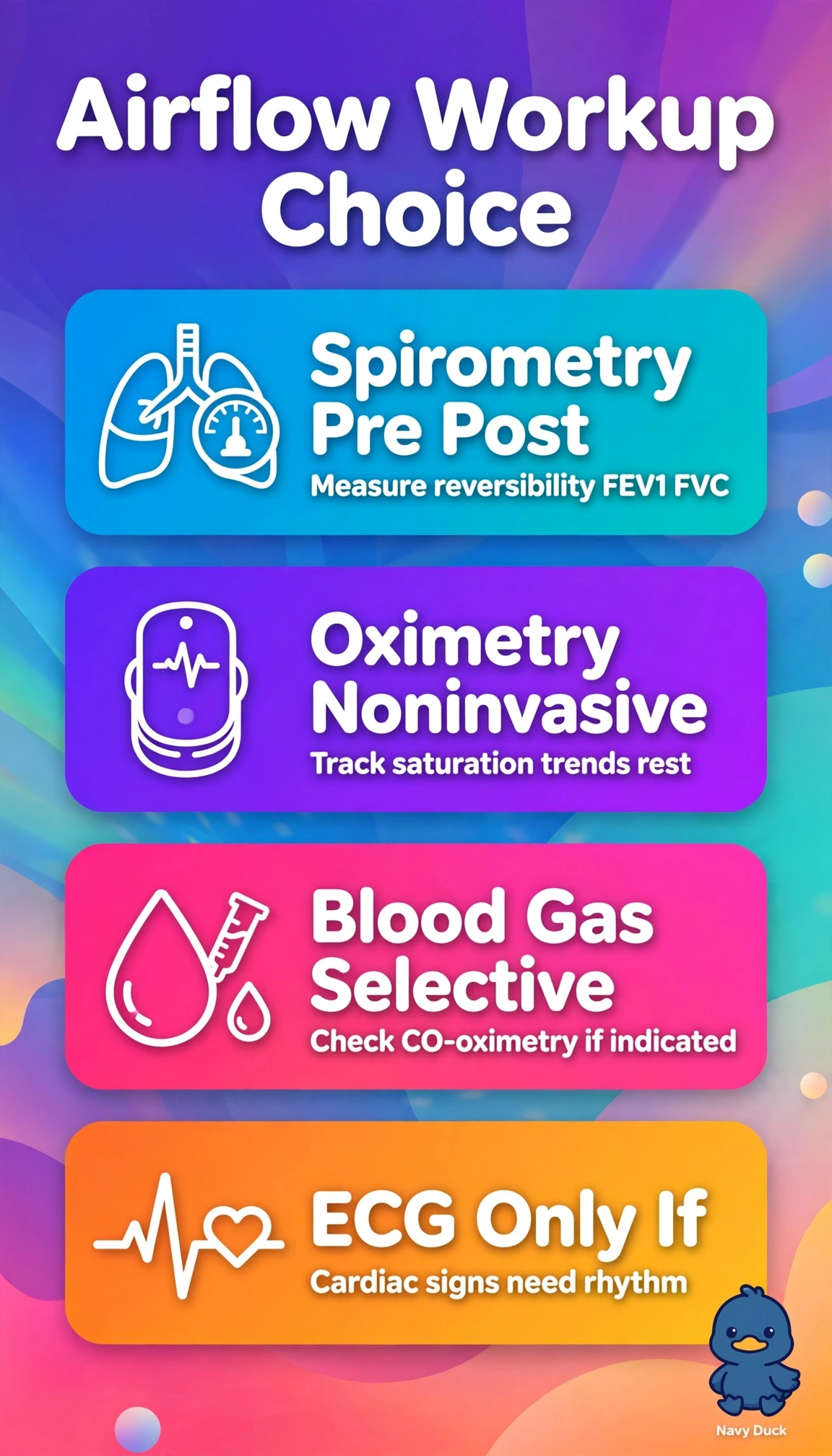
In stable clinic patient with chronic dyspnea and wheeze, normal radiograph and 96% saturation, variable airflow limitation is best evaluated by pre- and post-bronchodilator spirometry demonstrating reversible change in FEV1 and FVC, while ongoing pulse oximetry with arterial blood gas only if indicated appropriately evaluates gas exchange without routine invasive testing in a stable outpatient. Baseline spirometry with oximetry and blood gas lacking reversibility fails because without bronchodilator comparison it documents obstruction at one point but cannot confirm variability or treatment-responsive limitation suggested by history. Pre- and post-bronchodilator spirometry paired only with symptom diary and home peak flows fails because although useful for longitudinal variability, diary and peak flows do not measure oxygenation or ventilatory gas exchange required alongside airflow assessment. Full lung volumes with diffusion capacity plus oximetry and conditional blood gas fails because volumes and DLCO define restriction, hyperinflation and transfer, not reversible expiratory airflow limitation. Exam caveat is that normal chest film and preserved saturation never exclude asthma or COPD and should not prompt chest CT or invasive studies before quality spirometry. Practical check is to verify calibration and effort repeatability, hold bronchodilators per protocol, screen for recent infection or contraindications, and reserve arterial puncture for concerning desaturation, suspected hypercapnia or dyspnea out of proportion.