
A 29-year-old with severe asthma exacerbation is obtunded, hypercapnic, and acidemic despite continuous bronchodilators, magnesium, and steroids, with silent chest and inability to tolerate bilevel. After intubation, peak pressures are high and exhalation is prolonged. Which invasive ventilation strategy best manages intubated status asthmaticus?
Select an answer to reveal the explanation.
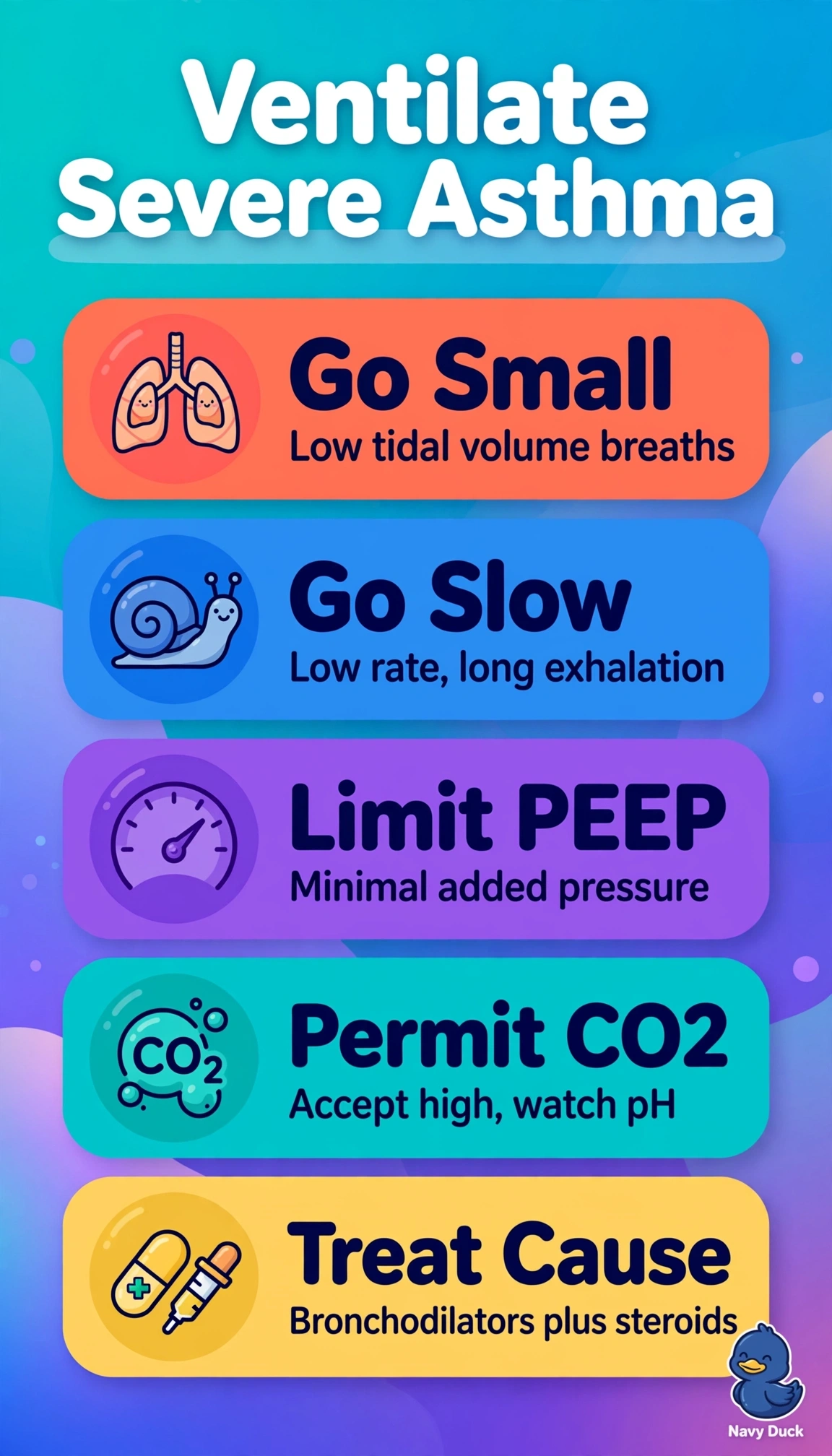
Short Explanation
You're ventilating through a tiny straw, so patience protects the lungs. Slow and small breaths embrace hypercapnia while trapped air finally finds its way out.
Full Explanation
Intubated status asthmaticus is controlled by expiratory limitation and air trapping, so low tidal volume, low rate, prolonged expiration with I:E around 1:4 to 1:5, and permissive hypercapnia maintaining pH generally above 7.15 with close hemodynamic and ventilator monitoring allow complete exhalation, limit auto-PEEP, barotrauma and hypotension from hyperinflation, matching the high peak pressures and prolonged exhalation described. Raising PEEP with recruitment to improve oxygenation is standard for ARDS-related atelectasis and shunt but fails here because added extrinsic PEEP superimposes on intrinsic PEEP, further impairs emptying, raises intrathoracic pressure and pneumothorax risk without treating bronchospasm. Increasing rate to normalize PaCO2 while limiting plateau pressure is appropriate for many acidemic ventilated patients but fails here because shorter expiratory time causes breath stacking and higher auto-PEEP, making normocapnia dangerous. Allowing assisted spontaneous breathing to reduce sedation and preserve muscle strength is useful during weaning but fails in this obtunded acidemic patient with silent chest and bilevel intolerance because active efforts worsen dyssynchrony, work of breathing and hyperinflation. An exam caveat is that normal CO2 does not equal correct ventilation in severe asthma and aggressive correction often signals misunderstanding. A practical check is to follow peak-plateau gradient, confirm expiratory flow returns to zero, monitor intrinsic PEEP, end-tidal CO2 and blood pressure, and disconnect briefly to allow exhalation if profound hypotension develops.