
A 45-year-old requiring urgent intubation in the emergency department has a short thick neck, limited mouth opening of 2 cm, Mallampati class IV view, beard obscuring landmarks, and a history of prior failed intubation. Which difficult airway recognition action best prepares the team before induction?
Select an answer to reveal the explanation.
Short Explanation
You spotted trouble before drugs took away breathing. Calling it early unlocks your backup plan and the right tools. Great airway clinicians predict, they do not chase.
Full Explanation
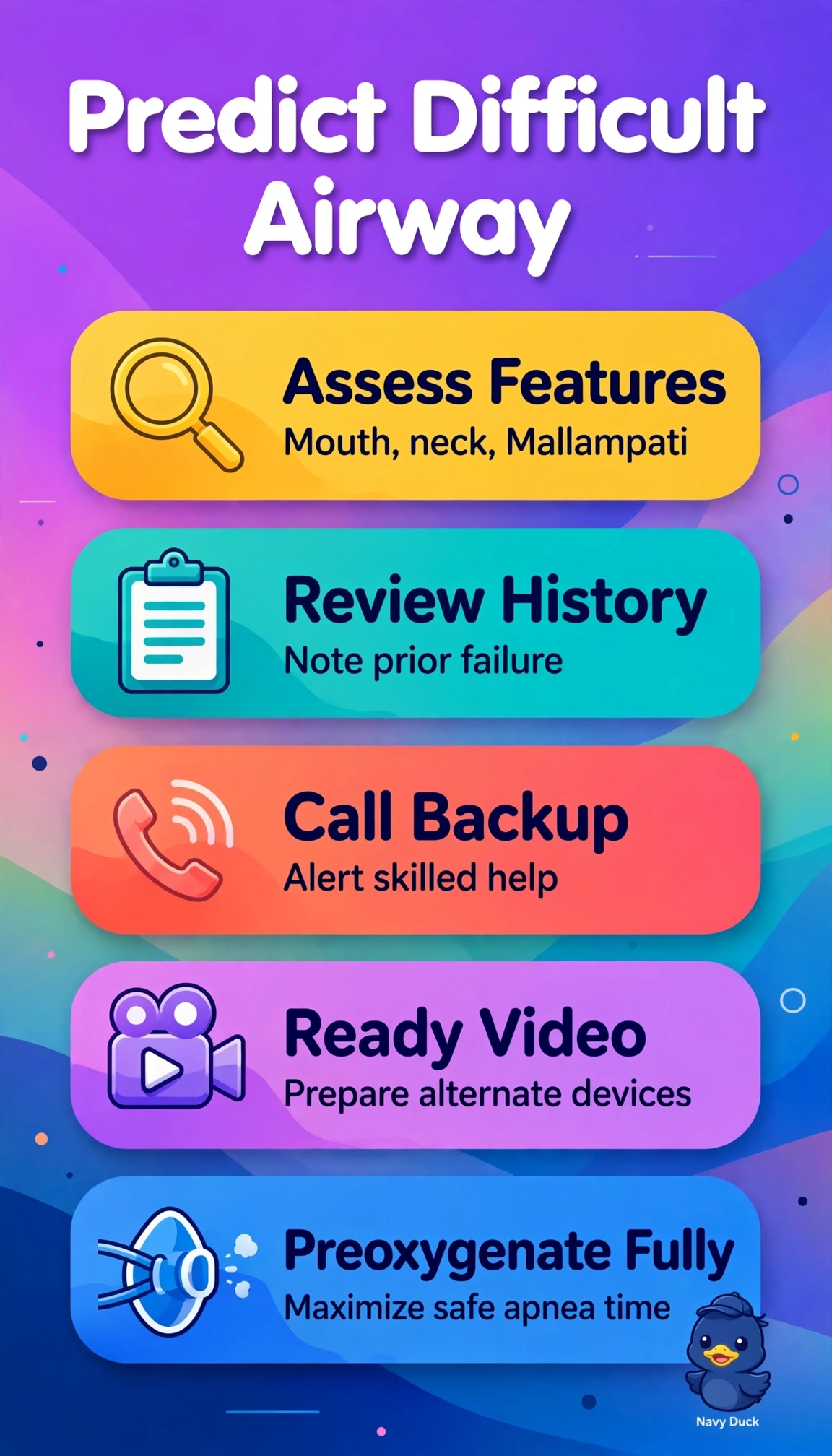
This patient has convergent high-risk predictors including 2-cm mouth opening, Mallampati class IV, short thick neck, beard impairing mask seal and landmarks, and prior failed intubation as the strongest predictor of recurrence, so declaring a predicted difficult airway and preparing video laryngoscopy with backup devices works by creating shared mental modeling plus upgrading both primary visualization and rescue readiness before apnea removes time to gather equipment. Preparing video laryngoscopy with backups and preoxygenation without declaring difficulty fails by communication because excellent equipment without explicit briefing leaves role assignment, thresholds to abort attempts, and cannot-intubate-cannot-oxygenate triggers undefined. Declaring difficulty but using direct laryngoscopy first with backups fails by device selection because direct line-of-sight view is most degraded by limited opening, high Mallampati class, and thick neck, while prior failure argues against repeating the same technique. Declaring difficulty and preparing video laryngoscopy with preoxygenation but no backup fails by rescue readiness because predicted difficulty carries substantial first-attempt failure risk requiring immediate bougie, supraglottic airway, alternative blades, and surgical kit. Exam caveat is urgency heightens rather than excuses preparation, and brief setup is not unsafe delay when apnea risk is high. Practical check is to verbalize predictors, assign operator and assistant, test suction and monitoring, confirm drug doses, lay out primary and backup devices in order, and state stop criteria and help triggers before induction.