
A 60-year-old on volume control ventilation shows peak pressure 38 cm H2O, plateau 28 cm H2O, PEEP 8 cm H2O, with prolonged exhalation and missed trigger efforts. The circuit is unkinked and secretions are minimal. Which measurement sequence should the therapist perform to assess compliance, resistance, plateau pressure and auto-PEEP?
Select an answer to reveal the explanation.
Short Explanation
You’ve got to split the pressure pie to know what’s stiff versus narrow. Pauses let the ventilator whisper the real numbers. Partitioning pressures reveals lungs versus airways in seconds.
Full Explanation
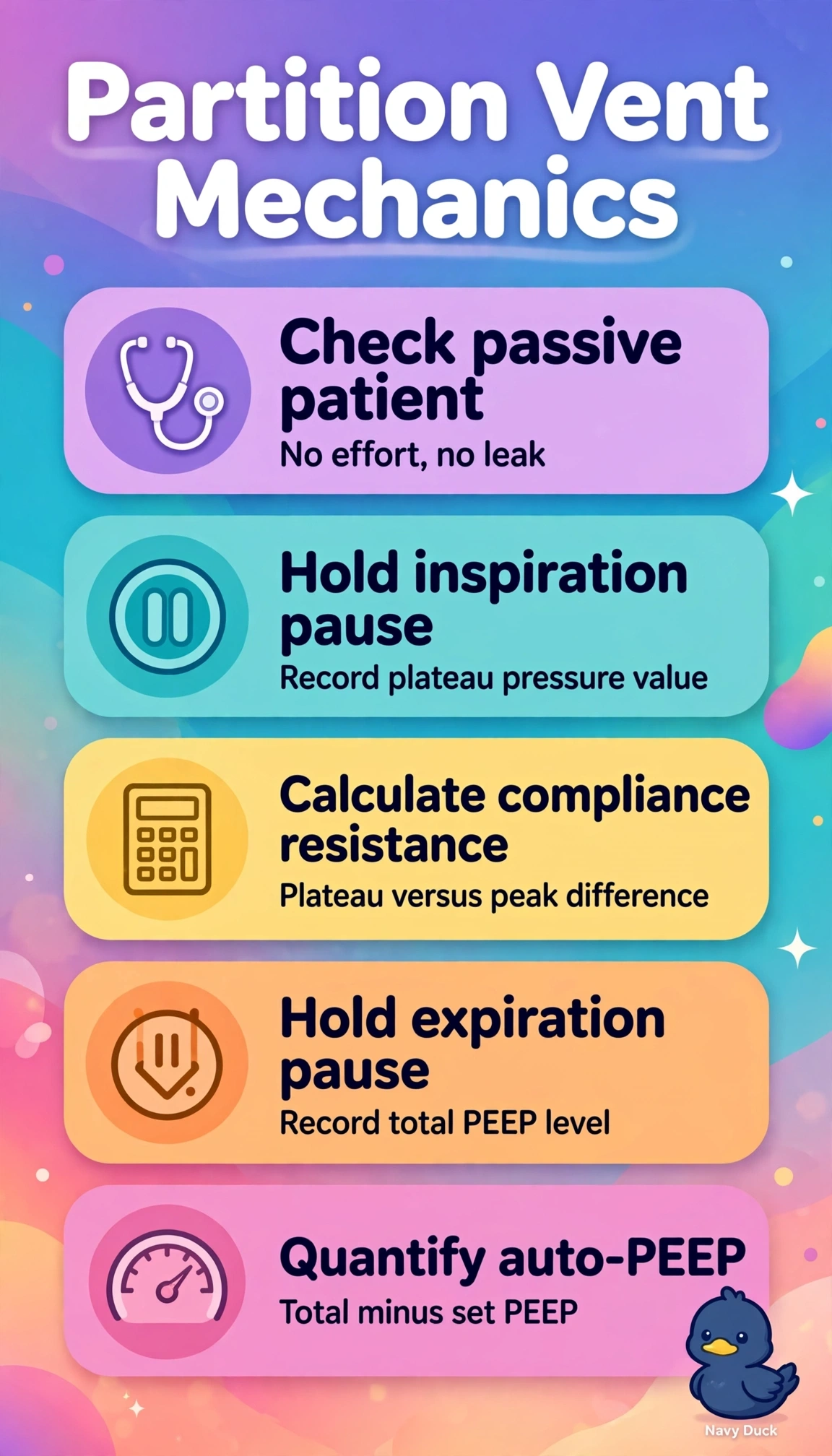
The peak-plateau gradient of 10 cm H2O indicates increased resistance while plateau above end-expiratory pressure indicates decreased static compliance, and prolonged exhalation with missed triggers in volume control ventilation signals incomplete emptying and auto-PEEP that raises alveolar pressure above set PEEP, so passive inspiratory hold is needed to record zero-flow plateau for static compliance as volume divided by plateau minus total PEEP and for resistance as peak minus plateau divided by flow, then expiratory hold is needed to equilibrate airway and alveolar pressure for total PEEP with auto-PEEP as total minus set PEEP, fully partitioning elastic versus resistive causes and explaining dyssynchrony. The inspiratory-hold calculation using set PEEP fails because it neglects trapped pressure, overestimating driving pressure and understating compliance. The dynamic compliance trend without a pause fails because peak-based values combine resistive plus elastic load and never isolate true plateau or static mechanics. The holds-for-compliance-only calculation fails because it discards the peak-plateau difference and leaves resistance unassessed despite the high gradient with unkinked circuit and minimal secretions. For exams, never substitute set for total PEEP when air-trapping cues are given, and practically confirm passive effort-free holds without leaks and verify expiratory flow reaches zero and pressures stabilize before calculating.