
A ventilated 70-year-old shows three-day positive fluid balance of 4 L, rising central venous pressure, new peripheral edema, RSBI rising from 68 to 118, vital capacity falling, and intracranial pressure 22 mm Hg with coughing. Which conclusion about ventilator liberation readiness best integrates fluid balance, hemodynamics, and pulmonary mechanics trends?
Select an answer to reveal the explanation.
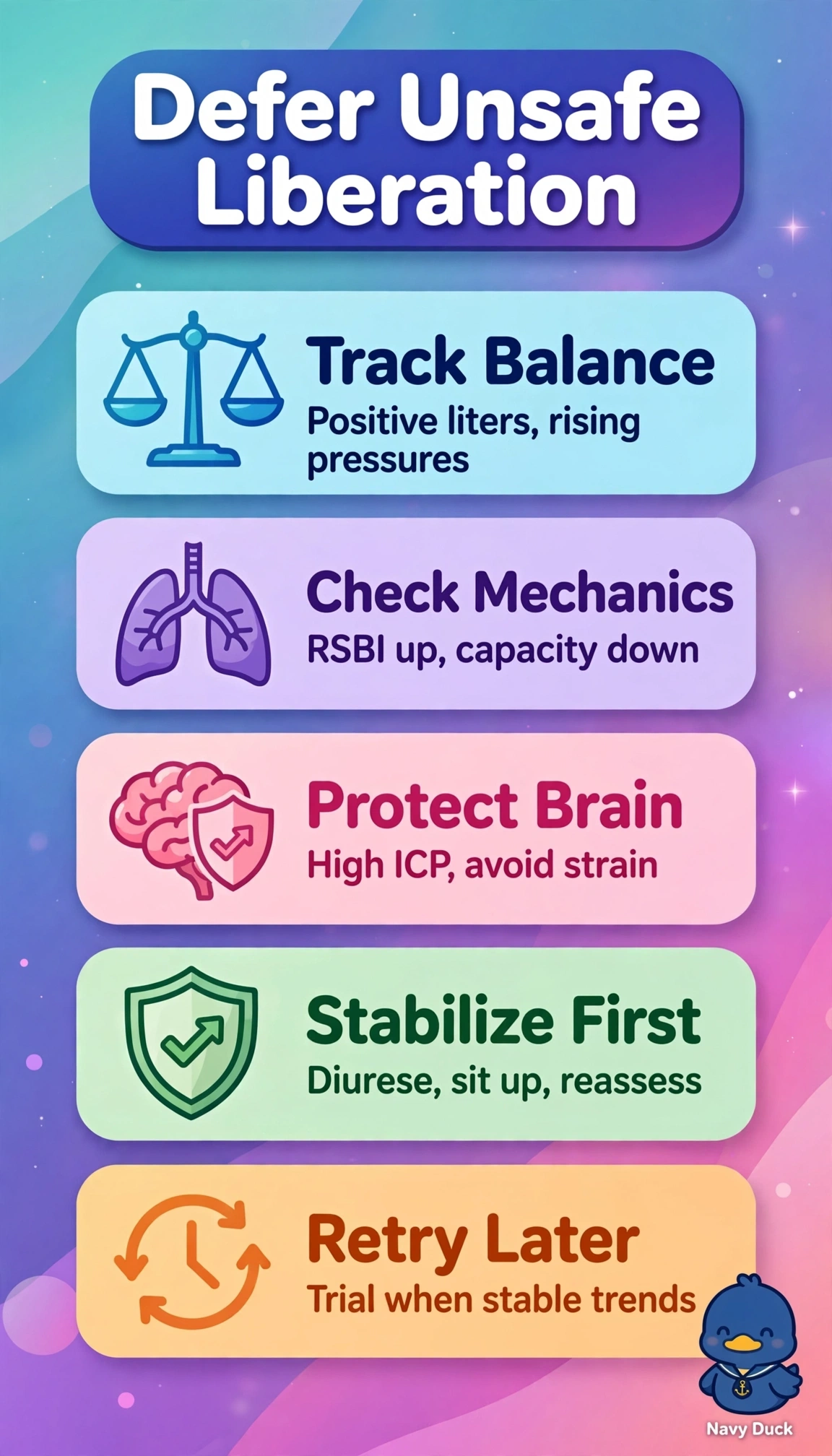
Short Explanation
You're reading a trend that screams not ready, not a single snapshot. Worsening mechanics plus overload means readiness requires stabilization before any breathing trial can succeed.
Full Explanation
The correct conclusion is to defer liberation because all domains trend adversely: 4-L positive balance with rising central venous pressure and new edema signifies intravascular hypervolemia and lung water that worsens compliance and work of breathing, rising RSBI from 68 to 118 with falling vital capacity shows deteriorating mechanics and load-capacity imbalance above the usual readiness threshold near 105, and ICP of 22 mm Hg with coughing exceeds normal limits where stimulation, hypercapnia, cough and suctioning can further raise ICP and lower perfusion, requiring head elevation, minimal stimulation and euvolemia before any trial. The breathing trial after diuresis using head elevation correctly addresses volume and cerebral protection but fatally ignores mechanics, since proceeding with RSBI 118 and falling vital capacity predicts trial failure and unsafe extubation. The gradual pressure-support weaning with cough suppression correctly invokes titrated support and ICP-friendly care but ignores frank overload, and liberation during hypervolemia with elevated venous pressure risks weaning-induced pulmonary edema and cardiac strain. The preload optimization with breathing monitoring and routine suctioning acknowledges volume vigilance but violates neuroprotection, since routine suctioning and cough in intracranial hypertension provokes Valsalva, hypercapnia and ICP spikes. Exam caveat is that trends outweigh single prior values, so a prior RSBI of 68 does not offset current 118 and ICP is not normalized by suction. Practical check is to confirm stable venous pressure with resolved edema, sustained RSBI below threshold with stable vital capacity, and ICP controlled without frequent suction need before resuming assessment.