
On a medical-surgical floor a patient develops sudden stridor and hypotension after antibiotics, the medical emergency team is activated, and multiple responders give overlapping verbal orders in a noisy room. The respiratory therapist is assigned airway management. Which team communication technique should the therapist use to ensure safe execution of emergency orders?
Select an answer to reveal the explanation.
Short Explanation
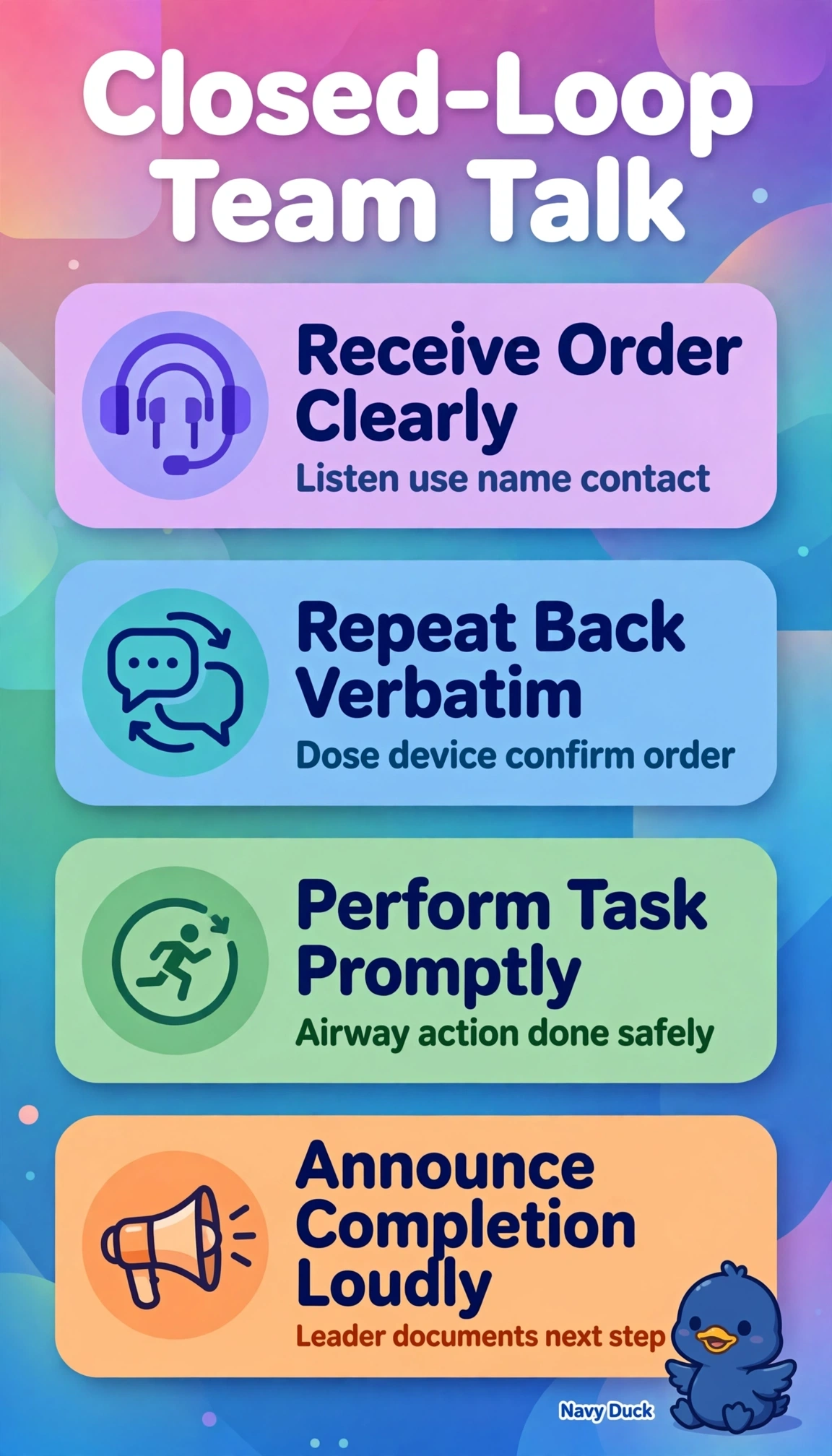
Chaos shrinks when your voice closes the circle. Consistent closed-loop talk turns noisy orders into verified action everyone can track.
Full Explanation
Closed-loop communication is required here because sudden stridor and hypotension after antibiotics suggests anaphylaxis with imminent airway compromise, and overlapping verbal orders in a noisy medical emergency team response create high risk for misheard, duplicated, or missed interventions; repeating back the order, executing the assigned airway task, then confirming completion with the leader closes the loop, verifies shared understanding, and gives the leader real-time accountability for next decisions. Calling out airway findings aloud is an essential TeamSTEPPS skill for building shared situational awareness, but it only broadcasts information without assigning responsibility or requiring confirmation that a specific order was heard and completed, so it cannot ensure safe execution under chaotic overlapping orders. Using SBAR is excellent for structuring concise assessments and recommendations during updates or handoffs to the leader, yet it organizes information transfer rather than providing order acknowledgment and completion verification, missing the immediate safety requirement for verbal emergency orders. Invoking the two-challenge rule is the correct advocacy tool when an order seems unsafe or a concern is ignored, but it addresses escalation of safety concerns rather than routine reliable execution of all valid airway orders, so it does not solve the core problem of order tracking. An exam caveat is to distinguish purpose by cue words: overlapping verbal orders, noisy room, and ensure execution point to closed-loop, while status updates point to SBAR or call-out and unsafe-order scenarios point to advocacy tools. A practical check is to always include the three steps aloud with names: acknowledge by repeat-back, announce when starting, then state completion and patient response to the leader.