
A 70-year-old with known COPD and hypercapnia presents with increased dyspnea, wheeze, pH 7.32 with PaCO2 58 mm Hg, alert mentation, manageable secretions, and good mask fit without hypotension or vomiting. Which combined noninvasive ventilation and medical treatment best manages this chronic lung exacerbation?
Select an answer to reveal the explanation.
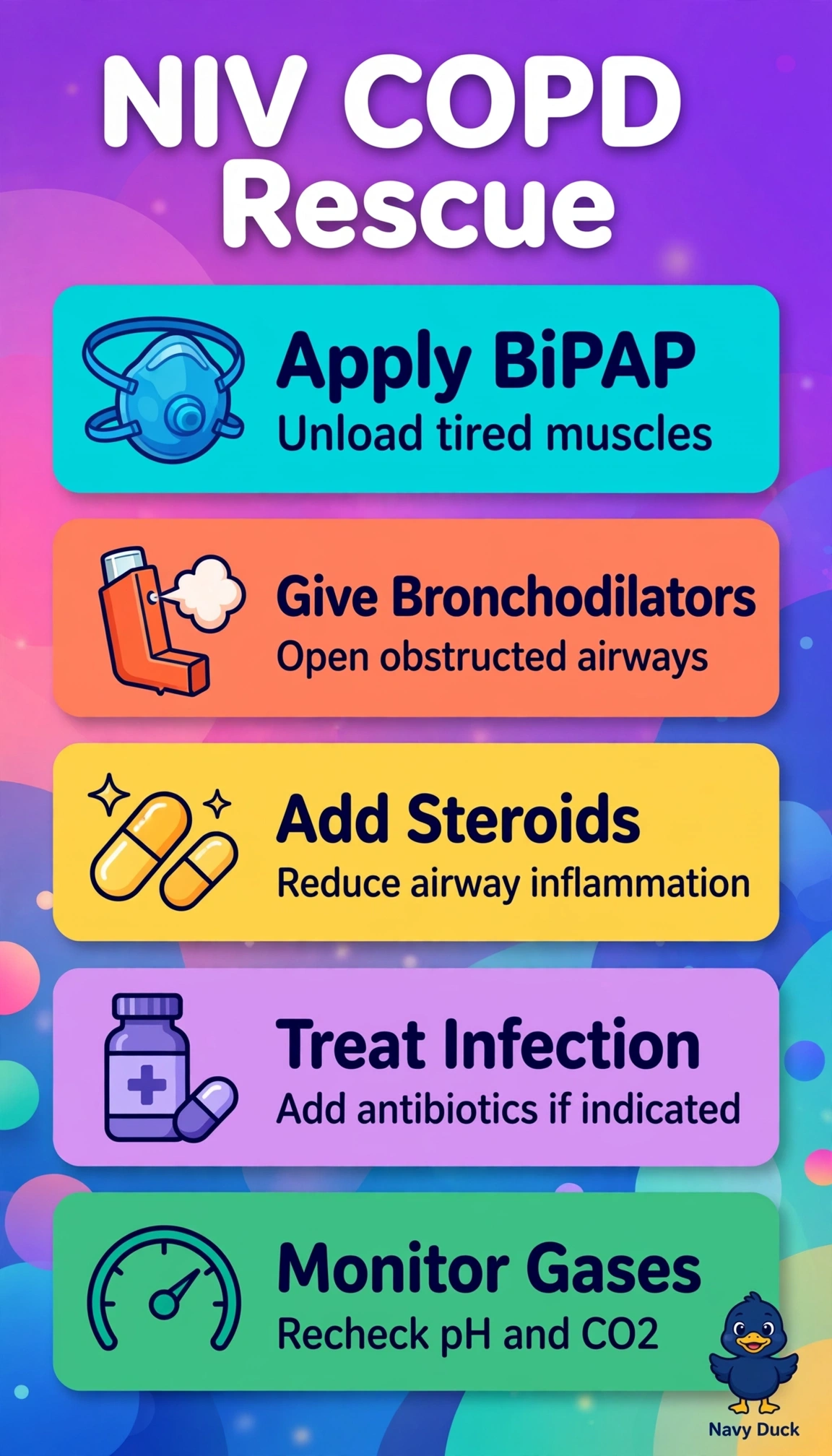
Short Explanation
You are buying tired muscles a breather while treating the trigger. Timely BiPAP plus steroids and bronchodilators reverses your ventilatory failure faster. Keep the patient alert and cooperative for success.
Full Explanation
This is acute-on-chronic hypercapnic failure from COPD exacerbation with respiratory acidosis, where BiPAP unloads fatigued muscles, augments tidal volume, improves alveolar ventilation and lowers PaCO2 while bronchodilators relieve wheeze and obstruction, systemic steroids reduce inflammation and treatment failure, and antibiotics when increased purulence or ventilatory need suggests infection lower mortality, making the combined approach guideline-concordant for an alert patient with manageable secretions, good seal, and no shock or aspiration risk. The CPAP-based approach fails on physiology because single continuous pressure aids oxygenation but gives no inspiratory assist to clear carbon dioxide and reverse acidosis. The steroid-sparing approach fails on inflammation because omitting systemic steroids prolongs obstruction and raises risk of ventilation failure and relapse. The bronchodilator-sparing approach fails on airway mechanics because withholding inhaled agents leaves reversible bronchospasm untreated despite steroids and antibiotics. An exam caveat is that noninvasive ventilation requires alert mentation, airway protection, manageable secretions, stability, and tolerance, so coma, copious secretions, vomiting, hypotension, or worsening gases mandate intubation. A practical check is to reassess rate, dyspnea, synchrony and leak with repeat gases in one to two hours to confirm rising pH and falling PaCO2.