
A 71-year-old is obtunded after stroke with preserved gag, noisy upper airway obstruction, edentulous mouth, and inability to protect secretions during transport to CT. Vital signs are stable but SpO2 is 89%. Which airway device selection and management step should the therapist implement to maintain a patent airway?
Select an answer to reveal the explanation.
Short Explanation
You need an airway that plays nice with a gag reflex. A soft nasal trumpet keeps the tongue off the back wall without triggering vomiting. Patency with tolerance is the win during that bumpy CT ride.
Full Explanation
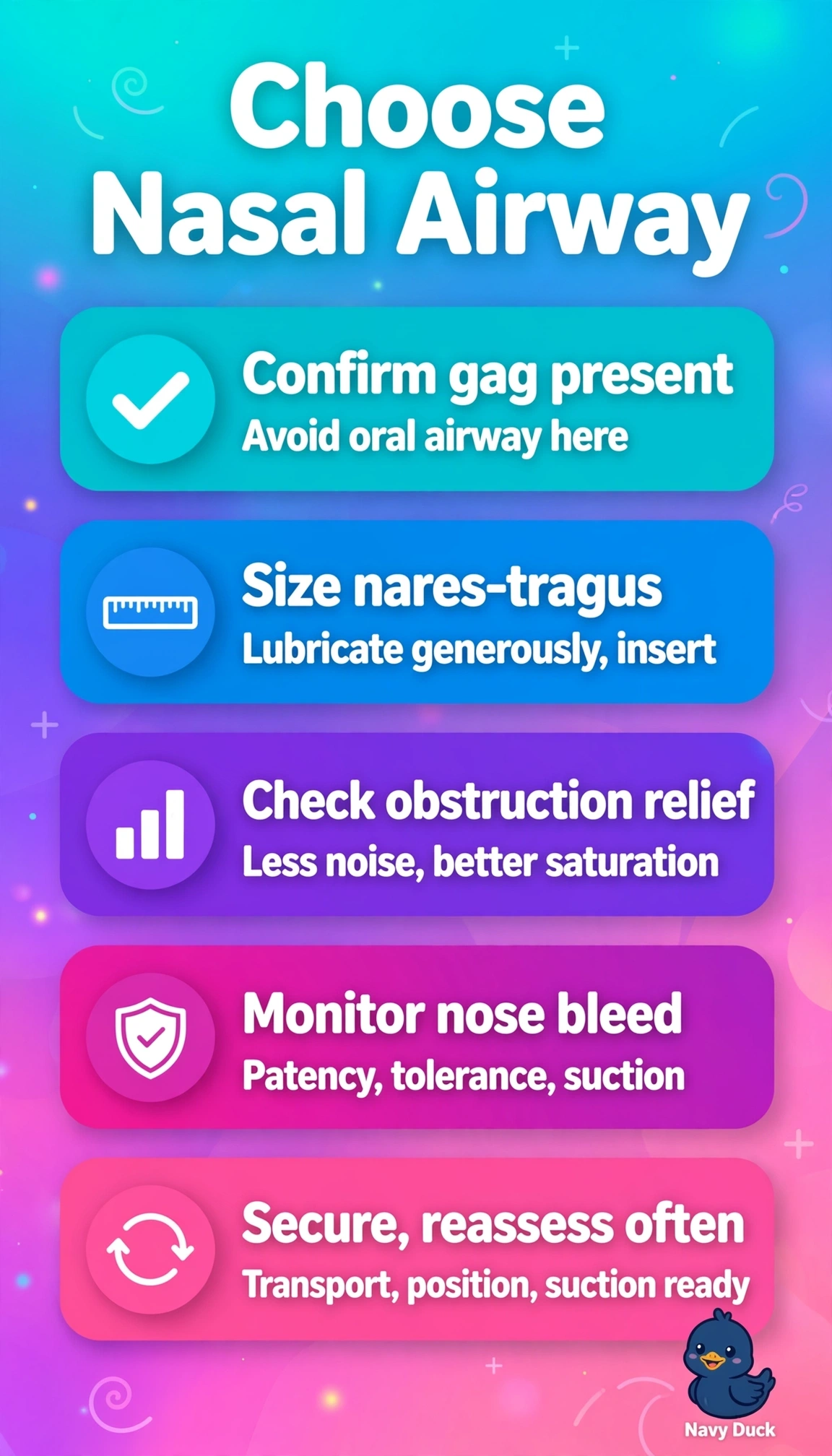
The nasopharyngeal airway with water-soluble lubricant maintains patency by stenting the upper airway in this obtunded patient with noisy obstruction, remaining tolerated despite a preserved gag reflex that contraindicates oral devices and seating reliably in an edentulous mouth where oral airways fit poorly, while lubricant reduces trauma to vascular nasal mucosa and monitoring for bleeding, displacement, vomiting, and improved stridor and SpO2 ensures transport safety. A correctly sized oropharyngeal airway with reassessment fails by tolerance because with intact gag any oral device provokes gagging, vomiting, and laryngospasm with higher aspiration risk, being reserved for absent gag despite effectiveness for tongue obstruction. Head-tilt positioning with supplemental oxygen fails by support because although repositioning and oxygen may transiently improve stridor and hypoxemia, manual maneuvers cannot provide continuous hands-free stenting for a patient unable to manage secretions during transport. A supraglottic airway with proper cuff pressure fails by protection because while it maintains patency during movement, it does not definitively protect against aspiration of unprotected secretions and demands deeper tolerance than preserved gag allows, making it excessive for stable partial obstruction managed by a simple adjunct. For examinations, preserved gag directs away from oral toward nasal adjuncts, whereas suspected skull-base fracture or severe nasal obstruction reverses that choice, and the practical check is to size nares to tragus, confirm airflow, secure without pressure injury, suction secretions, and continuously reevaluate noise, effort, saturation, and tolerance en route.