
A 68-year-old post-stroke patient on a medical floor is lethargic, coughs weakly, pools oral secretions, has right-sided weakness, a diminished gag reflex, and SpO2 91% on room air. Which patient position best optimizes airway patency for secretion drainage?
Select an answer to reveal the explanation.
Short Explanation
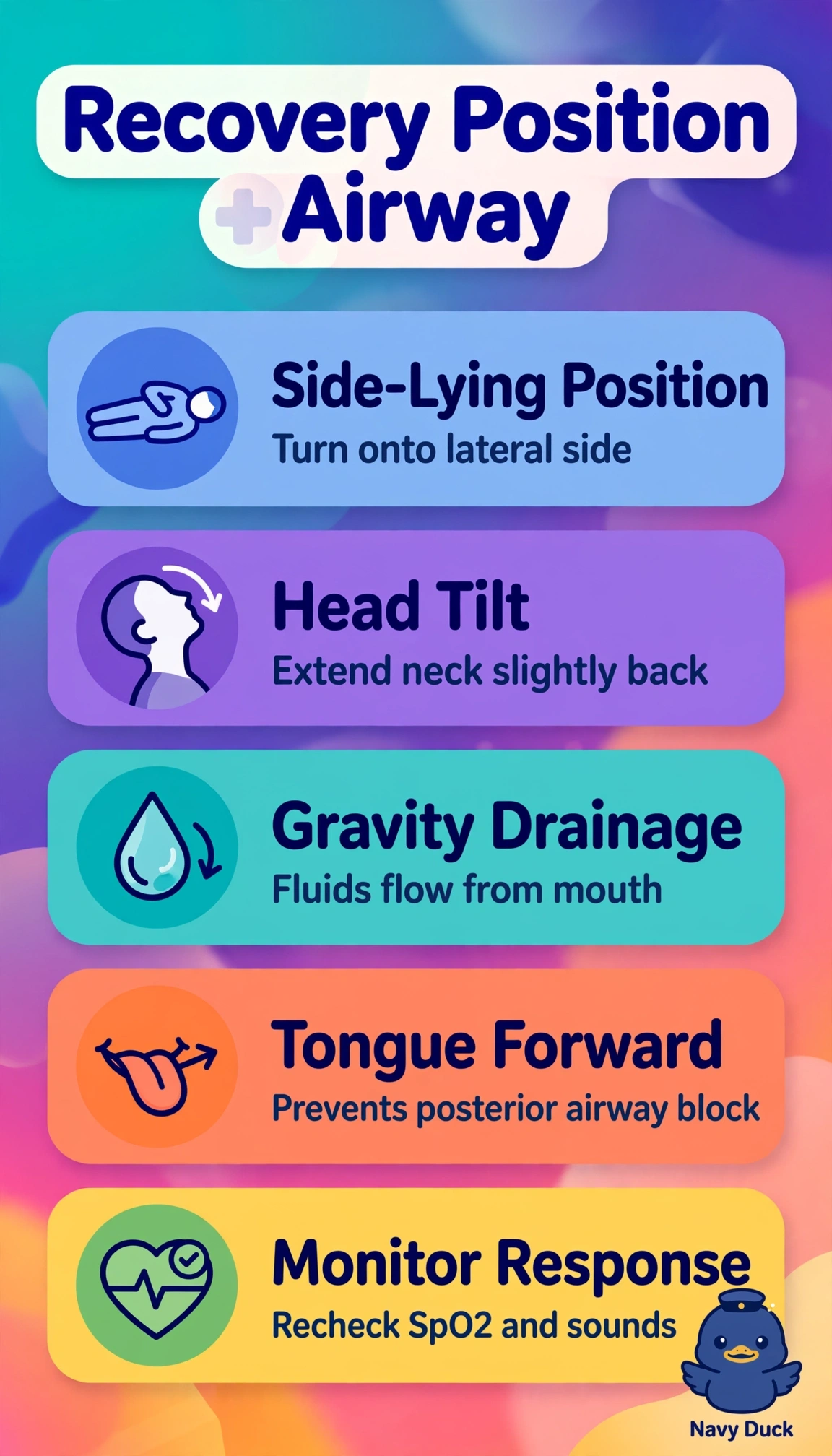
You've spotted pooled secretions plus a weak cough, so gravity is your helper here. Side-lying with slight extension keeps the tongue forward and lets fluids drain instead of pooling. That recovery position buys you a patent airway without equipment.
Full Explanation
The lateral recovery position with dependent head tilt is ideal because lethargy, weak cough, diminished gag and pooled secretions mean the patient cannot protect the airway, and side-lying uses gravity to drain secretions from the mouth while preventing tongue and fluid from occluding the pharynx, maintaining patency without effort and limiting aspiration causing SpO2 91%. Semi-Fowler with midline head improves oxygenation by enhancing lung expansion and diaphragmatic excursion, but it leaves secretions pooled posteriorly where impaired reflexes cannot clear them, so aspiration risk remains. Upright sitting with chin tuck is a standard dysphagia technique to narrow the airway inlet and improve bolus control during active swallowing, but it requires alert participation for meals and provides no continuous passive drainage for constant pooling with lethargy. Supine with thirty-degree elevation and neutral neck aids comfort and suction access, but supine directs secretions toward the glottis and increases aspiration when cough and gag are weak. The exam caveat is to separate oxygenation or feeding maneuvers from continuous drainage when the stem emphasizes pooling, weak cough and diminished gag. The practical check is to observe reduced gurgling, drooling from the dependent corner, improved SpO2 and easier suctioning with monitoring ready.