
In pulmonary clinic, a 9-year-old with persistent asthma uses a dry-powder inhaler for maintenance but reports poor control. The caregiver notes the child exhales into the mouthpiece, inhales slowly and gently, stores the device in a steamy bathroom and never checks the dose counter. Technique review shows no breath-hold. Which troubleshooting correction for the DPI technique restores drug delivery?
Select an answer to reveal the explanation.
Short Explanation
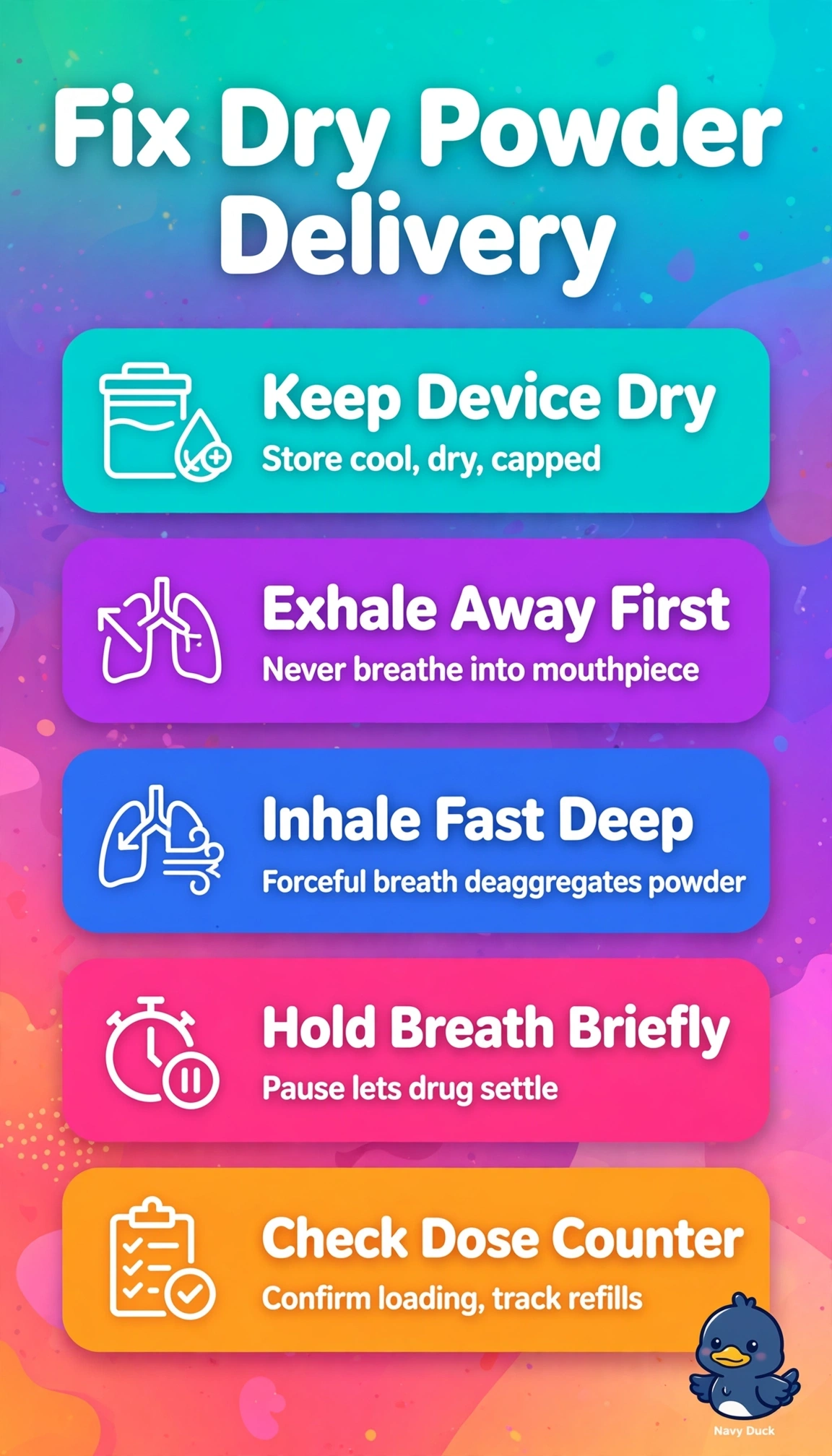
Dry powder needs a speedy sniff to fly, not a gentle sip. Your fix keeps moisture out and airflow strong so the dose actually reaches the lungs thanks to proper inspiratory-flow technique.
Full Explanation
The correct correction works because DPI delivery relies on inspiratory energy, so exhaling away avoids blowing humidity into powder that causes clumping, fast deep inhalation creates turbulent flow to deaggregate micronized drug from carrier, breath-hold up to 10 seconds allows sedimentation in small airways, dry storage preserves dispersibility, and counter review prevents inhaling from an empty device. The slow steady inhalation approach fails on aerodynamics because low flow cannot disperse dry powder even though it is ideal for pressurized and soft-mist devices requiring coordination and prolonged aerosol travel, leaving high mouth deposition and poor lung dose. The routine washing approach fails on moisture protection because rinsing the mouthpiece introduces water that aggregates powder and impairs metering, whereas DPI devices must stay dry and only be wiped unlike spacers or nebulizer cups that require washing. The immediate exhalation approach fails on retention because skipping breath-hold lets dispersed particles be exhaled before settling despite adequate inhaled mass. Exam caveat is to distinguish flow descriptors rather than matching inverse wording, remembering fast forceful for DPI versus slow gentle plus actuation timing for pressurized systems. Practical check is direct observation with trainer device, confirming audible adequate flow, exhale away, timed hold, dry storage, and counter advancement alongside symptom control.